

The Authority in Global Agricultural Chemistry & Bio-Resources
How to Evaluate Greenhouse Technology for Commercial Growers by Crop, Climate, and ROI
How to Evaluate Greenhouse Technology for Commercial Growers by Crop, Climate, and ROI
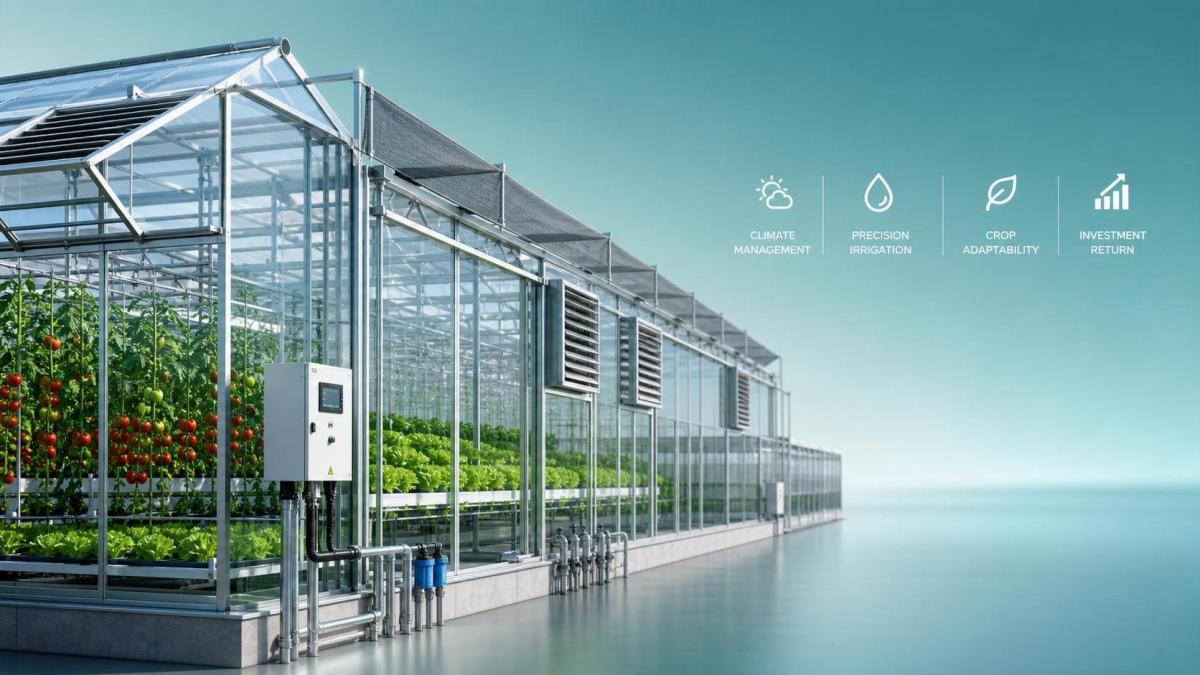
Choosing greenhouse technology for commercial growers now affects yield, labor efficiency, energy cost, and compliance exposure at the same time.
That makes evaluation less about buying structures and more about selecting a production system with durable financial logic.
The strongest decisions usually begin with three filters: crop biology, local climate, and expected return on investment.
When those filters are ignored, even advanced greenhouse technology for commercial growers can underperform or create avoidable operating friction.
In practical terms, a tomato producer in a hot, humid region needs a very different setup from a lettuce operator in a cold, high-latitude market.
The right benchmark is not the most advanced system on paper. It is the best-fit system for stable output and predictable payback.
Start with Crop-Specific Production Demands
Any review of greenhouse technology for commercial growers should start with crop response, not vendor features.
Different crops react differently to temperature swings, vapor pressure deficit, light intensity, root-zone control, and disease pressure.
Fruit-bearing crops often justify higher capital intensity because consistency has a direct impact on grade, shelf life, and market timing.
Leafy greens usually depend more on throughput, sanitation, and utility efficiency than on very high structural complexity.
Propagation facilities, meanwhile, need tighter environmental precision because small deviations can multiply downstream losses.
- Tomatoes and peppers: prioritize ventilation, climate uniformity, trellising compatibility, and fertigation control.
- Cucumbers: focus on humidity management, disease prevention, and labor-friendly crop handling.
- Leafy greens: compare automation, water reuse, crop turns, and sanitation design.
- Berries and specialty crops: assess light management, substrate flexibility, and harvest logistics.
This is where greenhouse technology for commercial growers should be scored against target yield, target quality, and target turnover.
If the technology cannot support the crop’s commercial rhythm, the rest of the ROI model becomes fragile.
Match Technology to Climate Reality
Climate fit is where many greenhouse evaluations either become credible or fall apart.
A system designed for mild coastal conditions may struggle in desert heat, monsoon humidity, or snow-heavy winters.
Commercial buyers should compare both annual averages and short-duration extremes, because peak stress drives failure risk and energy spikes.
In warm regions, cooling capacity and dehumidification strategy matter more than brochure-level glazing claims.
In cold climates, insulation value, heating system responsiveness, and snow-load engineering move much closer to the center of the decision.
Wind exposure also matters because it affects structural design, infiltration losses, and maintenance frequency.
Key Climate Questions to Ask Suppliers
- What outside temperature and humidity ranges were used in the engineering model?
- How does the greenhouse maintain crop conditions during heatwaves, frost events, or prolonged cloud cover?
- What energy assumptions were used for heating, cooling, and supplemental lighting?
- Which components have the highest failure rate in similar climates?
Good greenhouse technology for commercial growers performs under real weather pressure, not only under ideal modeling assumptions.
Compare the Core System Layers
Once crop and climate are defined, the next step is to compare the system layer by layer.
This keeps the selection process disciplined and helps separate essential capability from expensive add-ons.
Structure and Covering
Frame design affects longevity, maintenance access, and climate stability.
Glazing choice affects light transmission, insulation, cleaning frequency, and replacement cost.
Climate Control and Automation
Fans, vents, screens, heating loops, fogging, pad-and-fan cooling, and control software should be evaluated as an integrated package.
Fragmented systems often raise labor needs and make troubleshooting slower.
Irrigation, Fertigation, and Water Recovery
Water strategy now has operational and compliance value.
Closed-loop systems can improve resource efficiency, but only when filtration, dosing accuracy, and sanitation are well managed.
Labor and Workflow Design
Layout affects every daily task, from transplanting to harvest and crop cleanup.
The best greenhouse technology for commercial growers reduces labor waste without making routine maintenance harder.
Evaluate ROI Beyond Purchase Price
ROI is where many buying teams need a more realistic framework.
The cheapest greenhouse may produce the highest long-term cost if it causes weak yield stability or heavy labor dependence.
A higher-capex solution can be justified when it improves marketable output, extends seasonality, or reduces utility volatility.
To compare greenhouse technology for commercial growers properly, build a five- to ten-year operating model.
More importantly, run the model under optimistic, base, and stressed market assumptions.
That gives a clearer picture of whether the investment can absorb energy inflation, labor shortages, or price compression.
Check Compliance, Data, and Supply Chain Risk
For larger operators, greenhouse technology for commercial growers must also be reviewed through a governance lens.
That includes food safety protocols, environmental regulations, water discharge limits, worker safety, and electrical standards.
Digital controls and sensor networks introduce another layer: data ownership, cybersecurity, and service continuity.
A low-cost controller becomes risky if the vendor cannot provide support, firmware updates, or replacement parts within acceptable lead times.
This is increasingly relevant as greenhouse systems rely more heavily on automation and remote diagnostics.
- Confirm regional certification and engineering compliance.
- Verify spare parts strategy and local service coverage.
- Request performance references from comparable crop and climate conditions.
- Review who owns the operational data and how exports are handled.
A Practical Selection Framework
A disciplined selection process helps avoid decisions driven by novelty or sales pressure.
In real projects, a weighted scorecard usually produces better outcomes than an unstructured comparison.
- Define the crop program, annual volume target, and quality threshold.
- Map local climate stress points and utility cost exposure.
- Shortlist greenhouse technology for commercial growers that fits those constraints.
- Request modeled performance data, not generic product claims.
- Build a total-cost and payback model using site-specific assumptions.
- Check compliance, service capacity, and supplier bankability.
- Visit reference sites operating under similar conditions.
That process creates a more defensible decision and usually reduces post-installation surprises.
It also turns greenhouse technology for commercial growers into a business case, not just a capital purchase.
Final Decision Criteria That Matter Most
The best greenhouse technology for commercial growers is the one that aligns technical performance with commercial discipline.
That means the system supports the crop well, handles the climate reliably, and earns its cost under realistic market conditions.
If one feature set improves output but weakens serviceability or cash flow resilience, it deserves closer scrutiny.
A sound decision usually looks balanced rather than flashy.
Before final approval, compare at least two serious alternatives using the same assumptions, the same yield logic, and the same downside tests.
That final step often reveals which greenhouse technology for commercial growers will hold value long after installation is complete.
Related Intelligence
- Smart GreenhouseGreenhouse Equipment for Vertical Farming: Choosing Lighting and VentilationChoose greenhouse equipment for vertical farming with confidence. Compare lighting, airflow, and moisture control to improve crop uniformity and manage costs. Explore the guide.
- Smart GreenhouseSelecting Greenhouse Propagation Equipment for Hot, Humid Southeast Asian NurseriesGreenhouse propagation equipment Southeast Asia: discover how to select resilient irrigation, ventilation, benches, and automation for hot, humid nurseries.
- Smart GreenhouseWhat Are the Biggest Challenges in Agri-Tech Adoption in 2026?What are the biggest challenges in agri tech adoption for 2026? Explore cost, data, connectivity, skills, compliance, and ROI barriers.
The Morning Broadsheet
Daily chemical briefings, market shifts, and peer-reviewed summaries delivered to your terminal.
