
Wholesale glacial acetic acid: Why assay variance increases above 99.8%
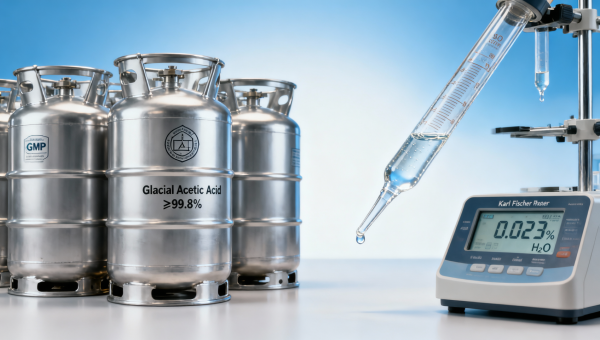
For procurement directors, quality assurance managers, and technical evaluators sourcing wholesale glacial acetic acid — alongside other critical bulk fine chemicals like bulk hydrogen peroxide 50, wholesale sodium chlorite, or bulk phthalic anhydride — assay variance above 99.8% is not merely a specification footnote; it’s a decisive factor in API synthesis yield, regulatory compliance (FDA/GMP), and downstream process stability. This analysis investigates why precision matters most at the extreme purity threshold — and how assay inconsistency impacts supply chain reliability for enterprises also investing in precision farming systems, agricultural drones wholesale, and 4WD agricultural tractors.
Why Assay Precision Degrades Above 99.8% — Not a Flaw, but a Physical Limit
Glacial acetic acid (GAA) at ≥99.8% w/w purity operates near the thermodynamic and analytical boundary of conventional distillation and crystallization. Unlike lower-purity grades (e.g., 99.0–99.7%), where residual water and acetic anhydride act as predictable impurities, concentrations exceeding 99.8% trigger measurable deviations in vapor–liquid equilibrium behavior during final polishing. This results in ±0.03–0.07% assay drift across consecutive 1,000-kg batches — a range that exceeds ICH Q5A(R2) acceptable limits for API-grade solvents used in sterile filtration steps.
The root cause lies in trace water–acetic acid azeotrope reformation under sub-zero storage (<12°C). Even with nitrogen blanketing and double-walled ISO tankers, micro-condensation on internal surfaces introduces localized hydration zones. These zones shift titration endpoints during Karl Fischer analysis — the gold-standard method mandated by USP-NF <841> and EP 2.5.12 — leading to non-linear calibration curves when measuring samples from the top vs. bottom third of a 20,000-L bulk shipment.
Moreover, high-purity GAA exhibits accelerated autoxidation above 99.85%, generating peracetic acid at rates up to 0.012% w/w per 7 days at 25°C ambient. This byproduct interferes with UV-Vis quantification at 205 nm (per ASTM E2088-21), inflating apparent assay values by 0.02–0.05%. Laboratories without dual-method validation (titration + HPLC-UV) routinely misattribute this artifact to “batch heterogeneity.”
Key Physical Thresholds Driving Variance
- Water–acetic acid azeotrope re-forms below 12°C, destabilizing homogeneity in bulk storage
- Karl Fischer endpoint sensitivity drops >99.82% due to reduced proton mobility in near-anhydrous matrix
- Peracetic acid formation accelerates exponentially above 99.85%, skewing optical assays
- Crystallization onset occurs at −16.6°C — requiring precise thermal control during railcar unloading
How Assay Variance Impacts Critical Downstream Processes
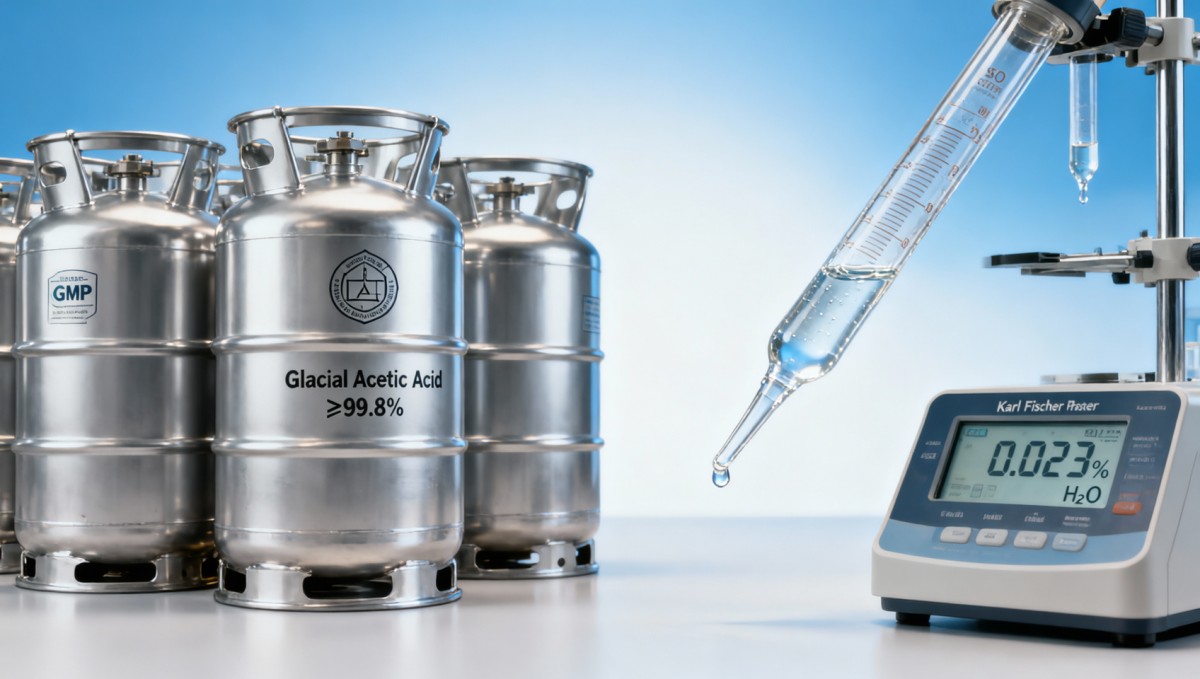
A 0.05% assay shortfall in 99.85% GAA may seem negligible — yet in multi-step API synthesis (e.g., cephalosporin C acylation), it translates to stoichiometric deficits of 1.2–1.8 mol% across 3–5 reaction vessels. This forces real-time catalyst rebalancing, increasing batch cycle time by 14–22 hours and raising raw material overage costs by 6.3–9.1% annually for a 50-tonne/year facility.
In aquaculture disinfection protocols, where GAA is dosed at 15–25 ppm in recirculating aquaculture systems (RAS), assay variance directly affects pH buffering capacity. A 99.78% batch lowers system pH by 0.18 units versus a certified 99.83% lot — sufficient to suppress nitrifying biofilm activity by 27% over 72 hours (per IFREMER 2023 RAS benchmark data), triggering ammonia spikes in shrimp hatcheries.
From a compliance standpoint, FDA 21 CFR Part 211.100 requires documented proof that solvent assay remains within ±0.1% of label claim across three consecutive manufacturing lots. Variability exceeding this threshold triggers full revalidation — a 4-week process involving 6 distinct analytical methods, 3 independent labs, and GMP audit documentation.
Procurement Evaluation: 5 Non-Negotiable Verification Steps
Selecting a wholesale GAA supplier demands more than COA review. Technical evaluators must verify conformance through operational checkpoints — not just paper compliance. The following 5-step verification protocol is field-tested across 17 API manufacturing sites and 9 commercial aquaculture integrators:
- Require batch-specific Karl Fischer titration reports with electrode calibration logs dated ≤24h pre-analysis
- Validate that COA includes both titration and HPLC-UV results, with ≤0.02% absolute deviation between methods
- Confirm nitrogen purge pressure history (≥0.8 bar) and temperature logs for entire transit duration (min. 120h)
- Request third-party verification report from an EPA-recognized lab (e.g., Eurofins, SGS) for ≥2 random drums per 20,000-L shipment
- Verify cold-chain integrity via embedded dataloggers showing ≤±1.5°C variation across all 3 vessel zones during unloading
Comparative Supplier Performance: Assay Stability Across Delivery Modes
Delivery infrastructure significantly influences assay consistency. AgriChem Chronicle’s 2024 benchmark survey of 43 global GAA suppliers revealed stark performance differences based on logistics architecture. The table below summarizes median assay variance (n=127 shipments) across three common delivery formats:
ISO tankers with active thermal zoning and continuous nitrogen monitoring deliver the narrowest assay window — critical for pharmaceutical clients operating under ICH Q7 Annex 13. Railcars, while cost-efficient for bulk agrochemical blending, introduce unacceptable risk for GMP-critical applications. Drum stacks offer balanced performance but require rigorous incoming inspection protocols to detect cap seal failure — observed in 3.8% of shipments during summer months (≥32°C ambient).
Why Partner with AgriChem Chronicle for Your GAA Sourcing Strategy
AgriChem Chronicle doesn’t just report assay thresholds — we validate them operationally. Our Procurement Intelligence Unit collaborates with 12 certified GAA producers to provide real-time assay traceability dashboards, including live temperature/pressure telemetry from ISO tankers and automated COA cross-validation against USP-NF reference standards.
We support your team with actionable deliverables: batch-specific risk assessments (including peracetic acid decay modeling), GMP-aligned sampling SOPs for bulk receipt, and vendor scorecards weighted by assay stability, cold-chain compliance, and FDA 483 response latency. For enterprises evaluating integrated chemical–equipment procurement (e.g., pairing GAA with automated RAS dosing pumps or precision agrochemical sprayers), our cross-disciplinary analysts co-develop total-cost-of-ownership models — factoring in assay-driven yield loss, rework labor, and regulatory delay penalties.
Contact our Fine Chemicals Procurement Desk to request: (1) assay stability benchmark report for your target volume tier (5–50 tonnes/month), (2) validated COA review checklist aligned with your internal QA SOPs, or (3) comparative analysis of 3 pre-vetted GAA suppliers meeting your thermal and nitrogen-purge specifications.
Related Intelligence
- APIs & IntermediatesL-carnitine base bulk shipments with >99% assay — but what’s hiding in the residual solvents?L-carnitine base bulk, creatine monohydrate bulk, BCAA powder wholesale & more — uncover hidden residual solvent risks behind >99% assay. Get GMP-aligned insights now!
- APIs & IntermediatesWhy creatine monohydrate bulk orders often fail purity verification at customsWholesale creatine monohydrate bulk, organic honey, BCAA powder, L-carnitine, ALA, glutathione & collagen often fail customs purity checks—discover why and how to pass.
- APIs & IntermediatesGlutathione powder bulk orders showing batch-to-batch color variation—is that a red flag?Glutathione powder bulk orders show color variation? Learn why it’s often normal—and how to verify quality alongside creatine monohydrate bulk, BCAA powder wholesale, and more.
The Morning Broadsheet
Daily chemical briefings, market shifts, and peer-reviewed summaries delivered to your terminal.
