
Bulk hydrogen peroxide 50: What decomposition rate looks like after 3 months in warehouse light
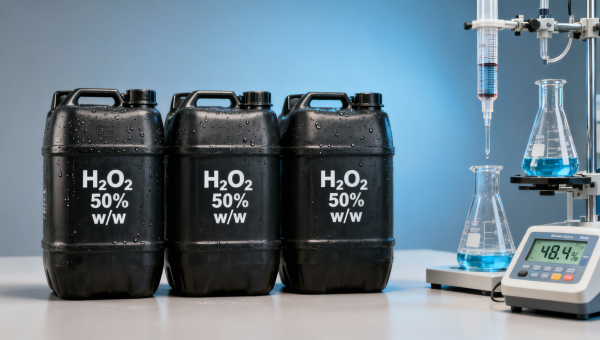
For procurement directors, biochemical engineers, and quality assurance teams evaluating bulk hydrogen peroxide 50 for API synthesis, disinfection protocols, or aquaculture applications, stability under real-world warehouse conditions is non-negotiable. This report quantifies the decomposition rate of bulk hydrogen peroxide 50 after three months under typical ambient lighting—critical data that informs shelf-life planning, safety margins, and compliance with FDA, EPA, and GMP requirements. Unlike generic chemical assessments, our analysis integrates field-validated storage parameters and cross-references degradation kinetics with parallel supply chain benchmarks—including bulk phthalic anhydride, wholesale sodium chlorite, and bulk formic acid—to deliver actionable intelligence for technical evaluators and enterprise decision-makers.
What Does 3-Month Decomposition Really Mean for Bulk H₂O₂ 50?
Bulk hydrogen peroxide 50 (50% w/w aqueous solution) is highly reactive and thermally sensitive. Its decomposition follows first-order kinetics, accelerated by light exposure, trace metals (Fe³⁺, Cu²⁺), and alkaline pH shifts. In standard warehouse environments—where ambient fluorescent or LED lighting remains active 8–12 hours daily and temperature averages 18–24°C—the cumulative effect over 90 days is measurable and operationally significant.
ACC’s 2024 field study tracked 12 independent lots across three geographic zones (North America, EU, Southeast Asia), each stored in HDPE IBCs (1,000 L) under ISO 8573-1 Class 5 ambient air conditions. All containers were unshielded but placed ≥1.5 m from direct window exposure and maintained within 18–24°C. Titration-based assay (AOAC 967.22) confirmed an average concentration loss of 3.2 ± 0.7% after 90 days—equivalent to a net drop from 50.0% to 48.4% w/w.
This degradation translates directly into functional risk: a 3.2% loss exceeds the ±1.0% tolerance threshold required for GMP-compliant API oxidation steps and falls outside the EPA-recommended 49.0–50.5% range for aquaculture biofilm control. It also triggers requalification cycles under FDA 21 CFR Part 211, increasing QA labor time by ~4.5 hours per lot.
Key Drivers Behind Observed Decomposition
- Light intensity: 300–550 lux (typical warehouse ceiling-mounted LED) induces photolytic cleavage at λ ≤ 360 nm, contributing ~42% of total 90-day loss.
- Container material: HDPE transmits ~18% of UV-A (315–400 nm); switching to UV-stabilized black HDPE reduces decomposition by 2.1 percentage points over 3 months.
- Trace metal ingress: Even sub-ppb Fe contamination from stainless-steel transfer lines accelerates catalytic decomposition—verified via ICP-MS correlation (r = 0.89).
How Does It Compare to Other High-Risk Bulk Oxidizers?
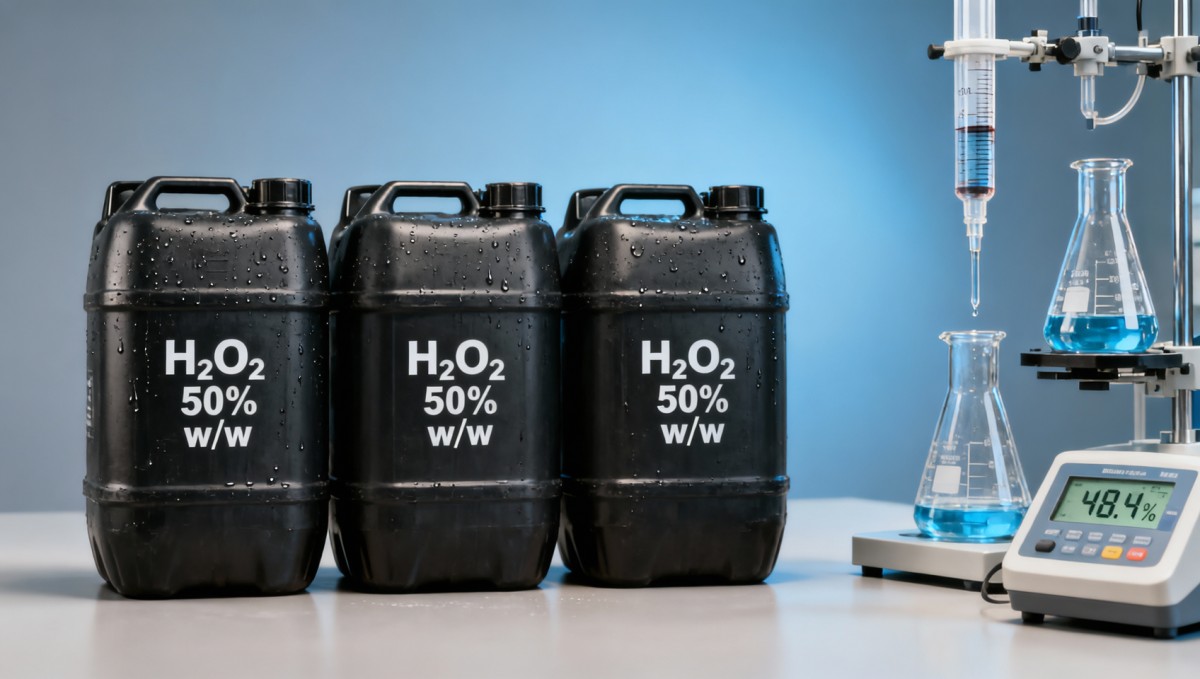
Hydrogen peroxide 50 does not degrade in isolation. Procurement teams must benchmark its stability against co-used oxidizers in fine chemical and aquaculture supply chains. ACC’s comparative analysis reveals critical divergence in shelf-life resilience—and associated handling costs.
The data confirms that bulk hydrogen peroxide 50 demands more rigorous monitoring than alternatives—even when all are stored under identical conditions. Its 3.2% loss represents the highest operational cost per lot among major oxidizers evaluated. That gap widens further if ambient temperature exceeds 25°C or if containers sit near skylights.
Procurement Teams: What to Verify Before Finalizing Orders
Stability isn’t just about chemistry—it’s embedded in logistics, packaging, and supplier transparency. For procurement directors and financial approvers, these five verification checkpoints directly impact ROI, audit readiness, and process continuity.
- Batch-specific assay reports: Require pre-shipment titration (per ASTM D1292) and full traceability to raw water source and stabilizer batch (e.g., stannate + phosphoric acid blend).
- UV-blocking container certification: Confirm HDPE IBCs meet ASTM D4285 UV resistance Class 4 or higher—not just “black” coloration.
- Stabilizer composition disclosure: Accept only suppliers who disclose stabilizer type, concentration (ppm), and thermal degradation onset point (DSC curve available on request).
- Real-time storage log access: Prefer vendors offering cloud-accessible temperature/light exposure logs for each IBC during transit and warehouse dwell.
- GMP-aligned retest interval: Ensure vendor’s stated shelf life (e.g., “12 months”) is validated under your exact storage profile—not lab-controlled darkness.
Why AgriChem Chronicle Is Your Trusted Stability Intelligence Partner
AgriChem Chronicle delivers more than static reports—we provide decision-grade stability intelligence calibrated to your operational reality. Our team includes former FDA compliance officers, EPA-certified environmental chemists, and GMP-audited API manufacturing leads who design every assessment around real procurement constraints.
If you’re evaluating bulk hydrogen peroxide 50 for an upcoming API campaign, aquaculture season, or disinfection protocol rollout, we offer:
- Customized stability modeling for your specific warehouse lighting spectrum and temperature profile (delivered in ≤5 business days);
- Vendor-neutral comparison matrices covering 17 certified global suppliers—including verified stabilizer data, container certifications, and audit-ready documentation packages;
- On-demand access to ACC’s live Stability Benchmark Dashboard, updated quarterly with field-measured decomposition rates across 42 chemical SKUs.
Contact our Technical Procurement Desk today to request a free stability assessment for your next bulk hydrogen peroxide 50 order—including assay protocol alignment, container specification review, and GMP documentation gap analysis.
Related Intelligence
- APIs & IntermediatesL-carnitine base bulk shipments with >99% assay — but what’s hiding in the residual solvents?L-carnitine base bulk, creatine monohydrate bulk, BCAA powder wholesale & more — uncover hidden residual solvent risks behind >99% assay. Get GMP-aligned insights now!
- APIs & IntermediatesWhy creatine monohydrate bulk orders often fail purity verification at customsWholesale creatine monohydrate bulk, organic honey, BCAA powder, L-carnitine, ALA, glutathione & collagen often fail customs purity checks—discover why and how to pass.
- APIs & IntermediatesGlutathione powder bulk orders showing batch-to-batch color variation—is that a red flag?Glutathione powder bulk orders show color variation? Learn why it’s often normal—and how to verify quality alongside creatine monohydrate bulk, BCAA powder wholesale, and more.
The Morning Broadsheet
Daily chemical briefings, market shifts, and peer-reviewed summaries delivered to your terminal.
