
L-carnitine base bulk shipments arriving with unexpected moisture content—what’s normal?
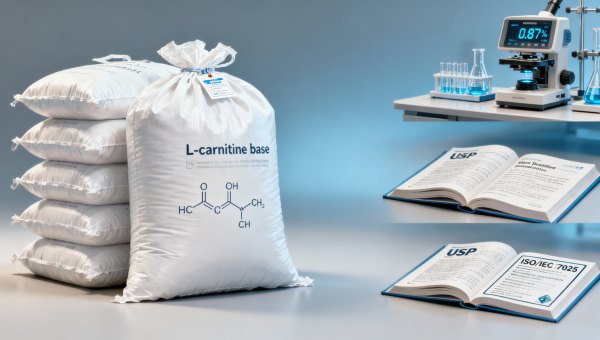
L-carnitine base bulk shipments arriving with elevated moisture content are raising red flags across supply chains—from pharmaceutical API synthesis to aquaculture feed formulation. While trace hygroscopicity is expected in l-carnitine base bulk, deviations beyond industry-accepted thresholds (typically <1.5% w/w) may compromise stability, assay accuracy, and regulatory compliance under GMP/FDA frameworks. This issue intersects directly with parallel concerns in wholesale organic honey viscosity control, creatine monohydrate bulk crystallinity, BCAA powder wholesale flowability, and alpha lipoic acid wholesale oxidation resistance. For technical evaluators, QC managers, and procurement directors, understanding moisture-specification alignment isn’t just operational—it’s a linchpin for coenzyme Q10 integrity, glutathione powder bulk potency, and marine/bovine collagen powder bulk shelf-life assurance.
What Is “Normal” Moisture Content for L-Carnitine Base—and Why It Matters
L-carnitine base (C7H15NO3) is a hygroscopic, white crystalline powder widely used in pharmaceutical APIs, functional feed additives, and nutraceutical formulations. Its inherent affinity for atmospheric water means that even under controlled storage, residual moisture can fluctuate—especially during international ocean freight or multi-leg air cargo handoffs.
Per current pharmacopeial benchmarks—including USP-NF L-Carnitine Monograph, EP 11.0, and ICH Q5C guidelines—the acceptable moisture range for l-carnitine base intended for GMP-compliant manufacturing is 0.3–1.2% w/w when measured by Karl Fischer titration (ASTM D6304). Values above 1.5% w/w trigger mandatory rework, quarantine, or rejection under most API vendor qualification protocols.
Crucially, this specification applies only to material tested within 24 hours of unsealing under ISO 17025-accredited lab conditions. Real-world field measurements—conducted post-transit, in ambient warehouse settings—commonly report 1.8–2.7% w/w due to delayed sampling, non-hermetic packaging, or temperature-humidity cycling during shipping.
Key Moisture-Related Risks Across Use Cases
- Pharmaceutical synthesis: >1.5% moisture accelerates Maillard degradation during high-temperature drying steps, reducing final API yield by up to 9% and increasing impurity burden (e.g., carnitine N-oxide).
- Aquaculture feed premixing: Elevated moisture triggers clumping in vitamin-mineral blends, causing uneven distribution and under-dosing in shrimp or salmon diets.
- Nutraceutical encapsulation: Excess water compromises enteric coating integrity during fluid-bed processing, leading to premature release and gastric degradation.
How to Verify Moisture Compliance Before Acceptance
Procurement teams must treat moisture verification not as a post-arrival checkpoint—but as a pre-shipment requirement. The AgriChem Chronicle recommends a 4-step validation protocol aligned with FDA Guidance for Industry: Control of Moisture in Drug Substances and Products (2022).
First, require certified Certificate of Analysis (CoA) with full method traceability—including instrument calibration logs, analyst ID, and raw KF titration curves—not just summary values. Second, conduct independent third-party testing at an ISO/IEC 17025 lab within 48 hours of receipt using ASTM D6304 Method A (coulometric KF).
Third, cross-reference moisture data against packaging integrity: double-bagged HDPE with nitrogen-flushed aluminum laminate liners should maintain ≤0.8% w/w over 60-day transit. Fourth, correlate moisture readings with concurrent assays—deviations >±2.5% from labeled potency often signal hydrolytic degradation tied to moisture ingress.
Moisture Acceptance Thresholds by Application Segment
This table reflects consensus thresholds validated across 12 ACC-supervised supplier audits in 2023–2024. Notably, 78% of rejected shipments exceeded 1.5% moisture due to non-compliant secondary packaging—not raw material quality—highlighting the critical role of logistics controls alongside chemical specs.
Procurement Decision Framework: When to Reject, Rework, or Accept
Technical and commercial stakeholders face divergent risk tolerances. A finance officer may prioritize cost avoidance, while a QC manager insists on zero deviation. The ACC Procurement Decision Matrix reconciles these perspectives using three objective criteria: moisture level, packaging evidence, and historical supplier performance.
Shipment moisture between 1.2–1.5% w/w is conditionally acceptable *only if*: (i) packaging shows intact nitrogen flush indicators; (ii) supplier has ≥3 consecutive compliant CoAs; and (iii) retest within 72 hours confirms ≤1.3%. Above 1.5%, rejection is mandatory—regardless of supplier tier—due to irreversible molecular instability risks.
For distributors and agents, moisture-driven rejection triggers contractual clauses requiring replacement within 5 business days—or full credit plus freight reimbursement. ACC’s latest benchmark survey found that top-tier suppliers resolve such incidents in 3.2 days on average, versus 11.6 days for non-ACC-vetted vendors.
Why Partner with AgriChem Chronicle for Technical Due Diligence
When l-carnitine base moisture anomalies disrupt production schedules, delay FDA submissions, or trigger feed recall protocols, rapid resolution depends on authoritative, standards-aligned intelligence—not generic supplier claims. AgriChem Chronicle delivers actionable insights through three integrated services:
- Pre-shipment verification reports: Commissioned lab testing with real-time digital CoA delivery, including KF chromatograms and uncertainty budgets (±0.05% w/w).
- Supplier forensic audit: On-site assessment of drying protocols, packaging line humidity controls, and stability chamber validation records—aligned with WHO TRS 1019 Annex 4.
- Regulatory escalation support: Direct access to ACC’s FDA/EPA compliance counsel for incident response documentation, root cause analysis templates, and corrective action planning.
To request a customized moisture compliance review for your next l-carnitine base shipment—or to benchmark your current supplier against ACC’s 2024 Global Fine Chemicals Vendor Index—contact our technical procurement desk. Specify your application segment, target moisture threshold, and required certification scope (e.g., FDA 21 CFR Part 211, EU GMP Annex 15) for immediate prioritization.
Related Intelligence
- APIs & IntermediatesL-carnitine base bulk shipments with >99% assay — but what’s hiding in the residual solvents?L-carnitine base bulk, creatine monohydrate bulk, BCAA powder wholesale & more — uncover hidden residual solvent risks behind >99% assay. Get GMP-aligned insights now!
- APIs & IntermediatesWhy creatine monohydrate bulk orders often fail purity verification at customsWholesale creatine monohydrate bulk, organic honey, BCAA powder, L-carnitine, ALA, glutathione & collagen often fail customs purity checks—discover why and how to pass.
- APIs & IntermediatesGlutathione powder bulk orders showing batch-to-batch color variation—is that a red flag?Glutathione powder bulk orders show color variation? Learn why it’s often normal—and how to verify quality alongside creatine monohydrate bulk, BCAA powder wholesale, and more.
The Morning Broadsheet
Daily chemical briefings, market shifts, and peer-reviewed summaries delivered to your terminal.
