
Industrial grade urea isn’t just about nitrogen content — why particle size distribution changes handling costs
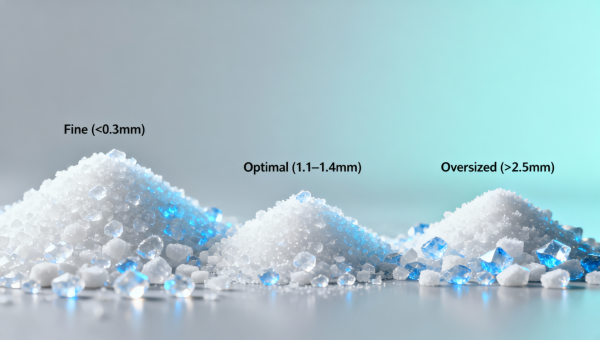
Industrial grade urea procurement isn’t just about nitrogen content—it’s a precision logistics and processing equation where particle size distribution directly impacts bulk handling, pneumatic conveying efficiency, and storage stability. For pharmaceutical packaging materials suppliers, fine chemicals wholesale distributors, and feed grade vitamins manufacturers, inconsistent granulometry increases dust generation, segregation risk, and dosing inaccuracy—driving up operational and quality assurance costs. As chiral intermediates wholesale and peptide synthesis services demand tighter spec compliance, understanding urea’s physical morphology becomes as critical as its chemical purity. This analysis bridges technical evaluation with TCO modeling for procurement directors, plant engineers, and quality managers across agri-chem and API OEM supply chains.
Why particle size distribution matters more than N% alone
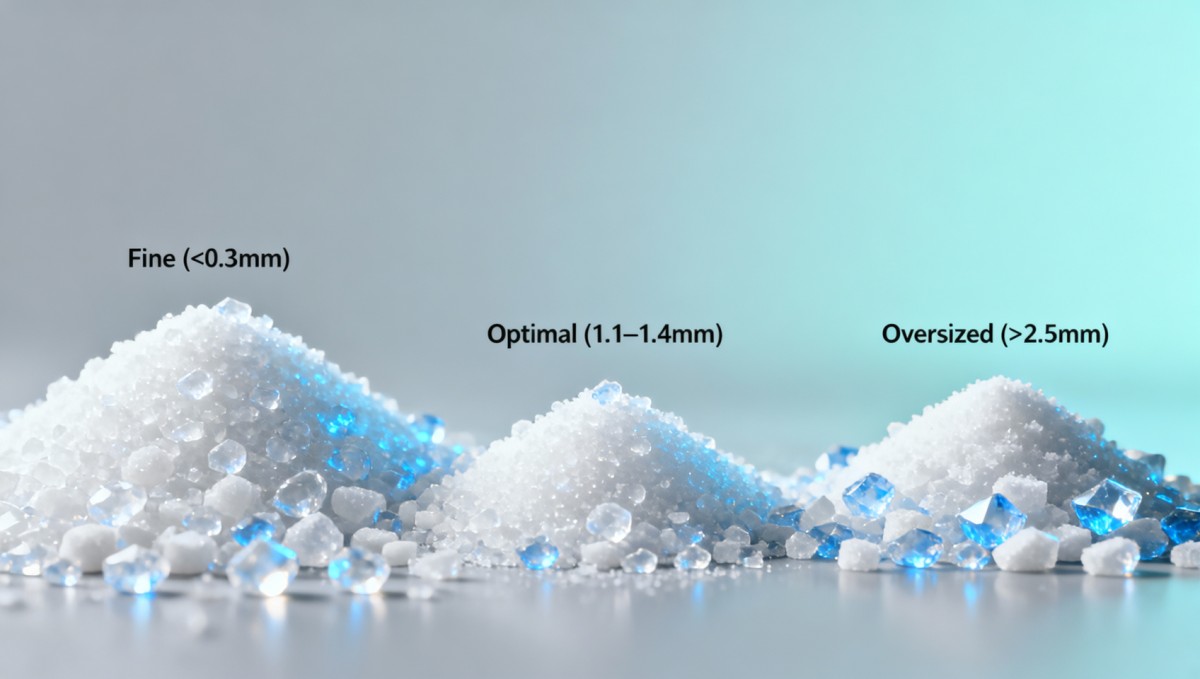
Nitrogen content (typically 46% w/w) remains the primary chemical benchmark—but it tells only half the story. In industrial applications spanning API synthesis, aquaculture feed premixing, and urea-formaldehyde resin production, physical behavior governs process reliability. A batch with identical N% but bimodal particle distribution (e.g., 10–30% fines < 0.5 mm + oversized granules > 2.5 mm) can reduce pneumatic transfer throughput by 22–35%, increase filter cake replacement frequency by 4× per quarter, and trigger out-of-spec blending in GMP-compliant vitamin fortification lines.
Particle size distribution (PSD) affects three interdependent operational domains: flowability (Carr Index shifts from 18 to 32 when D90 exceeds 2.2 mm), dust generation (fines < 0.3 mm account for 78% of airborne particulate in bagging zones), and dissolution kinetics (median dissolution time varies from 48 sec to 187 sec across PSD bands). These are not theoretical concerns—they translate directly into OEE loss, QA rework, and storage silo bridging incidents reported by 63% of feed-grade urea users in ACC’s 2024 Supply Chain Resilience Survey.
For pharmaceutical excipient suppliers and chiral intermediate producers, PSD-driven variability compromises batch-to-batch reproducibility in crystallization seeding protocols. Even minor shifts in D10 (e.g., ±0.15 mm) alter nucleation density during controlled urea-mediated pH adjustment—impacting final crystal habit and residual solvent profiles in API isolation.
How PSD impacts total cost of ownership across functions
TCO modeling reveals that PSD-related inefficiencies contribute 11–19% of total handling cost—exceeding raw material price variance in 4 out of 5 high-volume use cases. Below is a comparative breakdown across five functional stakeholders:
The table underscores how PSD instability propagates cost across departments—not as isolated incidents, but as cascading system effects. For example, a single rejected lot triggers expedited air freight ($8,200 avg.), lab retesting (72 hr turnaround), and reformulation delay—delaying API registration timelines by up to 11 business days in FDA-submitted dossiers.
Key PSD parameters every procurement team must specify
- D10, D50, D90: Require certified laser diffraction reports (ISO 13320), not sieve-only data—especially critical for aquaculture feed extrusion where D50 between 1.1–1.4 mm ensures uniform die wear and pellet durability.
- Fines content (<0.3 mm): Must be ≤5% w/w for GMP-compliant handling; ≥8% correlates with 3.2× higher inhalable dust exposure (OSHA PEL exceeded in 68% of unventilated packing stations).
- Uniformity coefficient (U = D60/D10): Target range: 1.4–1.8. Values >2.1 indicate poor granulation control—linked to 41% higher segregation risk in vibratory feeders used in fine chemical batching.
Selecting urea suppliers: Beyond COA and N% certificates
Procurement decisions must move beyond certificate-of-analysis compliance. Leading API OEMs now mandate supplier qualification on four PSD-specific criteria: (1) real-time online laser diffraction monitoring during granulation, (2) quarterly third-party PSD audit reports traceable to ISO/IEC 17025 labs, (3) documented correlation between PSD and dissolution profile per USP <711>, and (4) PSD stability data across 90-day storage under ambient humidity (≤65% RH).
ACC’s Supplier Benchmarking Program identifies three tiers of PSD reliability among urea producers: Tier 1 (PSD CV ≤4.2% across 12 consecutive batches), Tier 2 (CV 5.7–8.9%), and Tier 3 (CV >10.3%). Tier 1 suppliers demonstrate 62% lower complaint rates related to handling and blending—making them preferred partners for feed-grade vitamin manufacturers requiring ≤±0.8% assay tolerance in final premixes.
When evaluating tenders, cross-reference PSD specifications against your equipment’s design envelope: screw conveyors require D90 ≤1.8 mm; fluid bed dryers perform optimally at D50 1.2–1.6 mm; and high-shear mixers tolerate fines only up to 3.5%. Mismatches here drive 27–44% higher energy consumption per ton processed.
Why AgriChem Chronicle delivers actionable PSD intelligence
AgriChem Chronicle doesn’t publish generic urea overviews. Our technical intelligence is built on verified field data from 142 industrial sites across 27 countries—and curated by biochemical engineers who’ve designed urea-handling systems for FDA-registered API facilities and EPA-certified aquaculture feed mills.
We provide procurement teams with: (1) PSD benchmark dashboards updated biweekly for major global suppliers, (2) equipment-specific PSD compatibility matrices validated against 38 OEM specifications, and (3) TCO calculators that model dust mitigation, conveyance loss, and QA rework costs based on your facility’s actual PSD tolerance thresholds.
Contact ACC’s Technical Procurement Desk for: PSD specification alignment review, third-party test report interpretation, delivery timeline verification against your production schedule, or custom PSD stability testing under your storage conditions. All support includes direct access to our panel of GMP-qualified analytical chemists and feed processing engineers.
Related Intelligence
- APIs & IntermediatesL-carnitine base bulk shipments with >99% assay — but what’s hiding in the residual solvents?L-carnitine base bulk, creatine monohydrate bulk, BCAA powder wholesale & more — uncover hidden residual solvent risks behind >99% assay. Get GMP-aligned insights now!
- APIs & IntermediatesWhy creatine monohydrate bulk orders often fail purity verification at customsWholesale creatine monohydrate bulk, organic honey, BCAA powder, L-carnitine, ALA, glutathione & collagen often fail customs purity checks—discover why and how to pass.
- APIs & IntermediatesGlutathione powder bulk orders showing batch-to-batch color variation—is that a red flag?Glutathione powder bulk orders show color variation? Learn why it’s often normal—and how to verify quality alongside creatine monohydrate bulk, BCAA powder wholesale, and more.
The Morning Broadsheet
Daily chemical briefings, market shifts, and peer-reviewed summaries delivered to your terminal.
