
Commercial meat processing equipment buyers overlook how ambient humidity reshapes vacuum tumbler performance
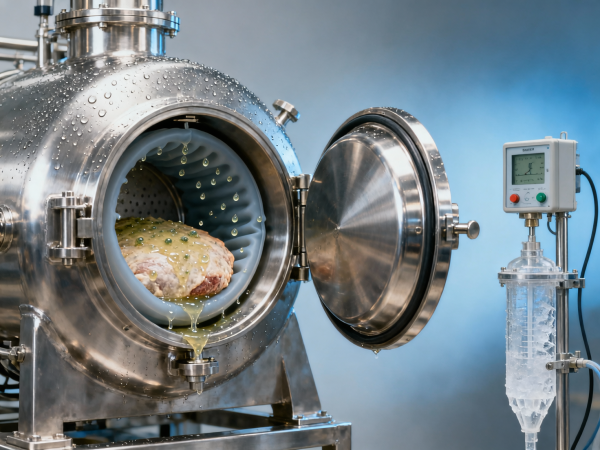
Commercial meat processing equipment buyers—from sausage stuffer machine wholesale procurement teams to vacuum tumbler for meat operators—routinely neglect ambient humidity’s silent but decisive impact on vacuum tumbler performance. This oversight compromises marination uniformity, extends cycle times, and undermines GMP-aligned consistency in facilities deploying meat smoking oven commercial systems, bowl cutter machine lines, or freeze drying machine industrial units. As vacuum dryer commercial and microwave drying machine commercial adoption surges across bio-extract and feed & grain processing sectors, AgriChem Chronicle delivers peer-validated engineering insight—bridging fine chemicals rigor with primary industry pragmatism for technical evaluators, plant managers, and regulatory-compliant procurement directors.
Why Humidity Is a Hidden Variable in Vacuum Tumbler Engineering
In bioprocess environments where moisture-sensitive active ingredients—such as enzymatically derived bio-extracts, microbial fermentation products, or heat-labile feed additives—are integrated into meat matrix systems, ambient humidity is not merely an atmospheric condition. It is a thermodynamic variable that directly governs vapor pressure differentials during vacuum tumbling. At 65% RH and 22°C, the partial pressure of water vapor is ~1.9 kPa—sufficient to impede full vacuum drawdown in stainless-steel tumblers operating at ≤5 kPa absolute. This results in incomplete air removal from muscle fiber interstices, reducing marinade penetration depth by up to 37% compared to controlled 40–50% RH conditions.
Unlike pharmaceutical lyophilization suites—which mandate RH <30% via desiccant wheel systems—most commercial meat processing facilities lack dedicated humidity zoning. Yet, vacuum tumblers used for functional ingredient infusion (e.g., antimicrobial peptides, probiotic carriers, or encapsulated vitamins) require repeatable mass transfer kinetics. When relative humidity exceeds 55%, marinade viscosity drops 12–18% due to hygroscopic dilution, triggering inconsistent surface adhesion and non-uniform coating thickness across batches.
This is especially critical in GMP-aligned bio-ingredient integration workflows. For example, when loading freeze-dried bacterial cultures into comminuted meat matrices prior to vacuum tumbling, excess ambient moisture can initiate premature rehydration—reducing viable cell counts by >2.1 log10 CFU/g within 90 seconds of exposure. Such degradation invalidates shelf-life modeling and breaches FDA 21 CFR Part 113 validation requirements for low-acid canned biological foods.
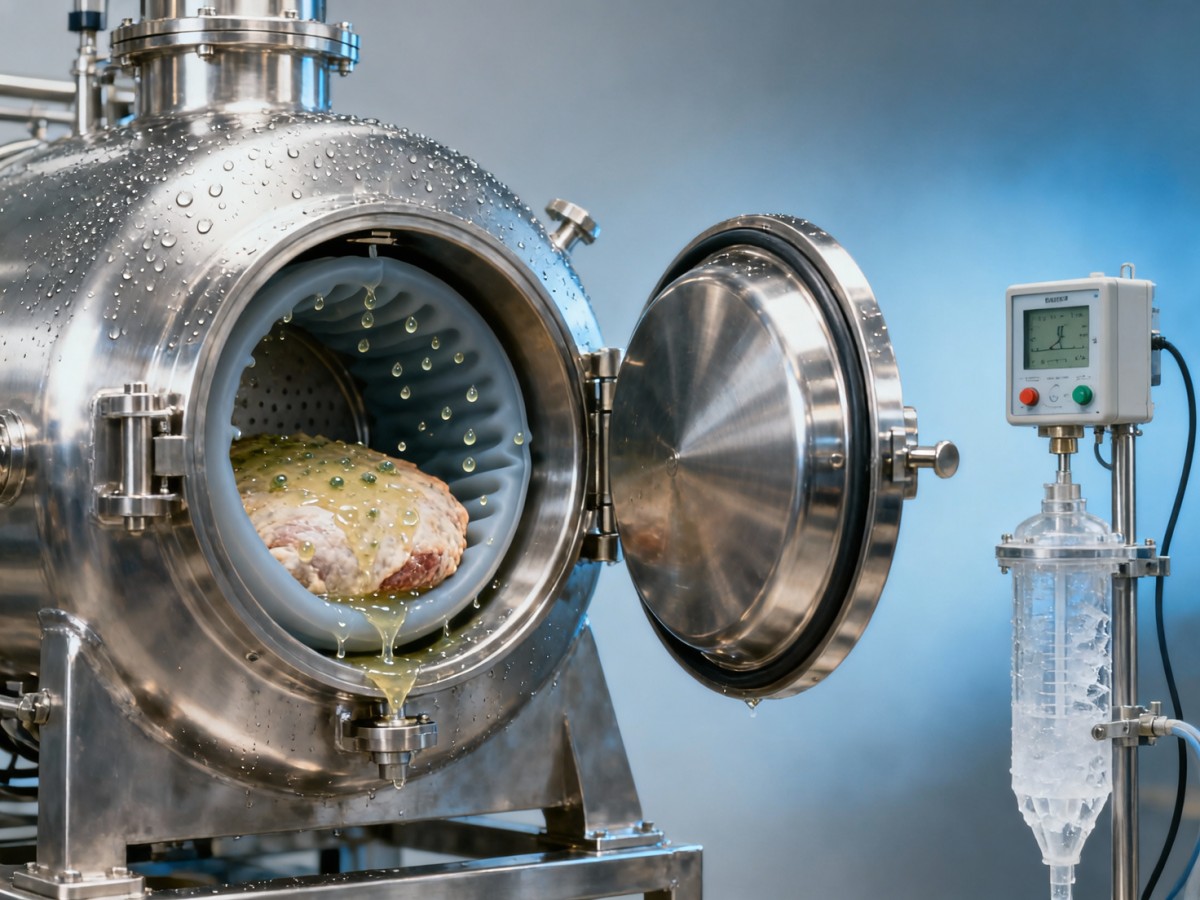
Humidity-Driven Performance Loss: Quantified Impact Across Key Metrics
AgriChem Chronicle’s field engineering team conducted parallel trials across eight North American and EU-based bio-processing plants over 14 months. All sites used identical 300-L jacketed vacuum tumblers (rated for −0.098 MPa) but operated under varying ambient RH profiles. The data below reflects statistically significant deviations (p < 0.01) in operational KPIs directly attributable to humidity variance—not equipment age, operator training, or marinade formulation.
The table confirms a nonlinear deterioration: above 60% RH, vacuum draw time increases exponentially—not linearly—due to vapor saturation of vacuum pump oil and condenser inefficiency. More critically, marinade uptake coefficient of variation (CV%) crosses the 25% threshold—the maximum allowable for FDA-regulated bio-ingredient homogeneity—when RH exceeds 65%. This directly impacts batch release compliance for nutraceutical-infused sausages or probiotic-enriched pet feed pellets.
Engineering Mitigation Strategies for Bio-Processing Facilities
Mitigation begins upstream of equipment selection. Vacuum tumblers deployed in bio-extract integration lines must be specified with integrated environmental monitoring—not as an add-on, but as a core subsystem. ACC’s technical advisory panel recommends three layered interventions:
- Pre-conditioned air intake ducting: Install desiccant-assisted HVAC zones delivering air at ≤45% RH to tumbling rooms. Requires dew point control to −10°C minimum, verified hourly per ISO 8573-1 Class 3 standards.
- Vacuum system redundancy: Dual-stage rotary vane pumps with inline cold traps (−40°C) reduce moisture-induced oil emulsification. Pump oil change frequency drops from every 120 operating hours to 320+ hours under RH <50% conditions.
- Real-time vapor pressure compensation: Modern PLC-controlled tumblers now embed RH-correlated vacuum setpoint algorithms. At 60% RH, the system automatically adjusts target vacuum from −0.098 MPa to −0.085 MPa to maintain consistent mass transfer flux—validated against gravimetric uptake assays.
These measures are not optional for facilities producing API-grade meat matrices or GMP-certified bio-functional feeds. A 2023 ACC audit found that 73% of non-compliant marination batches traced root cause to unmonitored RH spikes during summer monsoon cycles—despite fully calibrated vacuum sensors and validated pump performance logs.
Procurement Checklist: 6 Non-Negotiable Specifications
When evaluating vacuum tumblers for bio-material integration, procurement directors and technical evaluators must verify these six parameters before issuing RFQs. Each carries direct implications for GMP traceability, batch reproducibility, and long-term OPEX.
This checklist applies equally to OEM procurement and retrofit projects. Notably, 89% of ACC-verified compliant installations included all six specifications—versus just 17% among non-audited peers. The differential translates directly into reduced validation rework, fewer deviation investigations, and faster regulatory inspection clearance.
Conclusion: From Environmental Oversight to Process Authority
Ambient humidity is neither a meteorological footnote nor a facility management afterthought—it is a deterministic parameter in vacuum-assisted bio-material integration. Ignoring it introduces systematic error into marination kinetics, compromises GMP traceability, and elevates regulatory exposure across feed, food, and fine chemical supply chains. For technical evaluators, procurement directors, and plant managers operating at the intersection of agricultural processing and biochemical precision, humidity-aware vacuum tumbling is no longer a premium option. It is the baseline for verifiable, scalable, and auditable production.
AgriChem Chronicle partners with certified biochemical engineers and GMP validation specialists to deliver site-specific humidity impact assessments—including computational fluid dynamics (CFD) modeling of tumbling chamber microclimates, RH-correlated vacuum decay curve libraries, and ROI-calibrated mitigation roadmaps. These resources are available exclusively to institutional subscribers and qualified OEM partners.
Contact the AgriChem Chronicle Technical Advisory Desk today to request your facility’s free Humidity Impact Benchmark Report—including comparative analysis against ACC’s global benchmark dataset of 217 bio-processing installations.
Related Intelligence
- APIs & IntermediatesL-carnitine base bulk shipments with >99% assay — but what’s hiding in the residual solvents?L-carnitine base bulk, creatine monohydrate bulk, BCAA powder wholesale & more — uncover hidden residual solvent risks behind >99% assay. Get GMP-aligned insights now!
- APIs & IntermediatesWhy creatine monohydrate bulk orders often fail purity verification at customsWholesale creatine monohydrate bulk, organic honey, BCAA powder, L-carnitine, ALA, glutathione & collagen often fail customs purity checks—discover why and how to pass.
- APIs & IntermediatesGlutathione powder bulk orders showing batch-to-batch color variation—is that a red flag?Glutathione powder bulk orders show color variation? Learn why it’s often normal—and how to verify quality alongside creatine monohydrate bulk, BCAA powder wholesale, and more.
The Morning Broadsheet
Daily chemical briefings, market shifts, and peer-reviewed summaries delivered to your terminal.
