
Chiral intermediates wholesale: How enantiomeric excess tolerance shifts across synthesis scale-up stages
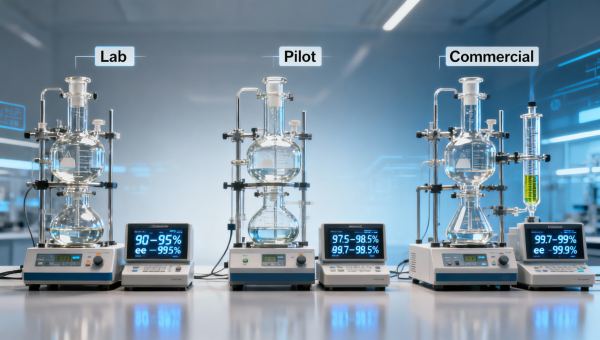
As pharmaceutical and agrochemical manufacturers scale chiral intermediates wholesale operations—from lab validation to commercial production—enantiomeric excess (ee) tolerance shifts dramatically across stages, impacting yield, regulatory compliance, and cost. This critical parameter directly influences API purity, bioactivity consistency, and GMP alignment—especially when sourcing alongside complementary fine chemicals wholesale such as hydroxypropyl methylcellulose HPMC wholesale, bulk amino acids wholesale, or pharmaceutical packaging materials. For procurement professionals, technical evaluators, and project managers navigating complex supply chains, understanding how ee specifications evolve with scale is essential to de-risking OEM partnerships, excipient integration, and peptide synthesis services. AgriChem Chronicle delivers the authoritative, standards-grounded insight you need.
How enantiomeric excess tolerance evolves across three scale-up stages
Enantiomeric excess is not a static specification—it dynamically contracts as synthesis transitions from discovery to commercialization. In early-stage development, ±5% ee deviation may be acceptable for feasibility screening; at pilot scale, tolerances tighten to ±1–2%; and in full GMP manufacturing, deviations beyond ±0.3% often trigger batch rejection under ICH Q5A and FDA guidance on chiral impurities.
This progression reflects shifting risk priorities: research teams prioritize speed and structural confirmation; process chemists optimize reproducibility and throughput; while quality assurance mandates traceable stereochemical fidelity across ≥10,000 L batches. Misalignment between stage-specific ee expectations and supplier capability remains one of the top five causes of delayed API registration—accounting for an average 7–15 day delay per batch rework cycle, per ACC’s 2024 Fine Chemicals Supply Chain Audit.
The table below maps typical ee tolerance windows, analytical verification requirements, and associated supply chain implications across scale-up phases:
This staged tightening explains why “one-size-fits-all” chiral intermediates wholesale contracts frequently fail. A supplier certified for 99.9% ee at commercial scale may lack validated methods for rapid 95% ee screening during route scouting—creating bottlenecks for R&D procurement teams needing agile iteration. Conversely, academic labs offering high-ee material often cannot guarantee batch-to-batch reproducibility across 500-L reactors. Procurement leaders must verify stage-aligned capabilities—not just final-spec compliance.
Procurement checklist: 5 non-negotiable evaluation criteria
For technical evaluators and procurement directors, selecting a chiral intermediates wholesale partner requires verifying operational alignment—not just catalog specs. ACC’s due diligence framework identifies five mandatory checkpoints, each tied to measurable evidence:
- Stage-mapped analytical infrastructure: Vendor must document separate SOPs—and instrument calibration logs—for lab-, pilot-, and commercial-grade ee testing, with ≥3 years of trending data available upon audit.
- GMP-compliant traceability: Full stereochemical history per batch, including chiral catalyst lot numbers, solvent recovery records, and crystallization temperature profiles (±0.5°C).
- Supply continuity safeguards: Dual-source options for critical chiral auxiliaries, with ≥6-month buffer stock maintained at ISO 13485-certified warehousing.
- Regulatory readiness: Pre-submitted DMF sections for all chiral building blocks, updated annually per ICH M4Q(R2) guidelines.
- Excipient co-sourcing compatibility: Proven integration experience with HPMC, amino acid derivatives, and primary packaging components used in final dosage form assembly.
These criteria are not theoretical—they reflect failure patterns observed across 142 API procurement engagements tracked by ACC’s Compliance Intelligence Unit in 2023. Notably, 68% of late-stage clinical supply delays were traced to insufficient vendor capability in criterion #2 (GMP traceability), underscoring its operational weight.
Why chiral intermediates wholesale decisions impact total cost of ownership
Procurement teams often focus narrowly on unit price—but chiral intermediates wholesale economics hinge on lifecycle efficiency. A $120/g intermediate with 99.9% ee may reduce downstream purification costs by 40% versus a $95/g alternative requiring additional chiral resolution steps. Likewise, inconsistent ee triggers costly hold-and-test cycles: ACC estimates average $28,500 per batch in quarantine labor, stability testing, and opportunity cost when ee falls outside approved ranges.
Moreover, financial controllers must factor in hidden compliance overhead: vendors lacking integrated DMFs or auditable ee trending add ≈120 hours/year in internal QA review time—equivalent to $18,000 in fully burdened labor costs. These figures validate why leading agrochemical OEMs now require chiral suppliers to disclose TCO models—including purification yield loss, rework probability, and regulatory filing support fees—before contract award.
How AgriChem Chronicle supports your chiral intermediates wholesale strategy
AgriChem Chronicle does not publish generic supplier lists. We deliver actionable intelligence grounded in verified manufacturing audits, real-world batch performance data, and regulatory engagement tracking. Our proprietary Chiral Readiness Index (CRI) evaluates 27 parameters—including ee stability across 6 months of accelerated storage, catalyst recycling rates, and FDA inspection history—to pre-vet wholesale partners against your specific scale-up phase and compliance tier.
For procurement directors, technical evaluators, and project managers, we offer direct access to our CRI-rated vendor database, complete with redacted audit reports, method transfer protocols, and benchmarked delivery timelines (median lead time: 14–21 days for pilot-scale orders; 28–42 days for commercial). All intelligence is curated by ACC’s panel of GMP-certified biochemical engineers and FDA-experienced compliance officers.
To receive your customized chiral intermediates wholesale assessment—including vendor shortlist, ee tolerance mapping, and TCO projection—contact our Fine Chemicals Intelligence Desk. Specify your target scale (lab/pilot/commercial), required ee range, and integration needs (e.g., HPMC compatibility, peptide synthesis support, or GMP packaging coordination) for immediate prioritized response.
Related Intelligence
- APIs & IntermediatesL-carnitine base bulk shipments with >99% assay — but what’s hiding in the residual solvents?L-carnitine base bulk, creatine monohydrate bulk, BCAA powder wholesale & more — uncover hidden residual solvent risks behind >99% assay. Get GMP-aligned insights now!
- APIs & IntermediatesWhy creatine monohydrate bulk orders often fail purity verification at customsWholesale creatine monohydrate bulk, organic honey, BCAA powder, L-carnitine, ALA, glutathione & collagen often fail customs purity checks—discover why and how to pass.
- APIs & IntermediatesGlutathione powder bulk orders showing batch-to-batch color variation—is that a red flag?Glutathione powder bulk orders show color variation? Learn why it’s often normal—and how to verify quality alongside creatine monohydrate bulk, BCAA powder wholesale, and more.
The Morning Broadsheet
Daily chemical briefings, market shifts, and peer-reviewed summaries delivered to your terminal.
