
The Authority in Global Agricultural Chemistry & Bio-Resources
Garlic peeling machine commercial: dry peel or wet peel line
When evaluating a garlic peeling machine commercial setup, the core decision often comes down to dry peeling or a wet peel line. For enterprise buyers, this choice affects not only throughput and labor efficiency, but also product hygiene, peel integrity, water consumption, and downstream processing costs. Understanding the technical and operational trade-offs is essential for selecting a system that aligns with production goals and compliance standards.
For most commercial processors, there is no universally better option. A dry peel line is usually the stronger choice when water savings, cleaner plant design, lower effluent burden, and easier integration into dry processing matter most. A wet peel line can be the better fit when buyers prioritize gentler peeling on certain garlic grades, reduced skin dust, and compatibility with washing-based preparation workflows. The right investment depends on your raw material profile, labor model, utility costs, food safety obligations, and target end use.
That is the real search intent behind this topic. Decision-makers are not looking for a generic definition of dry versus wet peeling. They want to know which system delivers the best operational outcome for their plant, what hidden costs appear after installation, and how to avoid buying a line that performs well in a showroom but poorly under actual production conditions.
What enterprise buyers actually need to know before choosing a garlic peeling line
Commercial buyers usually evaluate peeling systems through five practical questions: How many kilograms per hour can the line sustain? What is the peeling yield and clove damage rate? How much labor, water, and energy does it consume? How easy is it to clean and validate? And how well does it support downstream requirements such as sorting, packing, paste production, freezing, dehydration, or ingredient processing?
If your end product is whole peeled garlic for retail packs, foodservice, or export channels, appearance and breakage rate matter heavily. If your product goes into garlic paste, minced garlic, seasoning mixes, or dehydration, visual perfection may matter less than throughput consistency and low operating cost. That is why the best garlic peeling machine commercial decision starts with application mapping, not equipment brochures.
Executives should also be cautious about headline capacity claims. A machine rated at a high hourly capacity may only achieve that performance with uniform bulb size, low moisture variation, and well-conditioned garlic. In real facilities, bulb variability, storage conditions, and upstream trimming quality can significantly affect peeling performance. A purchasing decision should therefore be based on stable line output, not theoretical maximum speed.
Dry peel line: where it creates the strongest business case
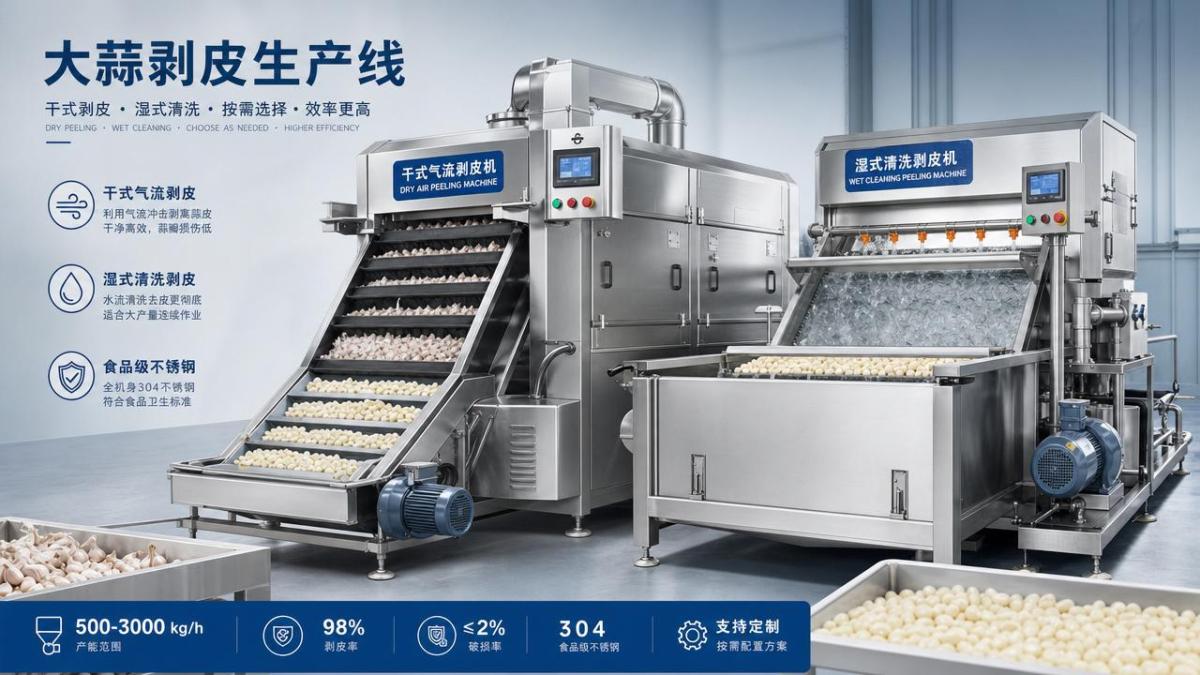
A dry garlic peel line typically uses compressed air, friction, or pneumatic separation to remove skins from cloves after pre-treatment. In many commercial plants, this approach is preferred because it reduces direct water usage and helps maintain a drier production environment. For facilities already under pressure to control utility consumption or wastewater discharge, that alone can materially improve the total economics of the line.
Dry peeling also tends to simplify environmental management. A wet line generates wastewater that may contain organic residues, suspended solids, and cleaning chemicals, all of which can increase treatment costs and compliance requirements. By contrast, a dry line produces peel waste that is generally easier to collect, handle, and potentially repurpose. For operators in regions with high water tariffs or strict discharge regulations, this becomes a strategic advantage rather than a minor technical detail.
Another important benefit is line integration. Dry peel systems often fit more naturally into facilities that feed peeled cloves into dry sorting, inspection, weighing, vacuum packing, freezing, or dehydration operations. Less surface moisture on the garlic can reduce the burden on downstream drying or handling stages. This may lower contamination risk, reduce sticking during transport, and improve packaging efficiency.
However, dry systems are not automatically superior. Their performance depends greatly on garlic variety, bulb curing condition, clove size uniformity, and pre-separation quality. If incoming garlic is inconsistent, some dry lines may produce higher residual skin rates or more mechanical damage than expected. Dust control is another concern. Enterprise buyers should confirm whether the supplier provides proper aspiration, peel collection, and air filtration measures to support hygiene and worker safety.
Wet peel line: when the higher utility burden may still make sense
A wet peel line generally uses water-assisted processing to loosen or remove skins, often combined with soaking, washing, or other pre-treatment steps. This approach can be attractive in plants where garlic is already moving through a washing-heavy workflow and where wet handling does not disrupt downstream operations. In some cases, wet peeling can be gentler on the product, especially when the facility processes delicate raw material or seeks to minimize visible clove abrasion.
One of the practical advantages of wet systems is reduced airborne skin dust. In facilities where airborne particulates are a sanitation or maintenance concern, wet handling may create a cleaner visual environment around the peeling stage. Some operators also find wet lines more forgiving when garlic lots are highly variable in skin tightness or surface condition, although this depends heavily on machine design and process control.
Still, the trade-off is substantial. Wet lines consume water, create effluent, and often require more robust drainage, floor design, and moisture management across the processing room. Excess water on peeled cloves may require additional dewatering or drying before packing or further processing. That adds time, equipment, floor space, and microbial control responsibilities. If the product is intended for chilled whole-clove packaging, excess surface moisture can shorten shelf-life performance unless managed carefully.
For many buyers, the critical question is not whether wet peeling works, but whether the overall plant is designed to absorb the hidden costs. A wet line can be sensible in a high-throughput plant with existing water treatment infrastructure and strong sanitation systems. It is less attractive for facilities trying to minimize wastewater, limit cleaning complexity, or maintain a predominantly dry processing layout.
Dry peel or wet peel line: compare total cost of ownership, not purchase price
Capital cost matters, but for enterprise procurement teams, the more important metric is total cost of ownership over three to seven years. The initial quotation for a garlic peeling machine commercial line is only the starting point. Buyers should model utilities, labor, consumables, maintenance, downtime risk, reject rate, cleaning time, wastewater handling, and spare parts availability.
Dry systems often gain an advantage in water savings and effluent reduction, but they may require consistent compressed air quality and reliable dust management components. Wet systems may appear straightforward operationally, yet their ongoing water, drainage, sanitation, and moisture-control costs can accumulate quickly. If a facility exports to markets with stringent food safety expectations, the cleaning validation burden and microbial monitoring protocol should also be added to the cost model.
Yield economics deserve special attention. Even a small increase in clove breakage or incomplete peeling can create a significant annual cost when raw garlic volumes are high. A machine that is cheaper upfront but causes more loss may become the more expensive option within months. Decision-makers should ask for documented data on peel removal rate, usable product yield, and product damage across different garlic sizes and crop conditions.
The best procurement teams build a line-item comparison table covering hourly throughput, labor per shift, water use per ton, energy demand, compressed air demand, cleaning hours, peel waste handling, spare part lead time, and expected service intervals. This approach turns an emotional purchasing decision into a defendable investment case.
What performance indicators should be tested before purchase?
Suppliers often present polished demonstrations, but a serious commercial evaluation should be based on factory acceptance testing or sample trials using your own garlic. This is especially important because garlic skin adhesion, clove firmness, and moisture vary widely by variety, origin, season, storage age, and curing practice. A machine that handles one source perfectly may perform very differently on another.
The most important indicators to validate are effective throughput, peel removal percentage, residual skin level, broken clove rate, unpeeled clove rate, labor intervention frequency, and sanitation turnaround time. If your business supplies premium channels, visual appearance standards should be scored as well. If your output is for ingredient manufacturing, consistency and usable yield may take priority over cosmetic quality.
It is also wise to test the line across multiple operating conditions rather than one ideal run. Ask how the machine responds to mixed bulb sizes, partially cured garlic, or lots with tighter skins. Observe startup and shutdown procedures, not just steady-state operation. Maintenance access, tooling changes, and daily cleaning effort should be part of the evaluation because they affect real production uptime.
For strategic buyers, after-sales support is another performance factor. A technically sound machine with weak spare parts support can become a production bottleneck. Ask where critical parts are stocked, how quickly technical support is delivered, whether remote troubleshooting is available, and what training is included for operators and maintenance staff.
How compliance, hygiene, and plant design influence the right choice
In food processing, equipment selection is never just a production question. It is also a hygiene design decision. Enterprise buyers should evaluate frame construction, material grade, weld quality, drainage design, dead spots, access panels, and ease of sanitation. A peeling line that is difficult to clean can raise contamination risk and increase labor cost, regardless of whether it is dry or wet.
Dry lines may support cleaner separation between raw and processed zones in some facilities, but they must manage dust, peel fragments, and air movement carefully. Wet lines may reduce dust yet increase wet-surface exposure, splash zones, and microbial control demands. In both cases, the surrounding room design matters: flooring, drains, airflow, humidity control, and traffic separation all influence food safety outcomes.
Companies selling into export, retail, or institutional food channels should ensure the line supports documented sanitation procedures, traceability requirements, and audit readiness. If the peeled garlic feeds into value-added ingredients, buyers should also consider how the peeling method affects downstream microbiological control and shelf-life performance. These issues often matter more to commercial success than the machine’s headline speed.
Which system is better for different commercial scenarios?
If your operation focuses on dehydrated garlic, garlic granules, powder feedstock, or ingredient processing where a dry production chain is valuable, a dry peel line is often the more efficient strategic fit. It reduces water dependency, simplifies waste handling, and usually aligns better with downstream dry processing and packaging systems.
If your plant already uses extensive washing, wet conveying, and moisture-managed preparation steps, a wet peel line may integrate more smoothly. This can be especially true where product cosmetics matter and the facility already has sufficient drainage, water treatment, and sanitation capacity. In that context, the additional water burden may be manageable.
For premium whole-clove packing operations, the answer depends on trial results. Some processors will favor dry peeling for lower utility cost and cleaner integration, while others will choose wet systems if they consistently achieve a better visual finish on their specific garlic sources. The correct answer is empirical, not theoretical.
For multi-product facilities, flexibility may be decisive. A line that can handle variation in garlic grades and destination products may outperform a highly optimized but narrow-use machine. Decision-makers should think beyond current demand and assess whether the equipment will remain suitable if product mix, labor cost, or environmental regulation changes.
Final decision framework for buyers of a garlic peeling machine commercial line
If you are choosing between dry peel and wet peel systems, begin with four priorities: end-product requirement, raw garlic variability, utility economics, and compliance burden. A dry line is usually the stronger default choice for buyers seeking lower water use, easier waste management, and better fit with dry downstream processing. A wet line becomes more compelling when product handling needs are gentler, wet workflows are already established, and the facility can absorb higher sanitation and wastewater demands.
The most reliable buying process is to request product trials with your own garlic, compare total cost of ownership, audit hygiene design, and verify after-sales support. Do not let nominal capacity or low purchase price drive the decision. The right machine is the one that produces stable yield, manageable operating cost, and predictable compliance performance in your specific plant environment.
In short, the best garlic peeling machine commercial investment is not defined by whether it is dry or wet in principle. It is defined by how well the system matches your raw material, production flow, labor structure, and market requirements. For enterprise buyers, that alignment is what turns equipment spending into measurable operational value.
Related Intelligence
- Milling Machinery5 Milling Machinery Firms Approved for Belt and Road Smart Farm Machinery Cloud Platform5 milling machinery firms approved for Belt and Road Smart Farm Machinery Cloud Platform — enabling multilingual remote diagnostics, cross-border spare parts ordering & national API integration.
- Milling MachineryTea leaf rolling machine pressure settings and leaf appearanceTea leaf rolling machine pressure settings directly shape twist, appearance, and quality. Learn how to balance pressure for cleaner leaves, less breakage, and more consistent tea processing results.
- Milling MachineryTea processing machines wholesale and the spare parts questionTea processing machines wholesale buyers now focus on spare parts, uptime, and lifecycle support. Learn how to compare suppliers, reduce downtime risk, and protect tea quality.
The Morning Broadsheet
Daily chemical briefings, market shifts, and peer-reviewed summaries delivered to your terminal.
