
The Authority in Global Agricultural Chemistry & Bio-Resources
Commercial fish farm equipment mistakes that slow expansion
Scaling an aquaculture operation is rarely limited by market demand alone. In many expansion projects, the real constraint is earlier equipment selection that looked efficient at pilot or mid-scale but becomes restrictive under commercial load. When commercial fish farm equipment is chosen without a clear growth scenario, farms often face avoidable bottlenecks in water treatment, grading, harvesting, feed delivery, labor flow, and compliance. The result is not only slower expansion, but also higher retrofit cost, unstable biological performance, and weaker return on capital.
In practical terms, the best equipment decisions are not the ones that minimize initial spending. They are the ones that match the expansion pathway of the site, the species, the production model, and the regulatory environment. This article examines where commercial fish farm equipment decisions commonly go wrong, how those mistakes differ by operating scenario, and what to check before new capacity is added.
When expansion plans outgrow the original farm design
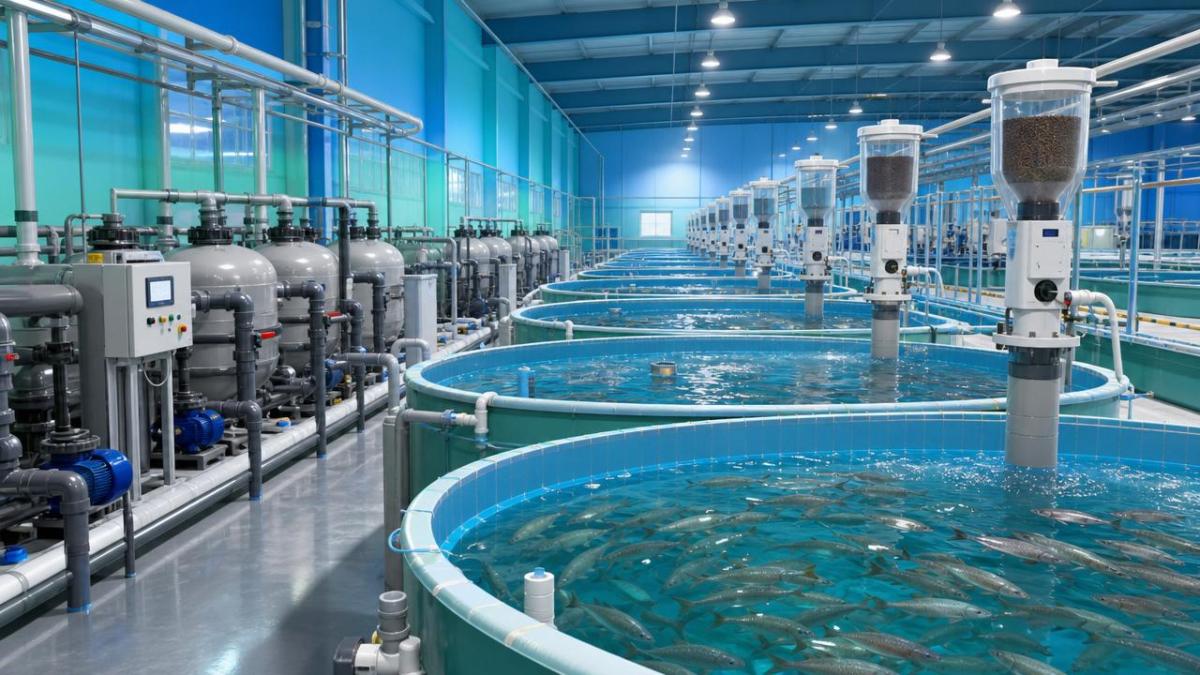
A common mistake is assuming that equipment installed for initial production can simply be duplicated during expansion. In reality, scale changes system behavior. A pumping system that supports one grow-out block may struggle when pipe length increases. A basic solids removal setup may work at moderate density but fail when biomass rises. In this scenario, commercial fish farm equipment becomes a limiting factor because the original design was optimized for start-up efficiency, not modular growth.
This issue appears in both land-based and open-water operations. Onshore farms may underestimate hydraulic balancing, oxygen redundancy, or backup power requirements. Cage systems may add units without upgrading feed barges, mooring components, net handling tools, or service vessel support. Expansion slows because each added production zone increases pressure on shared infrastructure that was never sized for future throughput.
Scenario 1: Land-based RAS expansion with hidden process bottlenecks
In recirculating aquaculture systems, one of the most expensive mistakes is focusing only on tank volume while underinvesting in process-critical commercial fish farm equipment. Biofiltration, degassing, oxygenation, UV or ozone treatment, sludge handling, and control automation determine whether a facility can truly support higher biomass. If only tanks are expanded, water quality instability quickly undermines growth performance and survival.
The core judgment point in this scenario is whether the equipment architecture is modular. A modular RAS layout allows production blocks to be added without redesigning the full plant. A non-modular setup often creates expansion delays because every new capacity step forces rework across filtration loops, sensor networks, and emergency systems. In this context, selecting commercial fish farm equipment with scalable control logic, spare treatment capacity, and maintenance access is usually more valuable than choosing the lowest upfront price.
What is often overlooked in RAS projects
- Undersized drum filters that cannot handle peak solids load after feeding cycles
- Insufficient backup oxygen supply for high-density events or power instability
- Control systems that monitor data but do not automate alarms, shutdown logic, or response actions
- Poor serviceability that turns routine maintenance into production downtime
Scenario 2: Cage and pond farms adding capacity without support equipment upgrades
In pond and cage operations, the mistake is often different. The visible expansion unit is easy to count: more cages, more pond area, more fish. But the supporting commercial fish farm equipment behind daily operations is frequently left unchanged. Feed transport, aeration, net cleaning, fish transfer, mortality handling, water quality monitoring, and harvest logistics must all scale with biomass, not just with farm footprint.
The key judgment point here is operational rhythm. If the farm adds production units but still relies on the same labor-intensive workflow, feeding windows become inconsistent, fish handling time increases, and disease response slows. In offshore or exposed locations, expansion can also multiply weather-related risk if lifting, mooring, and inspection equipment are not upgraded. Reliable commercial fish farm equipment in this scenario includes durable aeration systems, mechanized feeders, robust net handling tools, and maintenance equipment suited to harsher service conditions.
Scenario 3: Processing-linked farms that ignore harvest and post-harvest flow
Some operations scale production successfully but still experience slower expansion because downstream handling was not considered. Fish may be grown efficiently, yet harvest pumps, grading lines, chilling capacity, washdown systems, or live transport units remain undersized. In this situation, commercial fish farm equipment is not failing biologically; it is failing commercially because fish cannot move through the value chain at the required speed and quality standard.
This is especially important where farms supply premium fresh markets, regulated export channels, or integrated processing facilities. Equipment selection must account for biosecurity, traceability, food safety cleaning procedures, and labor flow. A farm that doubles output but creates harvest-day congestion often sees quality loss, higher mortality, and missed shipping windows. Expansion then appears profitable on paper but unstable in execution.
How equipment needs change across farm scenarios
Not every production model needs the same commercial fish farm equipment mix. Matching the equipment package to the operating scenario is essential for efficient capital allocation and smoother expansion.
Practical selection rules for expansion-ready commercial fish farm equipment
To reduce expansion friction, commercial fish farm equipment should be evaluated as part of a future operating system rather than as individual units. A useful approach is to test each equipment decision against the next capacity step, not only current output.
- Map shared infrastructure first. Identify pumps, blowers, electrical systems, treatment loops, roads, docks, and storage areas that multiple production blocks depend on.
- Design for maintenance access. Equipment that is hard to clean, inspect, or replace usually creates hidden downtime during scale-up.
- Check compatibility across vendors. Expansion often mixes old and new systems; incompatible controls, fittings, or data protocols can create expensive delays.
- Validate compliance early. Environmental discharge, food safety cleaning, electrical safety, and traceability requirements should be built into the equipment plan.
- Stress-test peak conditions. Use worst-case biomass, weather, feed events, and emergency scenarios to confirm whether the commercial fish farm equipment package is truly expansion-ready.
Common misjudgments that slow farm growth later
Several recurring errors appear across production models. One is purchasing equipment based on nameplate capacity without checking real operating efficiency under farm-specific conditions. Another is treating automation as optional, even when labor consistency is already a weakness. A third is ignoring spare parts strategy, which turns minor failures into long interruptions once biomass and financial exposure increase.
There is also a tendency to separate biological planning from engineering planning. Growth targets, feed conversion, fish size distribution, harvest cadence, and mortality assumptions should all inform commercial fish farm equipment selection. If engineering and production models are not aligned, the farm expands physically but not operationally. That mismatch is one of the most common reasons why commercial aquaculture infrastructure delivers less than expected after capital deployment.
A better next step before adding new capacity
Before purchasing additional commercial fish farm equipment, conduct a scenario-based audit of the current farm. Review which assets are local to one production unit and which are shared across the entire operation. Compare present capacity with the next planned biomass level, then identify where water treatment, oxygen delivery, aeration, handling, harvest, utilities, and compliance systems will tighten first.
A disciplined expansion plan usually starts with bottleneck ranking, phased upgrades, and equipment standardization rules. That makes future additions faster, lowers training complexity, and improves reliability across the site. When commercial fish farm equipment is selected with the real expansion scenario in mind, growth becomes less dependent on emergency retrofits and more aligned with sustainable production, regulatory confidence, and long-term operational efficiency.
Related Intelligence
- Commercial FishingQuaculture & Fishery equipment trends shaping 2026 projectsQuaculture & Fishery equipment trends for 2026: discover scenario-based insights on resilient design, energy efficiency, biosecurity, and traceability to plan smarter, higher-ROI projects.
- Commercial FishingCommercial fish farm equipment mistakes that slow expansionCommercial fish farm equipment mistakes can quietly block aquaculture growth. Learn how to avoid bottlenecks, cut retrofit costs, and choose scalable systems for faster expansion.
- Commercial FishingWhy Some Wholesale Fishing Waders Wear Out Too FastWholesale fishing waders wear out fast when material grade, seam design, and QC fall short. Learn how commercial neoprene chest waders and smart aquaculture buying reduce hidden replacement costs.
The Morning Broadsheet
Daily chemical briefings, market shifts, and peer-reviewed summaries delivered to your terminal.
