
Commercial Onion Dehydrator Sizing Mistakes That Raise Energy Use
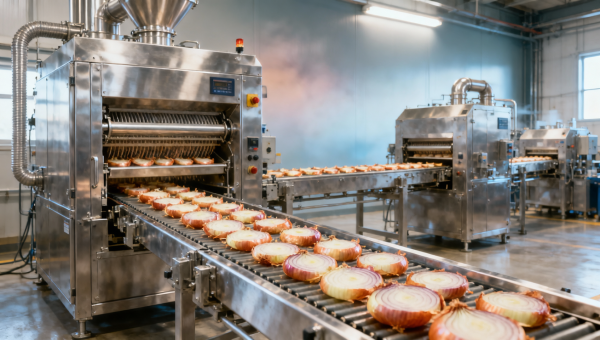
Selecting a commercial onion dehydrator with the wrong capacity can quietly inflate fuel and electricity costs, reduce throughput stability, and complicate downstream processing tied to an industrial food drying oven or even a garlic powder making machine line. This article examines the most common sizing mistakes, helping operators, buyers, and technical evaluators balance moisture load, batch volume, airflow, and expansion plans before energy losses become a long-term operating burden.
For most buyers and plant teams, the core issue is not simply “how big should the dryer be,” but “how do we size a commercial onion dehydrator so energy use per kilogram stays under control while production remains stable?” In practice, the biggest cost problems usually come from choosing equipment based only on hourly feed rate, nameplate capacity, or future growth assumptions without checking actual moisture removal duty, loading pattern, airflow efficiency, and line integration. If sizing is wrong, the dryer may run half-empty, cycle inefficiently, over-dry product, or force bottlenecks upstream and downstream. The result is higher operating cost, lower consistency, and a weaker return on capital.
For operators, technical evaluators, procurement teams, and decision-makers, the most useful way to assess sizing is to treat the dehydrator as part of a full process system: raw onion variability, pre-treatment, drying curve, heat source, fan power, shift structure, target moisture, and future utilization all matter. The sections below focus on the sizing mistakes that most directly raise energy use and on the practical checks that help avoid them.
Why commercial onion dehydrator sizing errors become an energy problem so quickly
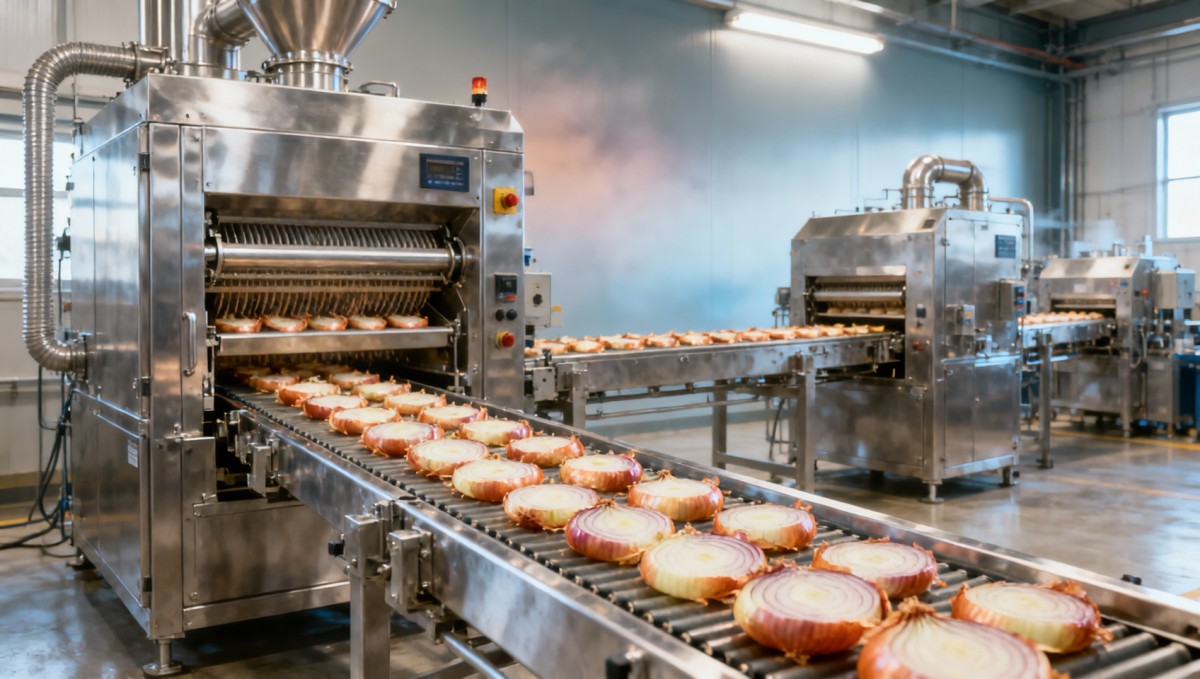
A commercial onion dehydrator does not consume energy in proportion to metal size alone. Energy intensity rises when the machine operates outside its efficient loading window. That is why two plants with similar production targets can report very different fuel and electricity costs. The true energy burden depends on how much water must be removed, how evenly product is distributed, how effectively air moves through the bed or trays, and whether the drying cycle is matched to the onion’s real moisture profile.
Onions are especially sensitive from an energy standpoint because they begin with high moisture content and often require tight control to meet downstream requirements for flakes, granules, or powder. If the dehydrator is oversized, excess heated air and fan power may be used without enough product load to absorb that thermal energy efficiently. If it is undersized, operators may compensate by increasing temperature, extending drying time, running more shifts, or accepting unstable moisture levels. All of these responses push total energy use upward.
This is also why sizing decisions affect more than the dryer itself. In a line connected to an industrial food drying oven, milling section, or garlic powder making machine configuration, inconsistent dehydration can create secondary losses through rework, waiting time, poor grinding behavior, or variable finished product bulk density.
The most common sizing mistake: choosing by raw input volume instead of moisture removal load
One of the most frequent mistakes is sizing the dehydrator by fresh onion feed rate alone. Buyers may ask for a machine that can handle a certain number of tons per day, but that figure is incomplete unless it is tied to starting moisture, target final moisture, slice thickness, and allowable drying time.
The most important sizing question is: how many kilograms of water must the system remove per hour under normal and peak conditions? That determines the real thermal load. A plant processing 2 tons per hour of onions at one moisture level can need very different energy input than a plant handling the same tonnage with different variety, storage condition, or pre-processing loss.
For example, if onion solids content fluctuates across suppliers or seasons, the dryer selected from a simple throughput number may be chronically misapplied. In such cases, the commercial onion dehydrator appears “large enough” on paper, but its actual evaporation capacity may be wrong for the real duty. This causes either underutilization or stress operation, both of which raise specific energy consumption.
Before finalizing equipment capacity, evaluators should verify:
- Average and worst-case incoming moisture content
- Target final moisture for the intended product grade
- Hourly water evaporation requirement, not just fresh feed quantity
- Expected change in moisture load across season, cultivar, and supplier mix
- Whether pre-draining, slicing, or air handling affects effective drying duty
Oversizing is not a safety margin if the dryer spends most of its life underloaded
Many procurement teams assume a larger dehydrator creates useful headroom and protects future growth. Some reserve capacity is sensible, but excessive oversizing often becomes a hidden energy penalty. Dryers are usually most efficient within a designed operating range. If production demand stays well below that range, the system may consume substantial baseline thermal energy and fan power regardless of reduced product mass.
Underloaded operation can increase energy use per kilogram in several ways:
- Heat losses remain relatively high even when output is low
- Air distribution may become less effective across partially filled zones
- Control systems may cycle burners, heaters, or fans inefficiently
- Operators may compensate with conservative, longer drying cycles
- Residence time may become excessive, causing over-drying and yield loss
From a financial perspective, oversizing can also weaken the business case. Capital cost rises first, then energy cost per unit remains elevated until production eventually grows into the machine—if it ever does. For financial approvers and plant managers, this is an important distinction: spare capacity only creates value when it is likely to be used within a realistic planning horizon.
Undersizing creates energy waste through process instability, not just capacity shortage
Undersizing is easier to recognize because production teams feel the pain immediately. However, its energy impact is often misunderstood. The problem is not only that the plant cannot process enough onions; it is that the system is pushed into less efficient operating behavior.
When the dehydrator is too small, teams often respond by:
- Increasing drying temperature beyond the ideal profile
- Extending run time or adding shifts
- Reducing batch uniformity to keep material moving
- Accepting higher final moisture variation and then re-drying some lots
- Creating queue buildup that disrupts upstream slicing and downstream packaging
These actions increase both direct and indirect energy use. A smaller machine may look economical at purchase stage, but if it requires overtime operation, repeated starts and stops, or high reject rates, lifecycle cost rises quickly. For onion processors producing flakes or powder-grade material, unstable moisture can also impair milling performance and final product consistency, adding further cost beyond the dryer.
Ignoring airflow, bed depth, and product geometry leads to false capacity assumptions
Another common mistake is to treat all nominal dryer capacities as comparable, even though real performance depends heavily on airflow design and product presentation. Onion slices, dices, or shreds do not dry the same way. Bed depth, tray loading, belt thickness, and particle geometry all influence how easily moisture escapes and how much resistance the air system must overcome.
If a dryer is sized without accounting for these variables, the expected throughput may only be achievable at poor energy efficiency or under product conditions that are not sustainable in daily production. For instance, a machine tested with thinner loading or more uniform feed may not perform the same way with thicker onion beds from a commercial shift.
Technical evaluators should pay close attention to:
- Air velocity and pressure drop across the product bed
- Uniformity of loading across trays or belts
- Whether the design suits onion slices, minced onion, granules, or mixed cuts
- Drying profile by zone rather than only total residence time
- Fan motor demand relative to expected product depth and moisture load
This matters for energy because poor airflow matching often forces plants to use more heat to compensate for uneven moisture removal. In many cases, what appears to be a heating problem is actually a sizing and air distribution problem.
Not matching the dehydrator to the full line can raise total plant energy cost
A commercial onion dehydrator should not be sized in isolation. It must fit the actual rhythm of the processing line, including washing, peeling, slicing, pre-treatment, drying, cooling, grading, and possible milling. A mismatch anywhere in that sequence can turn the dryer into an expensive buffer instead of an efficient conversion step.
Consider a line where upstream preparation supplies onions in uneven surges. If the dehydrator is sized for a smooth average flow but receives irregular peak loads, the system may spend part of the day overloaded and part underloaded. That pattern is bad for energy use because controls and residence time become inconsistent. Similarly, if downstream powder or flake finishing cannot accept output continuously, the dryer may be forced into stop-start operation that wastes thermal energy.
This issue is especially relevant where onion drying is linked to broader industrial food drying oven operations or adjacent garlic powder making machine lines. Shared utilities, ducting, labor, and shift structures can distort the “correct” dryer size if each machine is evaluated independently. Decision-makers should therefore assess line balance, not just standalone dryer specification.
Future expansion assumptions often distort today’s sizing decision
Growth planning is necessary, but it should be disciplined. Many plants purchase a larger dehydrator based on an optimistic five-year expansion model without confirming market demand, raw material availability, utility capacity, or labor readiness. If expansion is delayed, the plant operates an oversized system with poor load factor and elevated energy cost.
A better approach is to distinguish between realistic near-term utilization and uncertain long-term scenarios. Where growth is probable but timing is unclear, buyers should compare three options:
- One larger unit with low initial utilization
- A right-sized current unit with modular expansion later
- Parallel units that allow better turndown and maintenance flexibility
For procurement and executive teams, this is often where the best lifecycle decision is made. The lowest-risk purchase is not always the physically largest machine. It is the option that preserves efficiency across the most likely operating range while still allowing manageable expansion.
How to evaluate the right size before purchase: practical questions buyers should ask
To avoid energy-intensive sizing mistakes, buyers should request more than brochure capacity. The supplier should be able to discuss actual evaporation duty, utility demand, product-specific performance, and efficiency at different loading conditions.
Useful evaluation questions include:
- What is the guaranteed water evaporation rate per hour under onion-specific conditions?
- At what loading range does the dryer achieve its best energy performance?
- How does energy consumption change at 50%, 75%, and 100% utilization?
- What assumptions were used for slice thickness, initial moisture, and final moisture?
- How are airflow and temperature controlled across different drying zones?
- Can the system maintain efficiency during partial-load operation?
- How does the machine integrate with upstream preparation and downstream handling?
- What field data exist for similar onion products and production schedules?
For technical teams, supplier trials or reference-case validation are highly valuable. For procurement teams, total cost of ownership should include not just equipment price, but fuel use, electricity demand, labor effect, maintenance burden, and expected utilization profile. For quality and safety teams, sizing should also be checked against moisture consistency, sanitation design, and process control stability.
A simple decision framework for balancing energy efficiency and production flexibility
In most cases, the right commercial onion dehydrator size sits between aggressive oversizing and short-term underbuying. A useful decision framework is:
- Define the required finished product specification and target throughput.
- Calculate hourly water removal under average and peak raw material conditions.
- Map actual line behavior, including batch variation, shift pattern, and downtime.
- Compare equipment efficiency at realistic utilization levels, not ideal ones.
- Test future expansion assumptions against probable sales and supply conditions.
- Evaluate whether modularity or parallel equipment improves turndown efficiency.
- Model total operating cost per kilogram of finished onion product.
This framework helps different stakeholders align. Operators gain more stable drying conditions. Technical evaluators can compare meaningful process data. Procurement gets a stronger basis for supplier negotiation. Financial approvers see a clearer path to lower lifecycle cost rather than a purchase justified only by nominal capacity.
Conclusion
Commercial onion dehydrator sizing mistakes raise energy use when capacity decisions are made from incomplete assumptions—especially when buyers focus on fresh feed rate, oversized “future-proofing,” or nominal machine throughput without calculating real moisture removal duty. The most efficient choice is usually the one that matches actual onion characteristics, loading pattern, airflow design, and line integration across the plant’s realistic operating range.
For readers evaluating a new system or reviewing an existing one, the key takeaway is straightforward: do not size the dryer by tonnage alone. Size it by evaporation load, utilization pattern, and process fit. That approach not only reduces fuel and electricity waste, but also improves throughput stability, product consistency, and the long-term economics of the entire drying line.
Related Intelligence
- Milling MachineryHow to Choose a Horizontal Ribbon Blender for FeedHorizontal ribbon blender feed buying guide: compare vertical feed mixer machine options, animal feed mixers wholesale offers, and line fit for poultry, cattle, and floating fish feed plant projects.
- Milling MachineryWhy use a rotary drum sieve grain line?Why use a rotary drum sieve grain line? Discover how rotary drum sieve grain, grain pre cleaner machine, gravity separator grain, and magnetic separator for feed improve efficiency and quality.
- Milling MachineryHow to avoid grain destoner machine issues?Grain destoner machine issues explained: learn how gravity separator grain, grain pre cleaner machine, and rotary drum sieve grain setup affect performance, reduce downtime, and improve line efficiency.
The Morning Broadsheet
Daily chemical briefings, market shifts, and peer-reviewed summaries delivered to your terminal.
