
What Causes Uneven Results in an Industrial Food Drying Oven?
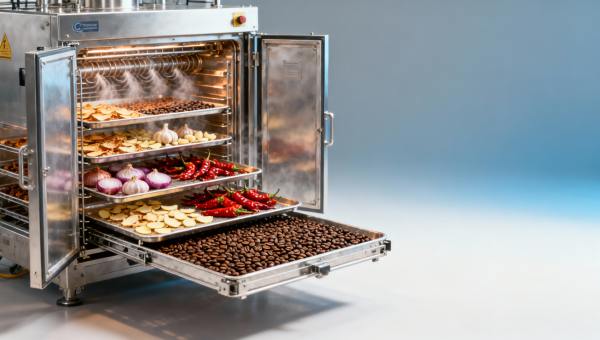
Uneven drying in an industrial food drying oven usually comes down to a small group of practical causes: poor airflow distribution, inconsistent loading, unstable temperature or humidity control, product variability, and maintenance or design limitations. For processors handling onions, garlic, turmeric, chili, black pepper, coffee, cocoa, or tahini-related ingredients, this is not a minor nuisance—it directly affects moisture consistency, color, aroma retention, throughput, food safety margins, and energy cost. Whether you are evaluating a commercial onion dehydrator, a garlic powder making machine, a chili powder making machine, or broader coffee bean processing equipment, the key question is not simply why uneven results happen, but how to identify the dominant cause quickly and choose equipment or operating practices that prevent it.
What usually causes uneven drying in an industrial food drying oven?
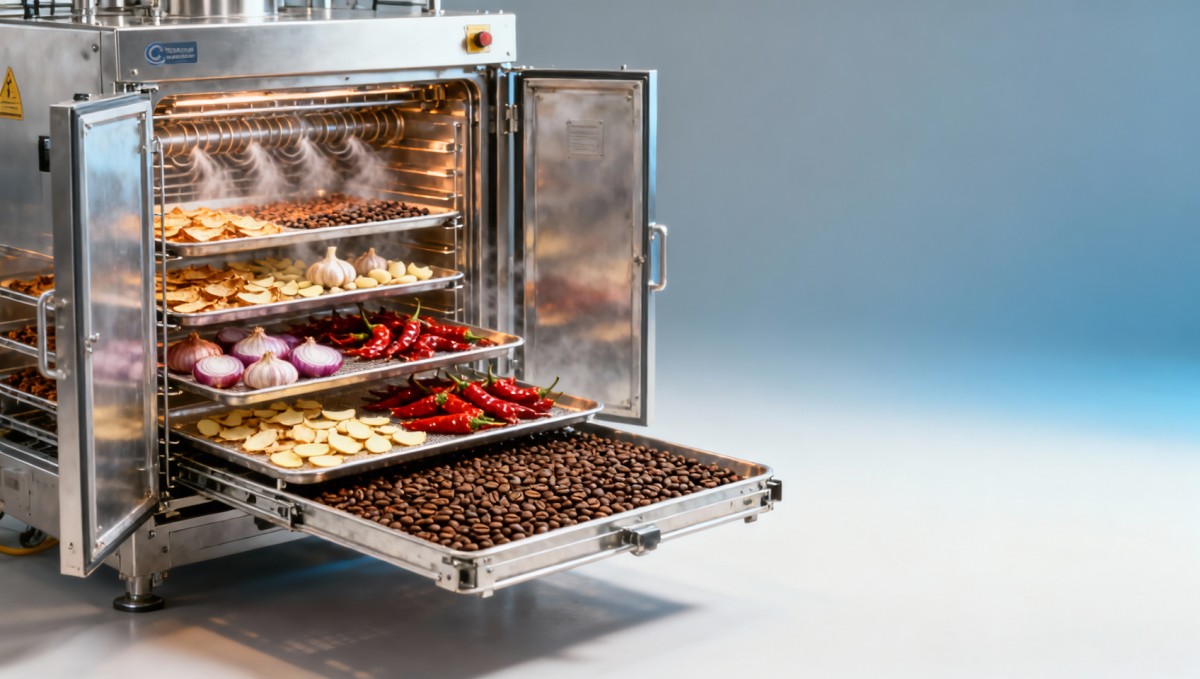
In most production environments, uneven results are caused by an imbalance between heat transfer, air distribution, moisture removal, and product loading. Industrial food drying depends on the same principle across many product categories: hot air must reach every part of the material bed at a consistent velocity, temperature, and humidity level for enough time to remove moisture evenly. If one of these variables shifts across the chamber, some product zones overdry while others remain wet.
The most common root causes include:
- Non-uniform airflow: Dead zones, short-circuiting air paths, or weak fan performance can leave some trays or sections underexposed.
- Inconsistent loading density: Thick product layers, overloaded trays, or uneven spacing create resistance differences that change drying speed.
- Temperature variation across the oven: Poor insulation, bad duct design, or inaccurate sensors can create hot and cold spots.
- Humidity not being removed efficiently: Even if air is hot enough, trapped moisture slows evaporation and causes patchy results.
- Product variability: Slice thickness, initial moisture, particle size, oil content, and surface area all affect drying behavior.
- Control system limitations: Basic ovens may lack zoning, variable fan control, or responsive feedback loops.
- Maintenance issues: Clogged filters, dirty heat exchangers, damaged seals, and worn fans reduce process stability over time.
For technical evaluators and buyers, the important takeaway is that uneven drying is rarely caused by temperature alone. In many plants, operators increase heat to compensate, but that often worsens quality loss without solving the real airflow or moisture-exhaust problem.
Why airflow distribution matters more than many operators expect
If one factor deserves priority in troubleshooting or equipment selection, it is airflow management. In an industrial food drying oven, drying uniformity depends on how evenly air is delivered through trays, belts, racks, or chambers. Two ovens can have the same heating capacity but produce very different results if one has better airflow engineering.
Signs of airflow-related drying problems include:
- Edge trays drying faster than center trays
- Top racks showing different moisture levels than bottom racks
- Products near the air inlet becoming brittle while outlet-side material stays damp
- Repeated need to rotate trays manually during a batch
This is especially important for products like onion slices, garlic flakes, chili pieces, turmeric chips, and black pepper, where bed permeability changes as moisture drops. It also matters in coffee bean processing equipment and cocoa drying lines, where uniformity affects both shelf stability and sensory quality.
When assessing a dryer, decision-makers should look beyond nominal capacity and ask:
- How is air distributed across the chamber?
- Is airflow adjustable for different product types and bed depths?
- Are there validated airflow maps or uniformity test results?
- Does the design minimize dead zones?
- Can the system maintain stable performance at full load, not only under ideal test conditions?
How loading practices create moisture variation even in a good oven
Even a well-designed industrial food drying oven can produce uneven results if loading is inconsistent. This is one of the most common operational causes and one of the easiest to overlook because the equipment itself may appear to be functioning normally.
Typical loading-related problems include:
- Different tray fill depths in the same batch
- Irregular slice or particle size
- Product piled against tray edges or corners
- Blocked perforations or airflow paths
- Mixing raw material lots with different initial moisture content
For example, in a commercial onion dehydrator, thicker onion slices or heavier tray loading can cause the center of the tray to retain moisture while the outer layer appears ready. In a garlic powder making machine line, inconsistent pre-drying of garlic pieces before milling can lead to unstable powder quality, poor flowability, and higher risk of microbial growth. In a chili powder making machine process, uneven drying before grinding can also affect color retention and final powder consistency.
For operators, standardizing preparation steps often delivers faster improvement than changing the setpoint. Useful controls include:
- Specified cutting thickness tolerance
- Defined tray loading weight per square meter
- Single-layer or controlled-depth loading rules
- Raw material moisture inspection before drying
- Clear SOPs for tray placement and batch arrangement
When temperature and humidity control are the real issue
Many processors assume an oven is underperforming because it “does not get hot enough.” In reality, the problem may be unstable temperature measurement or ineffective humidity evacuation. Drying requires both heat input and moisture removal. If moist air remains in the chamber too long, evaporation slows, and some areas of the load stay wet even at acceptable temperature readings.
This becomes more critical in high-moisture materials such as onions, garlic, and fresh turmeric, as well as in value-sensitive products like coffee and cocoa, where excess heat can damage volatile compounds, aroma, and color.
Common control-related causes include:
- Poorly placed temperature sensors that do not reflect product-zone conditions
- Inaccurate or drifting sensors
- Slow control response causing overshoot or temperature swings
- Insufficient exhaust damper performance
- Lack of humidity monitoring in processes where moisture removal rate matters
For procurement teams and plant managers, this means equipment evaluation should include instrumentation quality, control logic, and exhaust design—not just heater type or rated power. A dryer with better feedback control may deliver lower rework, tighter moisture specification, and better energy efficiency over time.
How product characteristics affect drying uniformity
Different foods behave very differently in an industrial food drying oven. Uneven results are often linked to the raw material itself, especially when operators run multiple products through one system without adjusting process parameters.
Important product variables include:
- Size and shape: Slices, granules, flakes, beans, seeds, and paste-derived materials dry at different rates.
- Initial moisture content: Seasonal and supplier variation can be significant.
- Oil, sugar, or solids content: These influence surface drying and internal moisture migration.
- Bulk density and porosity: These affect how air moves through the product bed.
- Surface damage from cutting or pretreatment: This can accelerate drying in some zones and slow it in others.
For coffee bean processing equipment, bean size distribution and preconditioning can influence drying consistency and final cup quality. In cocoa applications, uneven drying can affect mold risk, storage life, and flavor development. In spice and botanical materials such as turmeric, black pepper, and chili, moisture variation can lead to grinding instability and inconsistency in downstream packaging.
This is why serious buyers should ask suppliers whether drying recipes can be customized by product type and whether the oven has enough control flexibility for changing materials.
What uneven drying costs a processor in quality, compliance, and money
Uneven drying is not only a process issue. It creates direct business risk across operations, QA, procurement, and management.
- Product quality loss: Overdried material can lose color, volatile compounds, texture, and functional properties.
- Food safety exposure: Underdried pockets can support microbial growth or shorten shelf life.
- Batch rejection or rework: Moisture nonconformance increases labor, time, and utility cost.
- Lower throughput: Operators may extend drying time to compensate, reducing effective capacity.
- Energy waste: Longer cycles and overheating raise operating cost without ensuring uniformity.
- Customer complaints: Inconsistent powder flow, clumping, aroma, or appearance can damage trust.
For financial approvers and business decision-makers, the practical point is clear: a lower-cost oven can become more expensive if it creates repeated inconsistency, excess energy use, operator intervention, and downstream quality failures.
How to diagnose the root cause before changing equipment or process settings
A structured diagnosis saves time and prevents costly wrong decisions. Before replacing a dryer or making major process changes, processors should isolate whether the issue is design-related, maintenance-related, or operational.
A practical diagnostic sequence includes:
- Map the moisture pattern: Check where underdried and overdried zones appear repeatedly.
- Compare tray or zone loading: Verify actual fill weight, depth, and placement.
- Measure air velocity at multiple points: Look for major distribution differences.
- Verify sensor calibration: Confirm that displayed temperature matches product-zone reality.
- Inspect exhaust and recirculation paths: Make sure moisture is leaving the chamber efficiently.
- Review fan, duct, and filter condition: Reduced airflow is a common hidden cause.
- Check raw material consistency: Confirm whether the feed itself varies too much batch to batch.
- Run a controlled test batch: Standardize loading and compare results.
This kind of evidence-based review is useful for technical assessors and procurement teams because it clarifies whether the current system can be improved through SOPs and maintenance, or whether the oven lacks the design capability required for the application.
What buyers should look for when selecting an industrial food drying oven
When comparing suppliers, the best choice is not simply the hottest, largest, or cheapest machine. It is the dryer that can produce repeatable moisture uniformity for your actual products under real operating conditions.
Key evaluation criteria include:
- Proven uniform airflow design
- Stable temperature and humidity control
- Compatibility with onion, garlic, chili, turmeric, pepper, coffee, cocoa, or similar materials
- Scalable capacity without sacrificing consistency
- Easy cleaning and hygienic design
- Accessible maintenance points for fans, ducts, sensors, and filters
- Recipe control for different products
- Supplier support for commissioning, testing, and process optimization
If you are buying a commercial onion dehydrator, garlic powder making machine, chili powder making machine, or integrated coffee bean processing equipment, ask for test data, reference installations, moisture uniformity results, and expected operating conditions at full production load. This gives a much better basis for comparison than brochure specifications alone.
Conclusion
Uneven results in an industrial food drying oven are usually caused by airflow imbalance, poor loading practice, weak temperature or humidity control, raw material variability, or maintenance gaps. The most effective response is to identify which of these factors is dominant in your line rather than relying on higher temperature as a universal fix. For processors and buyers alike, the real goal is not just drying—it is consistent moisture, reliable product quality, safer storage, lower rework, and better operating economics. When a drying system is properly designed, correctly loaded, and well controlled, uniform production becomes far easier to achieve across onions, garlic, spices, coffee, cocoa, and other sensitive food materials.
Related Intelligence
- Climate Control & VentilationFAO Adds 12 Chinese Climate Control Firms to Global ListFAO adds 12 Chinese climate control firms to its Global Qualified Supplier List—unlocking FAO South-South Cooperation procurement access for certified agricultural ventilation equipment.
- Climate Control & VentilationFAO Launches Global Climate Control White List with 12 Chinese FirmsFAO's new Climate Control White List features 12 Chinese firms — discover how ISO 50001 & IEC 60335-2-80 compliance boosts global agri-export opportunities.
- Climate Control & VentilationWhat Causes Uneven Results in an Industrial Food Drying Oven?Industrial food drying oven uneven results? Learn root causes, fixes, and how to choose a commercial onion dehydrator, garlic powder making machine, or spice processing line.
The Morning Broadsheet
Daily chemical briefings, market shifts, and peer-reviewed summaries delivered to your terminal.
