
How Much Ozone Is Too Much in Aquaculture Systems?
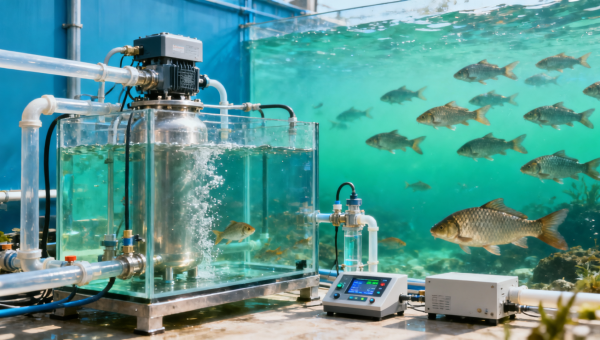
In modern aquaculture, ozone can improve water clarity and pathogen control—but too much quickly becomes a risk to stock health, equipment, and compliance. For buyers and operators evaluating ozone generators for aquaculture alongside water quality online monitor aquaculture systems, understanding safe dosage thresholds is essential. This article examines how to balance disinfection efficiency, oxygen demand, and operational safety in commercial fish farming environments.
The short answer is this: in aquaculture, ozone becomes “too much” when residual ozone reaches the culture water or fish contact zone at levels that irritate gills, suppress feeding, increase stress, damage biofiltration, or create compliance and safety problems. In most commercial systems, the practical goal is not to maximize ozone, but to apply enough in a controlled side-stream or contact loop to improve water quality while keeping residuals at or near zero before water returns to stock tanks.
For most readers evaluating system design, operations, or procurement, the key question is not just “what dose is safe?” but “how do we control ozone so it delivers measurable water treatment benefits without creating hidden biological or equipment risk?” That is the decision point that matters in hatcheries, RAS facilities, shrimp farms, and intensive fish production systems.
What “too much ozone” actually means in aquaculture operations
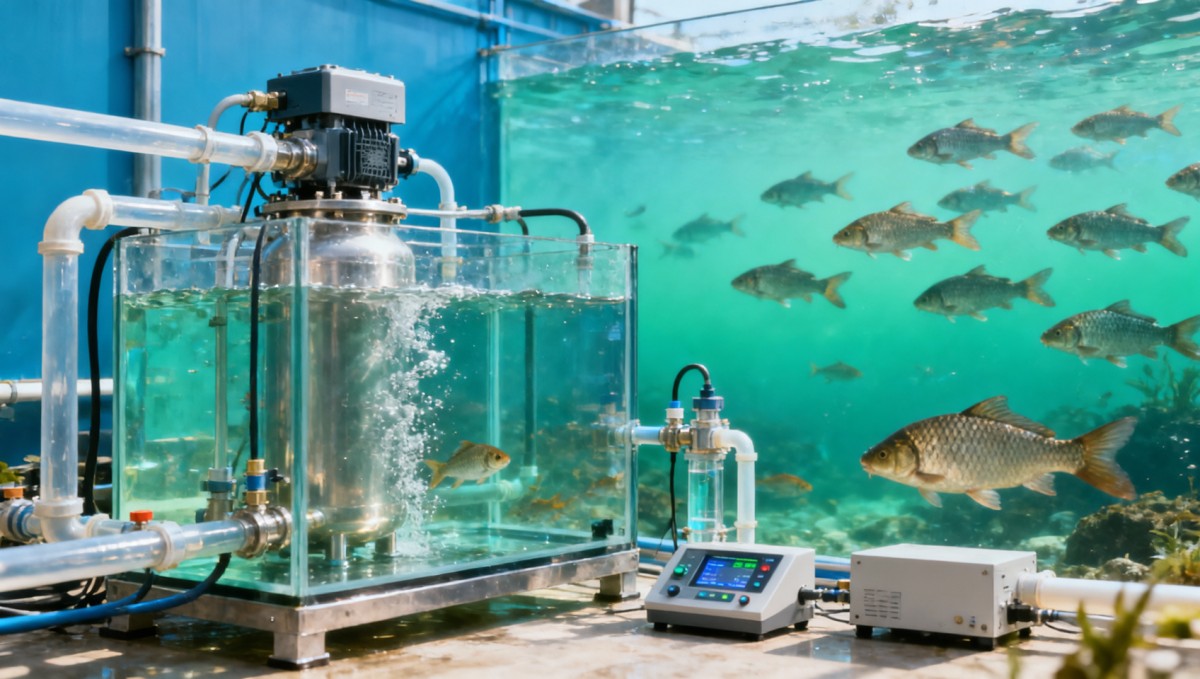
Ozone is a powerful oxidant. That is exactly why it is useful: it can reduce dissolved and fine suspended organics, improve water clarity, lower color, reduce some microbial loads, and improve protein skimmer performance in recirculating systems. But that same oxidation power is also why overdosing is dangerous.
In practical aquaculture terms, ozone is “too much” when one or more of the following happens:
- Residual ozone or harmful oxidation byproducts reach fish or shrimp holding areas.
- Oxidation-reduction potential (ORP) rises beyond the species- and system-appropriate control window.
- Fish show stress signs such as rapid ventilation, flashing, reduced feeding, crowding near inflow, or unexplained mortality.
- Biofilter performance declines because nitrifying bacteria are exposed to excessive oxidizing conditions.
- Rubber, seals, diffusers, sensors, and plastics degrade prematurely.
- Worker exposure risk increases from ozone gas release in enclosed plant areas.
Because ozone demand differs from one system to another, there is no universal “safe mg/L” number that applies across all farms. A heavily loaded recirculating aquaculture system with high dissolved organic carbon will consume ozone differently than a cleaner hatchery loop. Water salinity, bromide content, pH, temperature, contact time, and degassing efficiency all affect the real residual risk.
The thresholds operators and buyers should focus on
Most aquaculture teams do not manage ozone safely by relying on generator output alone. They manage it through process indicators and residual control. The most useful thresholds typically include the following:
- Residual ozone at fish exposure points: ideally non-detectable or near zero before return to culture tanks.
- ORP in treatment loop and culture water: monitored continuously rather than assumed from generator capacity.
- Contact tank retention time: enough for oxidation and decay before water re-enters production zones.
- Off-gas management: destruct units and ventilation to prevent worker exposure.
- Species sensitivity: salmonids, marine larvae, shrimp, and juvenile fish may have different tolerances and response patterns.
In many systems, ORP is used as the main operational control signal. While exact setpoints vary by species and design, operators generally treat high ORP as a warning that oxidant exposure risk is rising, especially if instrumentation calibration is poor or if the probe is installed in the wrong place. ORP is useful, but it is not a substitute for understanding where ozone is injected, where it reacts, and whether any residual survives into fish tanks.
For procurement and technical evaluation teams, this means the better question is not “How large is the ozone generator?” but “How does the system prevent overdosing under variable organic load?” A high-capacity generator without reliable feedback control, off-gas destruction, degassing, and interlocks may create more risk than value.
Why overdosing happens even in professionally designed systems
Excess ozone is often not caused by careless operation alone. It can also result from system mismatch. Common causes include:
- Generator output sized for peak disinfection claims rather than real water demand.
- Poorly placed injection and contact chambers.
- Insufficient degassing before treated water returns to culture tanks.
- Online monitoring gaps or poorly calibrated ORP and dissolved ozone instruments.
- Changes in feed load, biomass, temperature, or suspended solids that alter ozone demand.
- Operators increasing dose to fix water clarity without checking biofilter and stock response.
This is why ozone should be treated as a controlled process, not as a simple add-on sterilization tool. In a commercial farm, performance changes daily. If the control logic does not respond to that variability, a previously acceptable dose can become excessive very quickly.
How to judge whether your ozone dose is safe and useful
For operators, engineers, and quality managers, the best evaluation framework is straightforward: confirm that ozone is improving water quality indicators without causing biological stress or residual carryover.
Useful indicators to review together include:
- Water clarity and color improvement
- Reduced fine solids and better foam fractionation efficiency
- Stable ammonia and nitrite conversion in the biofilter
- No measurable residual ozone in return water
- Stable feeding behavior and normal respiration in stock
- No unexplained increase in lesions, gill irritation, or mortality
- Acceptable ORP trend rather than repeated spikes
If water looks cleaner but animals are stressed, the dose or process design is wrong. If microbial control improves but nitrification weakens, ozone may be reaching the biofilter or destabilizing the biological treatment balance. If instrument readings are inconsistent, the monitoring architecture may be inadequate for safe control.
This is where a water quality online monitor aquaculture setup becomes commercially valuable. Integrated monitoring of ORP, dissolved oxygen, pH, temperature, and sometimes residual ozone allows the team to detect process drift early. For enterprise buyers, this reduces operational uncertainty and makes performance more auditable for internal quality and environmental review.
What buyers should look for when evaluating ozone generators for aquaculture
When comparing ozone generators for aquaculture, buyers should assess the entire treatment package, not only the generator core. A credible solution should include:
- Accurate output control: turndown capability for changing organic loads
- Reliable injection method: venturi, oxygen-fed system, or diffuser design matched to flow conditions
- Adequate contact chamber: for reaction time and mass transfer efficiency
- Degassing and ozone destruction: to remove residual gas safely
- Instrumentation integration: ORP, DO, flow, and alarm logic
- Material compatibility: ozone-resistant components such as selected stainless steel grades, PTFE, PVDF, and resistant elastomers where appropriate
- Safety interlocks: shutdown on high ORP, low flow, off-gas failure, or room ozone alarm
- Serviceability: access to cell maintenance, spare parts, and sensor calibration support
From a business standpoint, the right system should lower risk-adjusted operating cost, not just promise stronger oxidation. That means fewer disease events, better water reuse performance, lower solids burden, and improved production consistency without adding avoidable mortality or maintenance cost.
Common mistakes that lead to poor ROI or compliance risk
For business evaluators and decision-makers, ozone projects often underperform for predictable reasons:
- Buying based on nominal output capacity without reviewing actual hydraulic design
- Ignoring off-gas destruction and worker safety requirements
- Assuming ozone can replace all sanitation or biosecurity measures
- Failing to budget for online monitoring, calibration, and staff training
- Applying freshwater assumptions directly to marine systems where bromide chemistry matters
- Overlooking local environmental, occupational, or discharge compliance obligations
These mistakes matter because ozone is not just a treatment technology; it is also a safety-managed oxidant. A poorly controlled system can create hidden liabilities in fish welfare, worker exposure, documentation, and equipment life.
A practical rule: optimize for zero harmful residual, not maximum oxidation
The most useful operating principle in aquaculture is simple: apply enough ozone to achieve water treatment benefits in a controlled loop, then ensure the oxidant is consumed or stripped out before the water returns to stock.
That approach supports both technical and commercial goals:
- Better water quality without direct stock exposure
- Lower chance of gill damage or stress-related performance loss
- More stable biofiltration
- More defensible SOPs for quality and safety teams
- Stronger basis for scaling the system across sites
For many commercial facilities, the safest answer to “how much ozone is too much?” is therefore operational rather than theoretical: it is too much whenever your monitoring and contact-loop design can no longer guarantee negligible residual entering the culture zone.
Conclusion
Ozone can be highly effective in aquaculture, but only when it is applied with control discipline. The real threshold of “too much” is reached long before obvious catastrophic failure; it starts when residual oxidant, excessive ORP, or unstable process control begins to threaten stock health, biofilter function, equipment integrity, or worker safety.
For operators, the priority is continuous monitoring, proper contact and degassing design, and species-aware control limits. For buyers and decision-makers, the priority is selecting ozone generators for aquaculture as part of a complete, monitorable treatment system rather than as a standalone output device. In commercial fish farming, the best ozone strategy is not the strongest one. It is the one that improves water quality consistently while keeping residual risk near zero.
Related Intelligence
- Aeration & Water TechFDA Updates Cybersecurity Guidance for Aeration & Water Tech DevicesFDA’s new cybersecurity guidance for aeration & water tech devices mandates immediate compliance—secure firmware, audit logs & password controls required for U.S. market access.
- Aeration & Water TechGlobal Alliances Hike Aeration & Water Tech Container Rates on Asia–Middle East RouteAeration & Water Tech container rates surge 18.5% on Asia–Middle East route—Maersk, CMA CGM & Hapag-Lloyd hike reefer/flat rack fees from 1 May 2026. Act now!
- Aeration & Water TechGlobal Shipping Alliances Hike Aeration & Water Tech Freight Rates on Asia–Middle East RoutesAeration & Water Tech freight rates surge 18% on Asia–Middle East routes as THE, Ocean & 2M Alliances align. Critical for RAS, aerators & water control exporters—act before May 1, 2026.
The Morning Broadsheet
Daily chemical briefings, market shifts, and peer-reviewed summaries delivered to your terminal.
