
Helium Price Up 35% MoM; Chinese Aeration Exporters Test Gas Substitutes
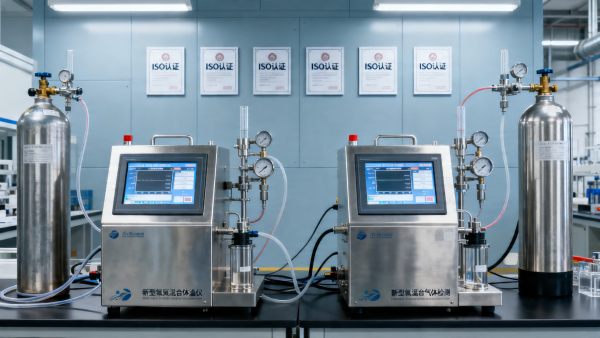
Helium prices for domestic tube-bundle supply in China rose over 35% month-on-month in April 2024, disrupting helium mass spectrometry leak testing in high-end aeration and water treatment equipment destined for export—particularly to the U.S. and EU markets. Manufacturers, exporters, and quality assurance teams in water tech, industrial gas-dependent instrumentation, and precision manufacturing sectors should monitor this closely.
Event Overview
In April 2024, the price of domestically supplied tube-bundle helium in China increased by more than 35% compared to March. This surge stems from overseas supply disruptions. As a result, Chinese exporters of aeration and water treatment equipment—which rely on helium mass spectrometry for final leak verification—have experienced delays and added complexity in quality control workflows prior to shipment. Multiple Chinese manufacturers have initiated joint validation trials with the Hefei Institutes of Physical Science, Chinese Academy of Sciences, focusing on nitrogen/argon gas mixture-based leak detection methods. Concurrently, efforts are underway to adopt ISO 10110-7 optical component cleanliness certification as an alternative compliance pathway for export deliveries.
Industries Affected
Direct Exporters of Aeration & Water Treatment Equipment
These companies face direct pressure on delivery timelines and certification validity. Helium mass spectrometry is widely specified in customer technical agreements—especially for U.S. and EU buyers requiring strict vacuum integrity verification. A shortage or cost spike in helium may trigger requalification requests, documentation gaps, or rejection at destination ports if alternative test protocols lack mutual recognition.
Manufacturers Relying on Helium-Based QA/QC Processes
Firms using helium leak testing across other precision-engineered products (e.g., sensors, valves, sealed enclosures) may encounter similar bottlenecks—not only in water tech but also in medical device assembly, semiconductor tooling, and vacuum system production. The impact extends beyond helium procurement to process validation, internal audit readiness, and third-party certification renewals.
Industrial Gas Procurement & Logistics Providers
Distributors and logistics partners handling specialty gases—including helium, argon, and nitrogen—must now assess blend compatibility, cylinder certification status, and regional availability of certified gas mixtures. ISO-compliant gas sourcing and traceable calibration records become critical when supporting clients’ transition to alternative leak test methods.
What Stakeholders Should Monitor and Do Now
Track official updates on helium allocation and import policy
While the current price surge is attributed to overseas supply disruption, no formal import restriction or quota change has been announced in China. Stakeholders should monitor announcements from the Ministry of Commerce and local market supervision bureaus—especially any guidance on priority allocation for export-critical industries.
Validate alternative test protocols against target-market requirements
ISO 10110-7 relates to optical element cleanliness—not leak integrity—and its use here appears to be part of a broader substitution strategy for helium-dependent steps. Companies should confirm whether nitrogen/argon mixture testing meets EN 13141-8 (ventilation systems), ASTM E499 (helium leak testing standards), or customer-specific acceptance criteria before deployment.
Document all process changes for audit readiness
Any shift from helium mass spectrometry to alternate gas-based detection must be formally recorded under ISO 9001 or IATF 16949 (where applicable). This includes method validation reports, equipment recalibration logs, operator training records, and comparative test data—especially if audits by EU Notified Bodies or U.S. FDA-registered auditors are scheduled.
Engage early with key customers on revised QC documentation
Proactive communication with U.S. and EU buyers about updated test methodology, supporting evidence, and timeline implications helps prevent shipment holds or contractual disputes. Where possible, align alternative certification pathways with existing quality annexes in supply agreements.
Editorial Observation / Industry Perspective
This development is best understood not as a one-off pricing anomaly, but as an early signal of growing vulnerability in globally distributed, helium-dependent quality assurance infrastructure. From industry perspective, helium’s role extends far beyond its use as a coolant or lifting gas—it functions as a de facto metrological standard in high-integrity leak detection. Analysis来看, the coordinated response among Chinese exporters and a national research institute suggests institutional recognition of systemic risk. Observation来看, adoption of mixed-gas alternatives remains in validation—not deployment—phase, meaning full operational substitution is not yet confirmed. Current more appropriate interpretation is that this reflects contingency planning, not established practice.
It is therefore more accurate to view this as a supply-chain resilience indicator than a completed technology pivot. Continued monitoring of both helium price stability and validation outcomes will determine whether this remains a short-term adaptation—or evolves into a longer-term recalibration of international QA norms.
Helium price volatility has historically triggered parallel innovation in leak detection (e.g., hydrogen tracer gas adoption in automotive), but cross-industry standardization lags behind technical feasibility. That gap is now coming into sharper focus for water tech exporters.
Conclusion
This event underscores how localized commodity price shifts—driven by global supply dynamics—can ripple through export-oriented manufacturing via highly specialized, standards-bound quality processes. It does not indicate a broad collapse in helium availability, nor a wholesale abandonment of helium-based testing. Rather, it signals heightened sensitivity in export-critical QA workflows and the emergence of coordinated, science-led mitigation strategies. For stakeholders, the current priority is verification—not assumption—and preparation—not reaction.
Information Sources
Main source: Publicly reported price data and manufacturer statements regarding April 2024 helium pricing and collaborative validation work with the Hefei Institutes of Physical Science, Chinese Academy of Sciences. Ongoing validation status and regulatory alignment with EU/U.S. standards remain under observation and are not yet confirmed.
Related Intelligence
- Aeration & Water TechHelium Price Up 35.2% MoM; Aeration Equipment Makers Test Ar/N2 SubstitutesHelium price up 35.2% MoM—Aeration equipment makers rush to validate Ar/N2 substitutes for CE/UL-compliant calibration in RAS & aquaculture systems.
- Aeration & Water TechWhy Some Deep Well Pumps Fail Long Before ExpectedSubmersible deep well pumps fail early when sizing, water quality, and controls are ignored. Learn how solar water pumps agricultural systems and agricultural diesel engines affect reliability.
- Aeration & Water TechSubmersible Deep Well Pumps and the Sand ProblemSubmersible deep well pumps in sandy wells: learn how solar water pumps agricultural systems and wholesale water pumps for farming compare, reduce wear, and improve irrigation reliability.
The Morning Broadsheet
Daily chemical briefings, market shifts, and peer-reviewed summaries delivered to your terminal.
