
Gaode Launches First Quadruped Robot, Open-Sources ABot-M0 for Aquaculture & Poultry
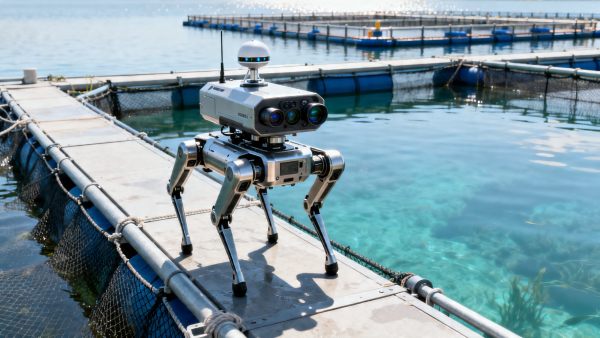
On April 14, 2026, Gaode Map announced the upcoming release of its first quadruped robot and the full open-sourcing of its embodied navigation and manipulation foundation model, ABot-M0 — with an 80.5% task success rate on Libero-Plus benchmarks. The development signals emerging operational readiness for autonomous inspection in commercial fishing and intelligent monitoring in poultry housing, drawing attention from equipment integrators, OEMs, and agri-tech service providers.
Event Overview
On April 14, 2026, Gaode Map confirmed it will soon launch its first quadruped robot and has fully open-sourced the embodied intelligence navigation model ABot-M0. Publicly reported performance shows an 80.5% success rate on the Libero-Plus benchmark. The model is already adapted to underwater sonar interfaces and multi-spectral vision modules for poultry housing environments. Chinese OEM manufacturers are currently developing commercially deployable hardware based on ABot-M0, targeting compliance with ISO 13849-1 functional safety standards.
Industries Affected by This Development
Commercial Fishing Equipment Integrators
Integrators deploying net-pen monitoring systems may face accelerated hardware refresh cycles as ABot-M0 enables new capabilities in underwater structural inspection and biofouling detection. Impact centers on integration timelines, interface standardization (e.g., sonar data ingestion), and validation requirements for marine-grade deployment.
Poultry Farming Technology Providers
Providers of farm management software or health-monitoring SaaS platforms may need to adapt APIs or data pipelines to ingest behavioral analytics derived from ABot-M0’s multi-spectral vision outputs. Impact includes compatibility testing, annotation schema alignment, and edge-compute resource planning for on-farm inference.
Industrial Robotics OEMs (China-based)
OEMs developing safety-certified mobile robots for agri-industrial use cases now have a validated, open-source perception-and-control base model to build upon. Impact lies in reduced R&D time for domain-specific navigation logic — but also introduces new responsibilities around safety certification documentation and real-world robustness validation.
What Relevant Enterprises or Practitioners Should Focus On Now
Monitor official technical documentation and API specifications for ABot-M0
The open-source release includes model weights and training configurations, but production deployment depends on verified interface protocols (e.g., ROS2 middleware support, sonar packet structure definitions). Enterprises should track Gaode’s GitHub repository and technical white papers for interface stability announcements.
Assess hardware-software co-design requirements for ISO 13849-1 compliance
While ABot-M0 provides the AI layer, achieving SIL 2/PL d per ISO 13849-1 requires joint validation of sensor fusion, emergency stop latency, and mechanical fail-safes. OEMs should initiate cross-functional reviews involving safety engineers, firmware teams, and third-party certification bodies early — not after prototype completion.
Distinguish between research-grade capability and field-deployable reliability
The 80.5% Libero-Plus score reflects controlled benchmark performance, not real-world uptime in humid, dusty, or saline environments. Operators evaluating pilot deployments should define KPIs beyond accuracy — including mean time between interventions (MTBI), thermal drift tolerance, and battery cycle degradation under load.
Prepare for sensor module interoperability evaluation
ABot-M0’s stated adaptations include underwater sonar and multi-spectral vision, but no public specification confirms supported vendors or communication protocols (e.g., CAN bus vs. Ethernet/IP). Integrators should inventory existing sensor inventories and draft compatibility test plans before committing to platform lock-in.
Editorial Perspective / Industry Observation
From an industry perspective, this announcement is best understood as a platform signal — not yet a market-ready solution. The open-sourcing of ABot-M0 lowers entry barriers for specialized robotics development in aquaculture and livestock operations, but widespread adoption hinges on two parallel tracks: OEM hardware certification progress, and domain-specific validation by end users. Analysis来看, the emphasis on ISO 13849-1 alignment suggests Gaode intends ABot-M0 to serve as a safety-aware foundation, not just a research model. Observation来看, the targeted adaptation to aquatic and avian environments — rather than generic warehouse or logistics use cases — reflects a strategic narrowing toward high-friction, labor-intensive verticals where ROI justification for autonomy is becoming more tangible. Current more appropriate interpretation is that this marks the start of a vendor-agnostic toolchain maturation phase, not the onset of immediate commercial substitution.
This development underscores a broader shift: embodied AI models are moving beyond lab benchmarks into domain-constrained, safety-relevant industrial contexts. Its significance lies less in near-term replacement of human tasks, and more in establishing standardized, auditable AI components for regulated physical operations. For now, it is more accurately viewed as an infrastructure milestone — one that invites scrutiny of implementation rigor, not just algorithmic novelty.
Information Sources:
• Official announcement by Gaode Map (April 14, 2026)
• Publicly released ABot-M0 model card and Libero-Plus benchmark results
• Statements regarding OEM development activity and ISO 13849-1 alignment
Note: Certification timelines, final hardware specifications, and field trial outcomes remain unconfirmed and require ongoing observation.
Related Intelligence
- Commercial FishingGaode Launches First Quadruped Robot, ABot-M0 Open-Source Model for Aquaculture & Poultry InspectionABot-M0: Gaode's open-source quadruped robot for aquaculture & poultry inspection—80.5% task success, field-tested in Brazil & Vietnam. Discover how it transforms autonomous farm inspections.
- Commercial FishingGaode Launches First Quadruped Robot, Open-Sources ABot-M0 for Aquaculture & PoultryGaode launches first quadruped robot & open-sources ABot-M0 — an embodied AI model for aquaculture and poultry automation, with 80.5% Libero-Plus task success.
- Commercial FishingWhy commercial fishing floats fail sooner in rough waterCommercial fishing floats fail faster in rough water due to impact, fatigue, and poor specs. Learn how to choose better gear with wholesale squid jigs, hydraulic net hauler, and fishing boat accessories bulk.
The Morning Broadsheet
Daily chemical briefings, market shifts, and peer-reviewed summaries delivered to your terminal.
