
Intel Launches World’s Thinnest GaN Chip for RAS Power Modules
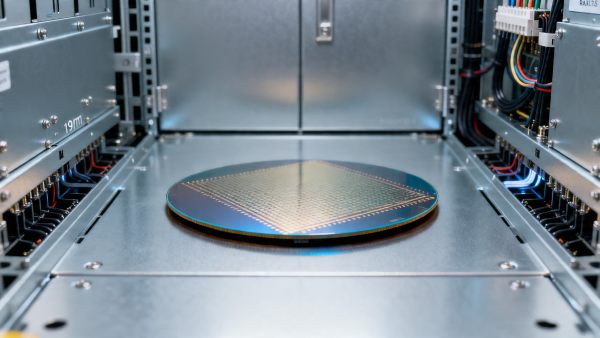
On April 14, 2026, Intel announced mass production of a 19μm-thin gallium nitride (GaN) power chip fabricated on 300mm wafers — the thinnest GaN chip globally to date. The device supports 78V high-voltage operation and 300GHz RF performance. This advancement directly impacts aquaculture technology providers, especially those deploying recirculating aquaculture systems (RAS), and signals accelerating upgrades in power electronics for export-oriented RAS infrastructure projects targeting North America and Northern Europe.
Event Overview
On April 14, 2026, Intel confirmed the start of volume production of its ultra-thin GaN power chip, measuring 19μm in thickness and manufactured on 300mm GaN wafers. The chip is rated for 78V operation and exhibits 300GHz射频 (RF) capability. Multiple Chinese RAS system manufacturers have initiated replacement programs for legacy power modules with new GaN-based units. The updated modules reduce energy consumption and thermal footprint in recirculating water systems. The technology complies with NSF/ANSI Standard 2 (U.S.) and CE-EMC (EU), enabling eligibility for tenders in high-end aquaculture infrastructure projects across North America and Northern Europe.
Industries Affected by This Development
Direct Exporters of RAS Systems
Exporters supplying complete RAS turnkey solutions to North American and EU markets are affected because GaN-powered modules now meet critical regulatory benchmarks (NSF/ANSI 2 and CE-EMC). Compliance reduces technical barriers in public-sector or certified-commercial bids, particularly where energy efficiency and compact footprint are evaluated in scoring criteria.
Power Electronics Module Integrators
Manufacturers integrating power modules into RAS control cabinets or pump drives face immediate component-level revision cycles. GaN’s higher switching frequency and lower conduction loss require redesigns of gate drivers, thermal management layouts, and EMI filtering — not just drop-in replacements.
Recirculating Aquaculture System OEMs
OEMs building skid-mounted or containerized RAS units must reassess mechanical packaging constraints. The reduced size and heat output of GaN modules allow denser system integration — but only if upstream supply chain partners can deliver certified, traceable modules with stable lead times.
Supply Chain & Certification Support Providers
Third-party testing labs, EMC compliance consultants, and logistics partners handling cross-border certification documentation (e.g., EU Declaration of Conformity, NSF listing coordination) will see increased demand for GaN-specific validation support — especially where legacy silicon carbide (SiC) or IGBT-based modules previously dominated submissions.
What Relevant Enterprises or Practitioners Should Monitor and Do Now
Track official module-level certification status from Intel’s manufacturing partners
Intel’s announcement references chip-level specs and standards alignment, but final module-level certifications (e.g., full NSF/ANSI 2 listing for a packaged AC–DC converter) depend on downstream integrators. Enterprises should monitor public listings from authorized module suppliers — not assume chip compliance equals system-level approval.
Assess compatibility with existing RAS control architecture before committing to full-scale rollout
GaN’s faster switching introduces new EMI challenges. Firms upgrading power stages must verify whether their current PLC communication buses, sensor signal conditioning, and grounding schemes remain robust — especially in stainless-steel, high-humidity RAS enclosures where parasitic coupling risks increase.
Confirm supply chain readiness for GaN-specific thermal interface materials and PCB fabrication
19μm-thin chips require precise die-attach processes and low-CTE substrates. Procurement teams should engage early with PCB fabricators and thermal pad suppliers to validate process compatibility — particularly for multilayer boards supporting high-frequency gate drive routing.
Prepare technical documentation packages aligned with NSF/ANSI 2 Annex D requirements
For U.S.-bound RAS projects, NSF/ANSI 2 requires detailed failure mode analysis, material traceability, and cleaning validation for all wetted components. Power modules — even if non-wetted — must be documented for electrical safety, thermal stability under continuous load, and fire resistance. Engineering teams should begin drafting these sections now using Intel’s published chip specifications as input.
Editorial Perspective / Industry Observation
From an industry perspective, this development is best understood not as an immediate product shift, but as a tightening of technical entry thresholds in premium RAS markets. The availability of a standardized, high-performance GaN chip lowers the barrier for qualified module makers — but does not eliminate system-level integration complexity. Analysis来看, adoption velocity will hinge less on chip performance and more on how quickly certified, drop-in-compatible modules reach volume production with stable pricing. Observation来看, the emphasis on NSF/ANSI 2 and CE-EMC suggests regulators — not just buyers — are beginning to treat power electronics as part of the food-safety-critical subsystem in land-based aquaculture. Current more relevant interpretation is that this marks the start of a component-level standardization cycle, not yet a wholesale technology transition.
In summary, Intel’s GaN chip release formalizes a new baseline for power density and regulatory readiness in export-grade RAS infrastructure. It does not replace engineering due diligence — rather, it redefines the minimum viable specification for competitive bidding in regulated aquaculture markets. For stakeholders, the priority remains verification at the module and system level, not assumption based on semiconductor-level announcements.
Information Source: Intel official announcement (April 14, 2026); public statements from Chinese RAS equipment manufacturers regarding GaN module integration timelines; NSF/ANSI Standard 2 (2024 edition); EU Commission Directive 2014/30/EU (EMC Directive). Note: Module-level certification status and commercial availability timelines beyond Intel’s chip shipment remain subject to ongoing verification.
Related Intelligence
- RAS SystemsIndia Removes Import Tariff on RAS Systems for AquacultureIndia removes import tariffs on RAS systems for aquaculture—unlocking $170M+ equipment demand. Key opportunity for exporters, technical documentation & after-sales providers.
- RAS SystemsLFP Battery Recycling Enters Deep Water: RAS & Feed Pellet Firms Tap Regenerated PhosphateLFP Battery Recycling breakthrough: Regenerated phosphate now powers RAS systems & feed pellets—EU/US-compliant, 20% cheaper, live since April 2026.
- RAS SystemsIntel Launches World’s Thinnest GaN Chip, Boosts RAS Power ModulesIntel's world’s thinnest GaN chip (19μm) boosts RAS power modules—40% smaller, 22% more efficient. Key for aquaculture exporters, equipment makers & supply chain partners.
The Morning Broadsheet
Daily chemical briefings, market shifts, and peer-reviewed summaries delivered to your terminal.
