
LFP Battery Recycling Enters Deep Water: RAS & Feed Pellet Firms Tap Regenerated Phosphate
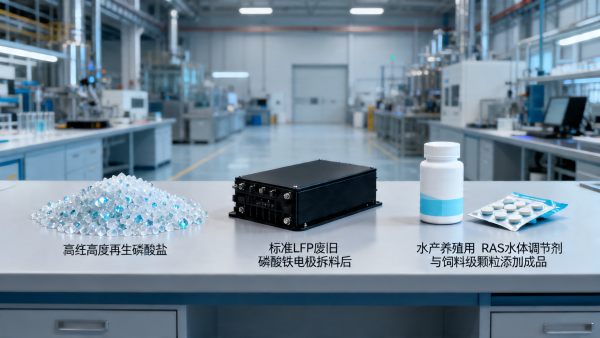
As China’s power battery recycling sector enters a critical phase of scale and standardization, high-purity regenerated phosphate from spent lithium iron phosphate (LFP) batteries has begun stable commercial supply to Recirculating Aquaculture Systems (RAS) water conditioners and commercial feed pellet manufacturers — starting April 2026. This development signals tangible cross-sector resource reuse, with implications for feed additives, aquaculture inputs, and circular material procurement industries.
Event Overview
Effective April 1, 2026,再生 materials enterprises in Guangdong and Hubei provinces began delivering high-purity regenerated phosphate — derived from retired LFP batteries — to RAS system water conditioner producers and commercial feed pellet manufacturers. The material meets EU REACH and US FDA requirements for feed additives and is priced 18–22% lower than virgin phosphate sourced from mined rock phosphate.
Industries Affected
Direct Trade Enterprises
Companies engaged in cross-border trade of feed-grade phosphates or aquaculture input chemicals may face shifting sourcing dynamics. Regenerated phosphate now offers a compliant, cost-advantaged alternative to traditional mineral-based suppliers — particularly for markets requiring strict regulatory alignment (e.g., EU, US).
Raw Material Procurement Teams
Purchasing units at feed pellet plants and RAS equipment integrators now have a new, verified feedstock option. Impact centers on procurement strategy: evaluating technical specifications (e.g., heavy metal limits, solubility profile), supply consistency, and documentation traceability — all distinct from conventional mineral phosphate procurement workflows.
Feed & Aquaculture Input Manufacturers
Formulators of commercial feed pellets and RAS water conditioners must assess compatibility of regenerated phosphate with existing product matrices. Regulatory compliance is confirmed (EU REACH, US FDA), but internal validation — including stability testing, nutrient bioavailability studies, and batch-to-batch performance consistency — remains the responsibility of end-product manufacturers.
Supply Chain Service Providers
Logistics, certification, and testing service providers supporting feed or aquaculture inputs may see demand shifts. For example, increased need for third-party verification of recycled content origin, battery-derived material chain-of-custody documentation, and feed-grade contaminant screening (e.g., Ni, Co, Mn residuals) — even where final product meets standards.
What Relevant Enterprises or Practitioners Should Monitor and Do Now
Track official classification updates for battery-derived feed ingredients
While current supply meets EU REACH and US FDA feed additive criteria, formal inclusion in national feed ingredient catalogs (e.g., China’s Feed Ingredient Directory) remains pending. Monitoring announcements from MARNR (Ministry of Agriculture and Rural Affairs of China) and provincial feed management offices is advisable.
Assess technical integration requirements for specific applications
Regenerated phosphate is not functionally identical to rock phosphate across all use cases. Feed pellet producers should verify particle size distribution, moisture sensitivity, and chelation behavior; RAS conditioner formulators should test pH buffering capacity and dissolution kinetics under recirculating conditions — before scaling trials.
Distinguish between policy signal and operational readiness
This is an early-stage commercial supply event — not yet a broad market shift. Current volume is limited to select enterprises in Guangdong and Hubei. Companies should treat this as a pilot-phase opportunity, not an immediate wholesale substitution trigger. Prioritize due diligence over procurement acceleration.
Prepare documentation and communication protocols for downstream customers
If adopting regenerated phosphate, feed or RAS firms may face customer inquiries about origin, sustainability claims, and regulatory status. Preparing transparent, audit-ready documentation — including material safety data sheets (MSDS), test reports, and origin certificates — supports credibility and avoids misrepresentation risks.
Editorial Perspective / Industry Observation
From industry perspective, this development is better understood as a milestone in functional validation — not yet a systemic market transformation. It confirms that battery recycling outputs can meet stringent, non-automotive end-use standards, which expands the economic rationale for LFP-focused recycling infrastructure. However, scalability hinges on consistent feedstock availability (i.e., predictable LFP battery retirement flows), refining yield stability, and harmonized global regulatory recognition beyond current EU/US acceptances. Current supply remains geographically and operationally narrow; wider adoption will depend less on technical feasibility and more on traceability frameworks and commercial risk allocation across the value chain.
Analysis来看, this reflects growing maturity in China’s battery circular economy — but one still anchored in niche, high-compliance applications rather than commodity-scale substitution.
Observation来看, it signals increasing convergence between EV battery waste streams and regulated industrial input markets — a trend likely to accelerate only if parallel developments occur in collection logistics, sorting accuracy, and international regulatory alignment.
Current more appropriate interpretation is that this is a validated pathway — not yet a dominant route — for LFP phosphorus recovery.
Conclusion
This April 2026 supply initiation marks the first confirmed commercial channel for battery-derived phosphate into regulated feed and aquaculture inputs. Its significance lies not in volume, but in precedent: it demonstrates technical and regulatory viability for a high-value, non-automotive reuse path. For industry, it warrants structured evaluation — not immediate adoption — and underscores that circularity gains increasingly depend on interoperability across energy, agriculture, and chemical regulatory domains.
Information Sources
Main source: Official supply commencement notice issued by participating再生 materials enterprises in Guangdong and Hubei (April 2026). No third-party verification reports or national policy documents cited. Ongoing observation required for feed ingredient catalog updates, export certification expansions, and regional scaling beyond current pilot zones.
Related Intelligence
- RAS SystemsLFP Battery Recycling Enters Deep Water: RAS & Feed Pellet Firms Tap Regenerated PhosphateLFP Battery Recycling breakthrough: Regenerated phosphate now powers RAS systems & feed pellets—EU/US-compliant, 20% cheaper, live since April 2026.
- RAS SystemsIntel Launches World’s Thinnest GaN Chip, Boosts RAS Power ModulesIntel's world’s thinnest GaN chip (19μm) boosts RAS power modules—40% smaller, 22% more efficient. Key for aquaculture exporters, equipment makers & supply chain partners.
- RAS SystemsIntel Launches World’s Thinnest GaN Chip for RAS Power ModulesIntel's world's thinnest GaN chip (19μm) powers next-gen RAS modules—enabling 78V operation, 300GHz RF performance, and NSF/ANSI 2 & CE-EMC compliance for North America and Northern Europe.
The Morning Broadsheet
Daily chemical briefings, market shifts, and peer-reviewed summaries delivered to your terminal.
