
Squid peeling machine results vary more than expected
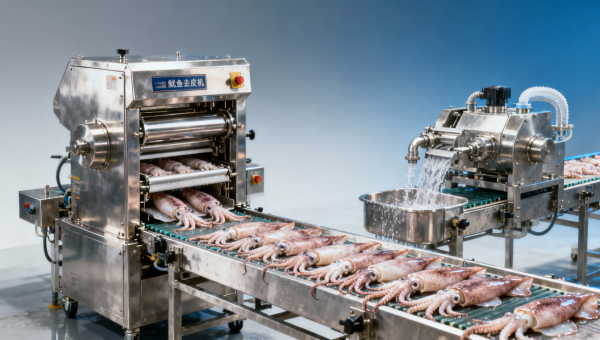
In the fish processing machinery sector, squid peeling machine performance often varies more than buyers expect, affecting yield, hygiene, and labor planning. For teams comparing a squid peeling machine with a fish skinning machine wholesale option, fish filleting machine commercial systems, or a commercial fish scaling machine, understanding the causes behind inconsistent results is essential before scaling procurement or line upgrades.
For processors, engineering managers, procurement teams, and quality supervisors, the issue is rarely the machine alone. Peeling consistency depends on raw material condition, operator settings, line integration, sanitation discipline, and whether the selected equipment matches species size and throughput targets. A unit rated for 200–300 kg/hour may underperform sharply if squid size distribution is wide or if pre-chilling is unstable.
This matters in B2B purchasing because small variations can create large downstream costs. A 3% to 8% drop in usable yield, 15–20 minutes of extra cleaning per shift, or a higher membrane residue rate can affect labor allocation, customer acceptance, and total cost per processed kilogram. For commercial buyers, the right question is not only “What is the machine price?” but also “Under what operating conditions does it keep results stable?”
Why squid peeling machine output changes from plant to plant
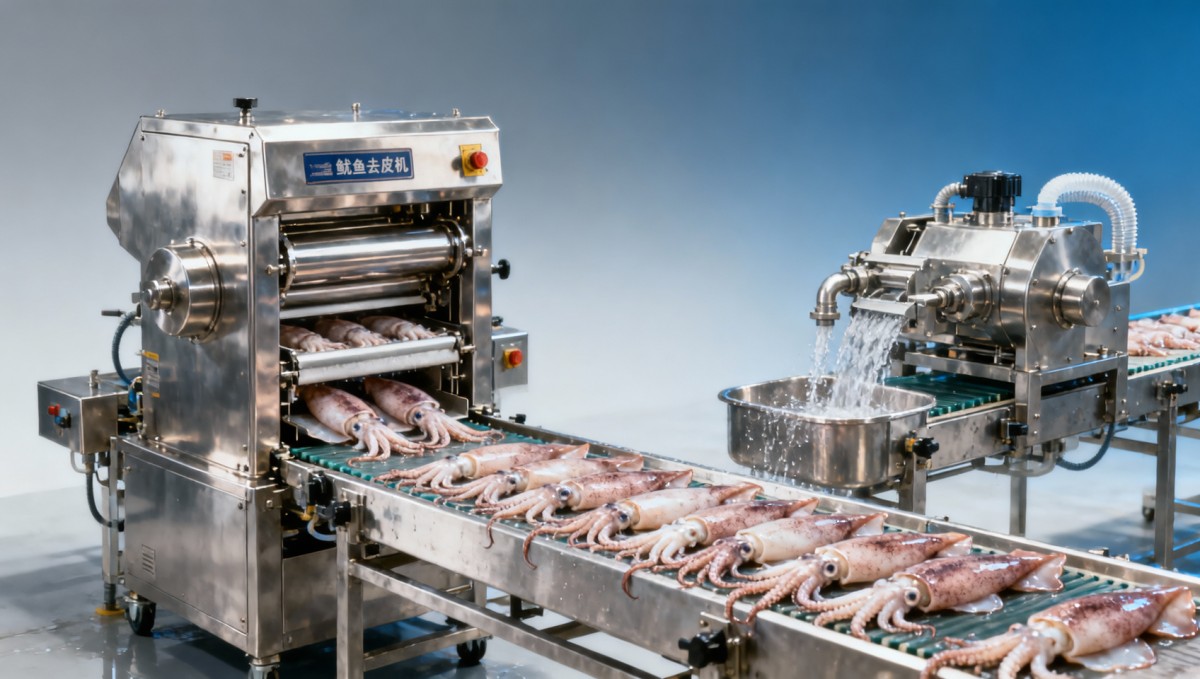
A squid peeling machine works on biological raw material, not on perfectly uniform industrial stock. That single fact explains much of the performance variation. Squid from different waters, seasons, and sizes can have different skin adhesion, body firmness, and moisture loss. Even when two factories buy similar models, one may process fresh chilled raw material at 0–4°C while another handles partially thawed stock at 6–10°C, leading to different peeling rates.
Mechanical configuration also matters. Roller pressure, brush hardness, water spray volume, conveyor speed, and feed orientation can change results significantly. In some plants, a line is tuned for medium squid in a 120–180 mm body length range. Once mixed lots enter the line, under-peeling and flesh damage often rise together. This is why technical evaluation should include product size distribution, not only motor power or machine footprint.
Another common cause is upstream inconsistency. If sorting, washing, or thawing is poorly controlled, the peeling step carries the burden. A squid peeling machine can only perform steadily when the incoming material is reasonably standardized. Plants that skip pre-sorting may save 1 labor step, but often lose much more in rework, quality complaints, and slower line balancing.
The table below summarizes the most frequent variables affecting result stability during commercial operation.
The key conclusion is practical: variation is usually multivariable. Buyers who evaluate only nominal capacity, such as 300 kg/hour versus 500 kg/hour, often miss the operational factors that determine whether the squid peeling machine will deliver repeatable output in a real processing environment.
Operational signs that inconsistency is becoming expensive
When peeling results fluctuate, the warning signs are visible across the line. Operators may need extra trimming after the machine, QA staff may report uneven surface appearance, and project managers may notice batch-by-batch cycle changes. If post-peeling manual correction exceeds 10–15% of total lot volume, the line is no longer operating efficiently.
- Residue rates rising above the plant’s internal tolerance, such as 3% to 5% by visual sampling.
- Hourly throughput falling below 80% of the machine’s tested operating target.
- Water use and cleaning time increasing because skin debris accumulates in contact zones.
- More operator intervention needed to adjust pressure, speed, or feed position during each shift.
How to compare squid peeling equipment with adjacent fish processing machines
Many buyers do not evaluate a squid peeling machine in isolation. They compare it with a fish skinning machine wholesale option, fish filleting machine commercial lines, or a commercial fish scaling machine because they are planning a broader seafood processing upgrade. That comparison is useful, but it should focus on process logic rather than appearance or vendor packaging.
These machines solve different biological and mechanical tasks. Fish skinning equipment usually separates skin from fillet surfaces with controlled tension and blade contact. A fish filleting machine commercial system prioritizes cut geometry and bone alignment. A commercial fish scaling machine removes external scales through abrasion or impact. Squid peeling sits closer to delicate membrane removal, where the tolerance for tissue damage can be narrower.
For procurement teams, this means benchmark criteria must change by application. Looking only at stainless steel grade, installed power, or footprint does not give enough insight. The more relevant questions include whether the equipment tolerates variable raw material, how long changeover takes, and how much manual correction remains after automated processing.
The following comparison helps technical and commercial reviewers align machine type with process expectation.
The comparison shows why substitution is rarely straightforward. A squid peeling machine should be assessed on gentle handling and repeatable membrane removal, not on criteria designed for fish filleting or scaling. Mixed-category comparison is useful only when line planners clearly define the end product specification and labor model.
What distributors and project teams should ask suppliers
Distributors, agents, and engineering teams should request test conditions in detail. A capacity claim without raw material description has limited value. A more reliable supplier discussion includes feed state, squid size range, skin residue target, washdown design, spare part life, and recommended operator count per shift.
- Ask what size range the machine handles without reconfiguration, for example 80–120 g or 120–180 g units.
- Confirm whether the stated throughput was tested on fresh chilled, thawed, or mixed-condition squid.
- Request cleaning and changeover time, such as 15–25 minutes for routine washdown or 30–45 minutes for deeper sanitation.
- Check whether post-peeling inspection still requires 1, 2, or more operators per line segment.
Key selection criteria for procurement, QA, and technical evaluation
A sound purchasing decision balances capacity, hygiene, durability, and process fit. In many seafood plants, the best-performing squid peeling machine is not the largest one. A medium-capacity unit that runs steadily at 250–350 kg/hour with low rework may outperform a higher-rated machine that creates unstable results, labor bottlenecks, or sanitation complications.
Quality and safety teams should review product-contact materials, drainage design, removable components, and splash control. Equipment used in wet processing should support daily cleaning and predictable inspection. Even if the machine frame is corrosion-resistant, inaccessible contact zones can increase contamination risk. A 5-minute saving in production can be erased by 20 minutes of extra sanitation or repeated residue checks.
Financial approvers and business evaluators should also consider total operating cost across 12–36 months. Spare wear parts, brush or roller replacement intervals, water consumption, downtime during cleaning, and training requirements all influence payback. If a lower-price unit needs major wearable replacements every 4–6 months, the cost advantage may disappear quickly.
The checklist below can support a cross-functional review before quotation approval or pilot testing.
Core evaluation checklist
- Capacity fit: verify whether the machine’s practical working band matches your target, such as 200–400 kg/hour rather than relying on peak claims.
- Yield protection: ask for typical flesh loss range under stable conditions and define your plant’s acceptable threshold before testing.
- Sanitation design: inspect removable guards, drainage slope, and access to rollers, brushes, and feed channels.
- Operator dependency: determine whether stable results require a highly skilled operator or can be maintained after 1–3 days of training.
- Serviceability: check spare part lead time, recommended maintenance interval, and whether local support is available within 24–72 hours.
- Integration readiness: confirm compatibility with upstream washing, sizing, and downstream trimming or packing steps.
Pilot test targets worth defining in advance
Before accepting a machine trial, define measurable targets. These may include residue rate after one pass, product damage percentage, average throughput over a 60-minute continuous run, cleaning time after the test, and the number of manual touch-up actions required per 100 kg. Without these indicators, buyers risk making a decision based on a short demonstration rather than operational evidence.
For many B2B buyers, three acceptance layers work well: mechanical stability, hygienic cleanability, and economic feasibility. A machine that performs strongly on only one of these dimensions may still be the wrong commercial choice.
Implementation, maintenance, and the hidden reasons performance drifts over time
Even a well-chosen squid peeling machine can show declining performance after 3–9 months if maintenance discipline is weak. Wear on contact parts, changes in water pressure, loosened alignment, and inconsistent cleaning all affect output. In many plants, performance drift is gradual, so teams notice labor pressure before they identify the mechanical cause.
Implementation planning should include more than installation. Operators need clear settings for different squid sizes, cleaning teams need documented washdown steps, and QA staff need simple inspection points. If start-up relies on undocumented experience from one technician, repeatability becomes fragile when shifts change or staffing turns over.
For project managers, a practical launch sequence often runs in 5 stages: site preparation, dry installation check, wet commissioning, pilot production, and post-launch optimization. Depending on site readiness, this may take 7–21 days. Rushed deployment can create false conclusions about machine quality when the actual issue is poor integration or inadequate training.
The maintenance planning matrix below helps teams connect routine actions with operational risk.
The pattern is clear: stable results come from a managed system, not from one-time machine purchase alone. A commercial seafood operation that documents settings, cleaning, and wear checks can maintain more consistent peeling quality and reduce emergency interventions.
Common implementation mistakes
Plants often make three preventable mistakes. First, they skip raw material sorting and expect the machine to compensate. Second, they accept an aggressive setting to maximize first-day throughput, then discover higher damage rates over a full shift. Third, they treat maintenance as reactive instead of preventive. Each mistake can distort the perceived value of a squid peeling machine and create avoidable friction between operations and procurement.
FAQ for buyers, operators, and decision-makers
The following questions reflect common concerns from seafood processors, distributors, and evaluation teams reviewing equipment for line upgrades or new plant projects. They are especially relevant when comparing a squid peeling machine with other fish processing assets in a broader capital expenditure plan.
How should a buyer test a squid peeling machine before purchase?
Use your own raw material whenever possible and run the test for at least 45–60 minutes, not just a short demonstration. Include mixed-size product if that reflects real production. Record throughput, residue rate, product damage, operator intervention frequency, and cleaning time. A test that only shows peak speed is incomplete for procurement approval.
What processing environments are most likely to see unstable results?
Instability is more common where incoming squid varies widely in size, thaw control is inconsistent, and operators change settings frequently without standard work instructions. Plants with weak pre-sorting or limited sanitation access also see greater variance. In these cases, even a good squid peeling machine may deliver uneven outcomes until the surrounding process is tightened.
Is a higher-capacity model always better for industrial seafood lines?
Not necessarily. If your upstream washing or downstream trimming line handles only 250–300 kg/hour, a 500 kg/hour peeler may not improve actual output. Oversizing can increase capital cost, water use, and maintenance complexity. Capacity should be matched to the bottleneck and to the target finished product specification.
Which teams should be involved in the final decision?
A balanced decision usually requires at least 5 perspectives: operations, QA or safety, maintenance, procurement, and finance. For larger projects, project engineering and commercial management should also join. This avoids common mismatches where one department approves a machine that later creates sanitation or servicing problems for another.
Performance variation in a squid peeling machine is more predictable than it first appears when buyers examine the full process: raw material condition, machine settings, sanitation design, maintenance discipline, and line integration. The best equipment choice is the one that delivers stable yield, manageable cleaning time, and repeatable quality under your plant’s real operating conditions.
For AgriChem Chronicle readers evaluating seafood processing equipment as part of a wider industrial procurement strategy, a structured review can reduce technical risk and improve long-term cost control. If you are comparing squid peeling systems, fish skinning machine wholesale options, fish filleting machine commercial lines, or a commercial fish scaling machine, now is the time to request a tailored assessment, review operating parameters, and align procurement with production reality.
Contact us to discuss application details, obtain a customized equipment evaluation framework, or explore broader processing line solutions for aquaculture and fishery technology projects.
Related Intelligence
- Commercial FishingGaode Launches First Quadruped Robot, ABot-M0 Open-Source Model for Aquaculture & Poultry InspectionABot-M0: Gaode's open-source quadruped robot for aquaculture & poultry inspection—80.5% task success, field-tested in Brazil & Vietnam. Discover how it transforms autonomous farm inspections.
- Commercial FishingGaode Launches First Quadruped Robot, Open-Sources ABot-M0 for Aquaculture & PoultryGaode launches first quadruped robot & open-sources ABot-M0 — an embodied AI model for aquaculture and poultry automation, with 80.5% Libero-Plus task success.
- Commercial FishingFish Processing Machinery Upgrades That Cut ReworkFish processing machinery upgrades cut rework fast. Compare block ice machine for fishery, commercial ice flaker machine, squid peeling machine, and filleting solutions to boost yield.
The Morning Broadsheet
Daily chemical briefings, market shifts, and peer-reviewed summaries delivered to your terminal.
