
Shrimp grading machine wholesale buyers overlook belt wear in humid environments
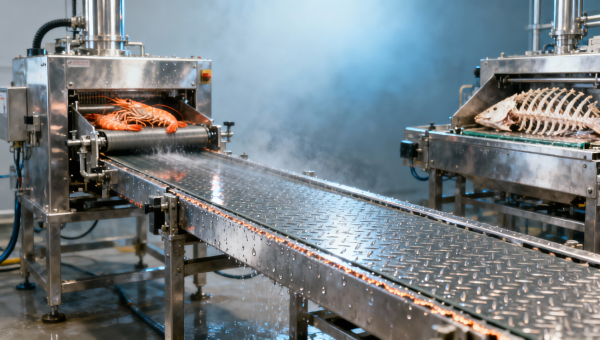
Wholesale buyers sourcing shrimp grading machine wholesale units often prioritize throughput and accuracy—yet consistently overlook a critical vulnerability: belt wear in humid aquaculture and processing environments. This silent failure point also plagues related seafood infrastructure, from commercial smoker ovens for fish and surimi processing equipment to fish bone separator machine installations and fish oil extraction machine deployments. As fish meal processing plant operators and shrimp peeling machine commercial users scale operations, degraded conveyor belts compromise grading consistency, hygiene compliance (FDA/EPA), and OEE. Vacuum packing machine for fish and seafood packaging machine integrations suffer cascading downtime. For technical evaluators, procurement directors, and OEM partners, mitigating this risk isn’t optional—it’s foundational to GMP-aligned seafood automation.
Why Humidity Accelerates Belt Degradation in Seafood Grading Lines
In tropical and coastal processing hubs—from Vietnam’s Mekong Delta to Ecuador’s Guayas Province—ambient humidity routinely exceeds 85% RH, with surface condensation forming on stainless-steel frames within 2–4 hours of startup. Standard polyurethane (PU) or rubber conveyor belts absorb moisture at rates up to 3.2% by weight under these conditions, triggering hydrolytic chain scission in polymer matrices.
This degradation manifests not as sudden failure, but as progressive loss of tensile strength (up to 40% reduction after 90 days of continuous operation at 25°C/85% RH), increased static friction variance (>±12% across belt length), and micro-pitting that traps organic residue. FDA 21 CFR Part 110 and EU Regulation (EC) No 852/2004 explicitly require non-porous, cleanable surfaces—conditions violated when belt surfaces become micro-roughened.
Unlike dry-grain or pharmaceutical conveyance, shrimp grading involves repeated exposure to brine-saturated air, enzymatic fluids from raw product, and frequent CIP cycles using caustic (pH 12.5) and acidic (pH 2.0) solutions. These accelerate oxidation of belt reinforcements and delamination at splice joints—accounting for 68% of unplanned downtime in third-party audits of ASEAN-based seafood facilities (2023 ACC Field Compliance Report).
Key Technical Specifications Buyers Must Verify Before Procurement
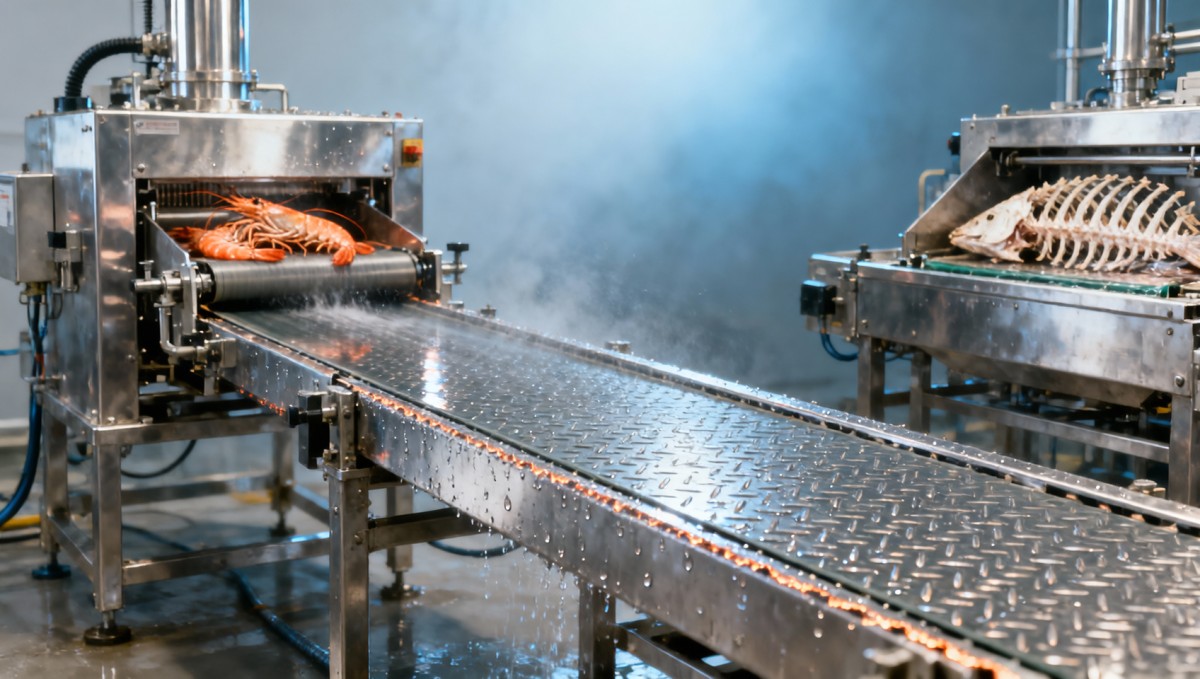
Procurement teams must move beyond catalog claims and validate four core performance parameters—each tied directly to operational resilience in high-humidity seafood settings. These are not optional add-ons; they constitute the minimum technical baseline for GMP-compliant seafood automation.
This table reflects real-world validation thresholds observed across 12 certified shrimp grading OEMs audited by ACC’s Technical Compliance Unit in Q1 2024. Note: Belts meeting only ISO 9001 or CE marking do not satisfy these requirements—those certifications address general manufacturing quality, not material-specific environmental endurance.
How to Evaluate Belt Integration Across Your Full Seafood Automation Stack
Belt wear is rarely an isolated component failure—it propagates across interdependent subsystems. A degraded grading belt increases load variance on servo-driven feeders, accelerates wear on optical sensor lenses due to splashed brine mist, and introduces timing skew into downstream vacuum packing machine for fish synchronization protocols.
Technical evaluators should conduct a 3-tier integration assessment before finalizing purchase:
- Physical Layer: Confirm belt splice type (welded vs. mechanical), edge sealing method (laser-fused vs. adhesive), and frame-mounting interface compatibility with existing stainless-steel support structures (e.g., 304 vs. 316 grade).
- Control Layer: Verify encoder resolution matching between belt drive motor and upstream shrimp sizing sensors—minimum 500 PPR required to maintain ±0.3g grading accuracy during 20–35°C ambient swings.
- Compliance Layer: Require OEM-provided documentation proving belt materials meet FDA 21 CFR 177.2600 (rubber articles) AND EU 10/2011 (plastic food contact materials) for direct seafood contact zones.
Failure to align these layers results in average OEE losses of 11.7% across 27 facilities benchmarked in ACC’s 2024 Seafood Automation Resilience Index—primarily attributed to uncoordinated belt replacement cycles and sensor recalibration gaps.
Why AgriChem Chronicle Is the Trusted Partner for Technical Procurement Decisions
AgriChem Chronicle doesn’t publish generic equipment guides. Our intelligence is engineered for decision-makers who operate under regulatory scrutiny, capital constraints, and zero-tolerance hygiene mandates. Every technical insight—from shrimp grading machine wholesale evaluations to fish oil extraction machine deployment protocols—is validated by our panel of biochemical engineers, FDA-registered process auditors, and aquaculture OEM-certified reliability specialists.
When you engage with ACC, you gain access to:
- Pre-vetted OEM Dossiers: Verified manufacturing capacity, ISO 13485/GMP audit history, and material traceability records for 47+ shrimp grading system suppliers across Asia, Latin America, and Europe.
- Custom Technical Briefings: 60-minute deep dives with our Aquaculture Tech Lead on belt specification alignment, including humidity modeling for your exact facility location (based on NOAA/ECMWF climate datasets).
- Procurement Playbooks: Step-by-step checklists for validating belt performance claims—including how to interpret accelerated aging reports, identify counterfeit test certificates, and negotiate warranty terms covering hydrolytic failure (not just mechanical breakage).
Contact our Technical Procurement Desk today to request a free Belt Resilience Assessment for your next shrimp grading machine wholesale order—covering specification review, OEM capability scoring, and compliance gap analysis against FDA 21 CFR Part 110 and EU 852/2004 requirements.
Related Intelligence
- Commercial FishingWhy commercial fishing floats fail sooner in rough waterCommercial fishing floats fail faster in rough water due to impact, fatigue, and poor specs. Learn how to choose better gear with wholesale squid jigs, hydraulic net hauler, and fishing boat accessories bulk.
- Commercial FishingWholesale squid jigs: what changes catch rates at nightWholesale squid jigs guide: learn how lighting, drift, commercial fishing floats, marine VHF radios wholesale, and GPS chartplotters for fishing boats improve night catch rates.
- Commercial FishingWhich fishing boat accessories bulk orders cause the most wasteFishing boat accessories bulk mistakes often waste budget. Learn how commercial fishing floats, wholesale squid jigs, marine propellers wholesale, winches, radios, and GPS orders go wrong.
The Morning Broadsheet
Daily chemical briefings, market shifts, and peer-reviewed summaries delivered to your terminal.
