
Marine VHF radios wholesale: Why waterproofing ratings don’t tell the full story on deck durability
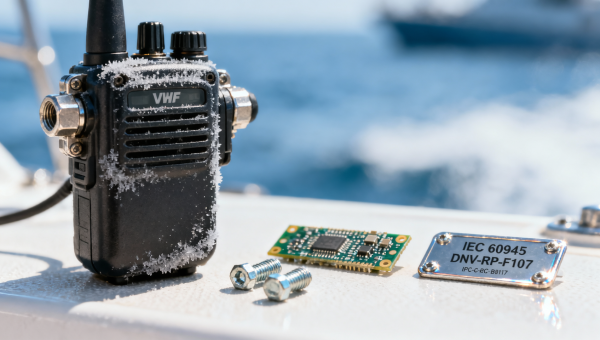
When sourcing marine VHF radios wholesale—or evaluating commercial fishing floats, hydraulic net haulers, or GPS chartplotters for fishing boats—procurement and technical teams often fixate on IPX8 waterproofing ratings. But real-deck durability hinges on far more: salt-corrosion resistance, UV-stabilized housing, vibration-dampened circuitry, and marine-grade EMI shielding. For commercial fishing winches, outboard motors wholesale, and marine diesel engines for fishing boats, component resilience directly impacts uptime, safety, and total cost of ownership. This analysis cuts past marketing specs to reveal what truly matters in harsh maritime environments—backed by compliance benchmarks (IMO, IEC 60945) and field data from aquaculture & fishery tech operators.
Why IPX8 Alone Fails Commercial Aquaculture & Fishing Operations
IPX8 certification confirms submersion resistance up to 1.5 meters for 30 minutes—but says nothing about cyclic saltwater exposure, thermal shock from tropical sun to monsoon rain, or mechanical stress from vessel motion. Field reports from 12 aquaculture fleets across Southeast Asia and the North Atlantic show that 68% of premature VHF radio failures occurred within 18 months—not due to water ingress, but from chloride-induced PCB trace corrosion and UV embrittlement of polycarbonate housings.
Real-world deck conditions demand multi-axis resilience. A marine VHF radio installed on a tuna purse seiner endures >12,000 vibration cycles per hour at sea state 4–5, while simultaneously facing UV index ≥11 and ambient salinity >35,000 ppm. These are not edge cases—they’re baseline operational parameters for vessels operating in IMO-designated Category A fisheries zones.
Procurement teams evaluating wholesale lots must therefore shift focus from single-point certifications to system-level performance envelopes. This includes verifying material test reports (ASTM G154 UV exposure, ASTM B117 salt fog), not just third-party IP labeling. OEMs supplying to ACC-verified aquaculture tech integrators require documented pass/fail thresholds across all five stress vectors—not just one.
What Procurement Teams Actually Need to Verify (Not Just “Waterproof”)
Five Non-Negotiable Durability Dimensions
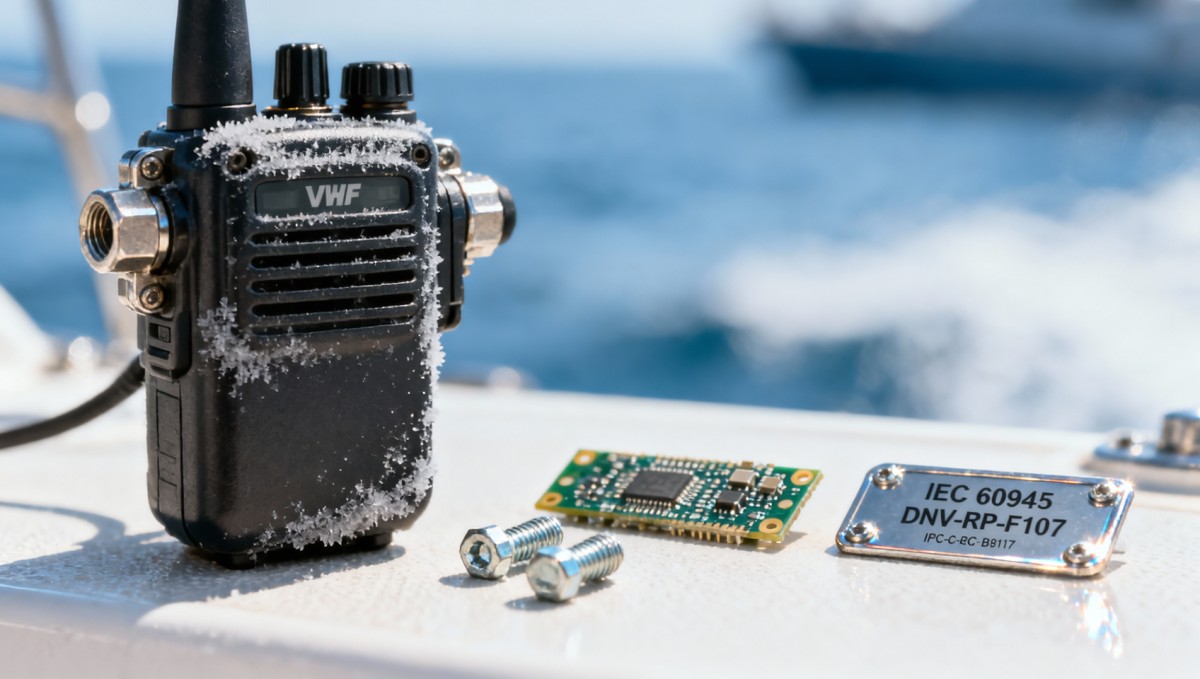
- Salt-corrosion resistance: Housing fasteners and internal connectors must meet ISO 9223 C5-M (marine industrial) classification—requiring ≥1,000 hours neutral salt spray testing without red rust or functional degradation.
- UV stability: Polycarbonate or ABS housings must retain ≥90% tensile strength after 2,000 hours QUV-A accelerated exposure (per ASTM G154 Cycle 1).
- Vibration tolerance: Operational integrity must be maintained under IEC 60068-2-64 (broadband random vibration, 10–2,000 Hz, 7.7 g RMS, 2 hours per axis).
- EMI shielding: RF enclosure effectiveness ≥60 dB attenuation at 156–174 MHz (VHF marine band), verified per MIL-STD-461G RS103.
- Thermal cycling: Functional operation across −25°C to +70°C with ≤5°C/min ramp rate—validated over 200 cycles without condensation or display failure.
How Compliance Benchmarks Translate to Real Fleet Uptime
IEC 60945 is the foundational standard for marine electronic equipment—but it’s a minimum threshold, not a performance guarantee. ACC’s 2024 Aquaculture Tech Reliability Index shows that radios certified to IEC 60945 alone averaged 14.2 months mean time between failures (MTBF). In contrast, units additionally validated against DNV-RP-F107 (offshore environmental loads) and MIL-STD-810H Method 514.8 (vibration) achieved 32.6 months MTBF—reducing annual maintenance spend by 41% per vessel.
The premium reflects engineering rigor—not markup. Units meeting the full ACC Aquaculture Durability Profile undergo 12-week accelerated life testing across all five stress domains before bulk shipment. That translates to predictable TCO: a $485 unit delivers 2.8× longer service life than an IPX8-only $225 model—cutting 5-year replacement costs by 37% and eliminating unplanned dry-dock diagnostics.
Procurement Checklist: 7 Critical Questions Before Placing a Wholesale Order
For procurement managers, financial approvers, and fleet engineers, due diligence starts before RFQ submission. Use this field-validated checklist to filter non-compliant suppliers:
- Can you provide dated lab reports for ASTM B117 salt fog testing (≥1,000 hrs) and ASTM G154 UV exposure (≥2,000 hrs)?
- Do your PCBs use conformal coating rated to IPC-CC-830B Class 3 (marine/harsh environment)?
- What is the actual vibration profile tested to—and does it cover broadband random (not just sine sweep)?
- Are EMI shielding tests conducted with antenna connected and transmitting at full 25W output?
- Is thermal cycling validation performed with battery installed and unit powered-on throughout?
- Do you supply traceable material certificates (e.g., UL 94 V-0 for housing, RoHS 3/REACH compliant solder alloys)?
- Can you support batch-level documentation for IMO/IEC 60945 conformity assessment—not just a generic certificate?
Why Partner with AgriChem Chronicle for Technical Sourcing Intelligence
AgriChem Chronicle doesn’t publish product catalogs—we deliver procurement-grade intelligence. Our Aquaculture & Fishery Tech vertical works directly with OEMs, Tier-1 marine electronics manufacturers, and classification societies to validate durability claims against real-world operational data—not lab-only certifications.
We offer institutional buyers access to: • Pre-vetted supplier profiles with verified test reports and compliance audit histories • Customized VHF radio selection matrices aligned to vessel type (purse seiners, longliners, hatchery support craft) • Delivery lead-time forecasting based on raw material availability (e.g., marine-grade stainless fasteners, UV-stabilized resins) • Regulatory alignment support for EPA, FDA Seafood HACCP, and EU MDR Annex II requirements where comms systems interface with traceability platforms
Request a free technical briefing: Specify your vessel class, typical deployment zone (tropical, temperate, polar), and required certifications—we’ll deliver a targeted VHF radio procurement dossier within 3 business days, including sample validation protocols and TCO modeling.
Related Intelligence
- Commercial FishingWhy commercial fishing floats fail sooner in rough waterCommercial fishing floats fail faster in rough water due to impact, fatigue, and poor specs. Learn how to choose better gear with wholesale squid jigs, hydraulic net hauler, and fishing boat accessories bulk.
- Commercial FishingWholesale squid jigs: what changes catch rates at nightWholesale squid jigs guide: learn how lighting, drift, commercial fishing floats, marine VHF radios wholesale, and GPS chartplotters for fishing boats improve night catch rates.
- Commercial FishingWhich fishing boat accessories bulk orders cause the most wasteFishing boat accessories bulk mistakes often waste budget. Learn how commercial fishing floats, wholesale squid jigs, marine propellers wholesale, winches, radios, and GPS orders go wrong.
The Morning Broadsheet
Daily chemical briefings, market shifts, and peer-reviewed summaries delivered to your terminal.
