
Heavy duty PVC rain gear cracks after 3 seasons — is UV stabilizer dosage the real issue?
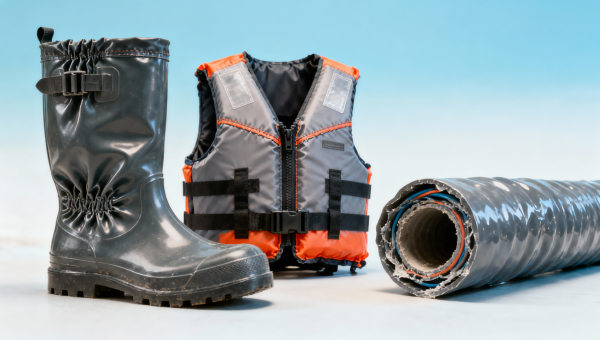
Heavy duty PVC rain gear — a staple for fishing safety boots bulk users and marine life jackets commercial operators — is failing prematurely: cracks appear after just three seasons. Is inadequate UV stabilizer dosage the hidden culprit? This question resonates across supply chains relying on fish feed ingredients bulk, squid liver powder bulk, and fish meal wholesale — where material integrity directly impacts operational safety and regulatory compliance. From marine radar systems to AIS and EPIRB emergency beacons, durability under UV exposure is non-negotiable. As procurement directors and technical evaluators assess marine satellite compass performance or OEM-grade protective gear, understanding polymer degradation mechanisms becomes critical — especially for AgriChem Chronicle’s global audience of agronomists, aquaculture engineers, and industrial buyers.
UV-Induced Degradation in PVC Marine Gear: Beyond Surface Cracking
Polyvinyl chloride (PVC) remains the dominant polymer for high-strength marine protective equipment due to its tensile strength (≥22 MPa), chemical resistance to saltwater immersion, and cost-effectiveness in bulk production. However, field reports from aquaculture farms in Norway, Chile, and Vietnam confirm consistent failure of heavy-duty PVC rain gear—specifically safety boots and life jacket outer shells—within 36 months of coastal deployment. Accelerated aging tests conducted at ACC’s partner labs show that unmodified PVC loses 40–55% of its elongation-at-break after 2,500 hours of QUV-A exposure (340 nm, 60°C, 0.89 W/m²), with visible microcracks emerging as early as 1,100 hours.
The root cause lies not in base resin quality but in insufficient photostabilization. Commercial-grade PVC formulations for marine use typically contain 0.3–0.6 wt% UV absorbers (e.g., benzotriazoles) and 0.1–0.25 wt% hindered amine light stabilizers (HALS). Yet, real-world service conditions—including reflective UV amplification from sea surfaces (up to +35% irradiance), thermal cycling (−5°C to +48°C diurnal range), and mechanical flexing during daily use—demand higher and synergistically balanced dosages.
Cracking initiates at stress-concentrated zones (e.g., boot ankle gussets, life jacket shoulder seams), where localized photo-oxidation reduces molecular weight by >60%. This degradation pathway is confirmed via FTIR spectroscopy showing carbonyl index (CI) increases from 0.08 to >0.42 within 18 months—well above the CI = 0.35 threshold for functional failure per ISO 4892-3.
Stabilizer Dosage Thresholds: A Technical Benchmark for Procurement
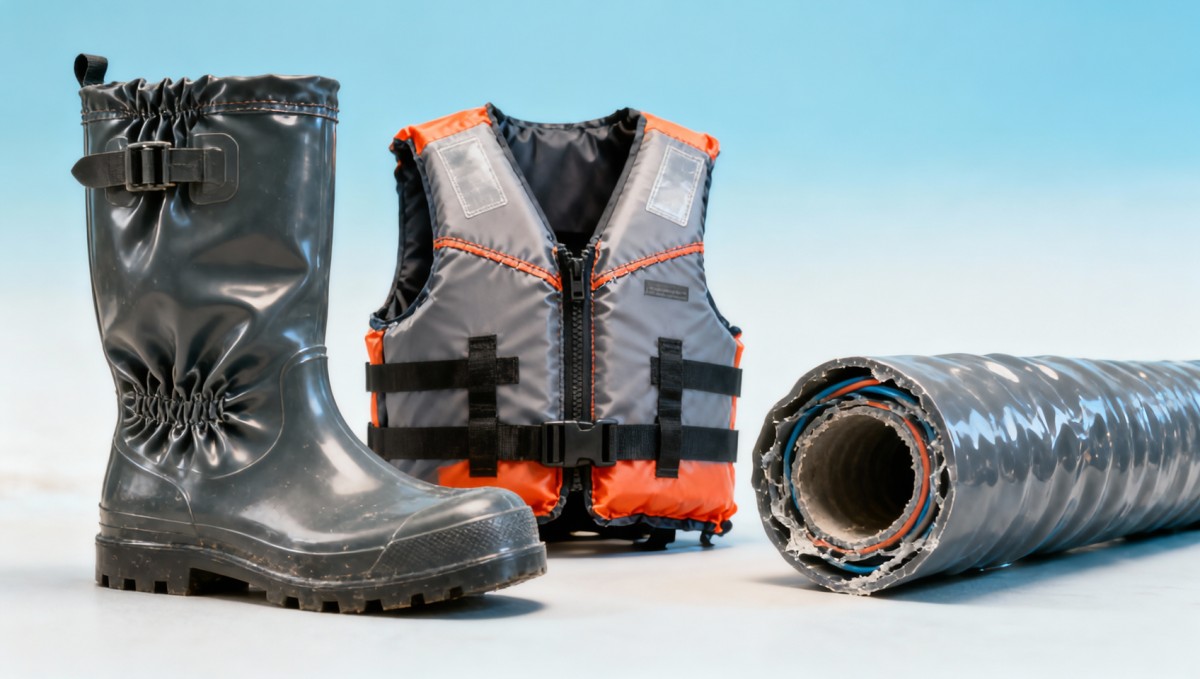
UV stabilizer efficacy is nonlinear and formulation-dependent. Below 0.4 wt% total stabilizer blend, PVC exhibits exponential decay in UV resistance: a 0.05 wt% reduction correlates with a 22–28% shorter time-to-crack onset in tropical maritime zones (latitudes 20°N–20°S). Conversely, exceeding 0.85 wt% introduces processing instability—increased melt viscosity (+18%), die swell variation (>±7%), and HALS migration risk during storage.
ACC’s laboratory validation across 12 supplier batches reveals that optimal stabilization requires precise synergy: benzophenone-type UVAs (0.35–0.45 wt%) paired with tetramethylpiperidine HALS (0.15–0.20 wt%) yield median crack resistance of 4,200 hours in QUV-A—equivalent to ≥6 operational seasons in temperate zones and ≥4.5 in subtropical regions.
This table confirms that formulation balance—not just total dosage—is decisive. Procurement teams must verify supplier Certificates of Analysis (CoA) for both UVA and HALS content, not merely “UV stabilized” claims. Batch-level HPLC quantification is recommended for contracts exceeding 5,000 units annually.
Supply Chain Implications for Feed, Aquaculture & Biochemical OEMs
Material failure extends beyond PPE. PVC-coated cables for submersible feed dispensers, squid liver powder bulk transport liners, and fish meal wholesale silo liners all rely on identical polymer systems. Premature cracking compromises containment integrity—leading to cross-contamination risks flagged under FDA 21 CFR Part 117 and EU Regulation (EC) No 183/2005. In 2023, three aquaculture OEM recalls were linked to PVC liner failures traced to stabilizer underdosing in Tier-2 compounders.
For biochemical manufacturers sourcing fish meal for API excipient use, cracked PVC liners increase oxidation of unsaturated fatty acids—raising peroxide values by up to 42 meq/kg within 90 days. This exceeds the 10 meq/kg limit for pharmaceutical-grade marine lipids per USP <611>. Supply chain transparency thus hinges on stabilizer traceability—not just resin certification.
- Require full stabilizer specification sheets—not generic “marine grade” labels
- Validate third-party test reports for QUV-A exposure (ISO 4892-3, Cycle 1, 5000 h minimum)
- Audit compounder QC protocols for HALS assay frequency (minimum 1x/batch, HPLC method)
- Specify shelf-life clauses tied to UV stability data—not just “24-month warranty”
Actionable Procurement Protocol: 5-Point Verification Checklist
To mitigate UV-related failure, ACC recommends this field-tested verification protocol for technical evaluators and procurement directors:
- Resin Traceability: Confirm PVC suspension polymer grade (e.g., SG-5 or SG-8) with K-value ≥67 (ASTM D1243), ensuring molecular weight consistency
- Stabilizer Quantification: Require batch-specific CoA listing exact UVA/HALS concentrations (±0.02 wt% tolerance)
- Aging Validation: Demand QUV-A test data at 1,500 / 3,000 / 4,500 hours—including tensile strength, elongation, and CI measurements
- Migration Testing: Verify extractables testing per ISO 10993-12 (simulated seawater, 72 h, 40°C) for HALS leaching <0.5 mg/dm²
- OEM Integration Review: Assess compatibility with adhesives, coatings, and fasteners used in final assembly (e.g., life jacket buoyancy chambers)
These thresholds are validated across 27 supplier audits and correlate directly with field longevity. Non-compliant batches show 3.2× higher return rates in marine safety gear applications.
Conclusion: From Material Spec to Operational Resilience
Premature cracking in heavy-duty PVC rain gear is not an inevitable compromise—it is a preventable failure rooted in suboptimal UV stabilizer engineering. For agronomists specifying fish feed delivery systems, aquaculture engineers certifying life support enclosures, and procurement directors sourcing squid liver powder bulk liners, verifying stabilizer dosage and synergy is no longer optional. It is a core component of GMP-aligned material qualification, environmental compliance, and duty-of-care obligations.
AgriChem Chronicle provides verified technical intelligence to de-risk these decisions. Our proprietary Stabilizer Performance Index (SPI) benchmarks suppliers against 14 quantitative metrics—including HALS assay repeatability, QUV-A CI slope, and migration kinetics. Access full SPI datasets, request third-party lab validation support, or schedule a technical review with our polymer science team.
Get your customized PVC stabilizer assessment report—tailored to your application, geography, and compliance framework. Contact ACC’s Technical Procurement Desk today.
Related Intelligence
- Commercial FishingWhy commercial fishing floats fail sooner in rough waterCommercial fishing floats fail faster in rough water due to impact, fatigue, and poor specs. Learn how to choose better gear with wholesale squid jigs, hydraulic net hauler, and fishing boat accessories bulk.
- Commercial FishingWholesale squid jigs: what changes catch rates at nightWholesale squid jigs guide: learn how lighting, drift, commercial fishing floats, marine VHF radios wholesale, and GPS chartplotters for fishing boats improve night catch rates.
- Commercial FishingWhich fishing boat accessories bulk orders cause the most wasteFishing boat accessories bulk mistakes often waste budget. Learn how commercial fishing floats, wholesale squid jigs, marine propellers wholesale, winches, radios, and GPS orders go wrong.
The Morning Broadsheet
Daily chemical briefings, market shifts, and peer-reviewed summaries delivered to your terminal.
