
Commercial fishing hooks bulk: what changes with hook material
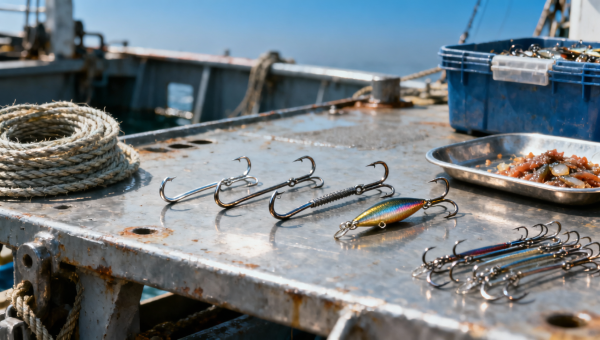
For buyers comparing commercial fishing hooks bulk options, hook material changes far more than corrosion resistance alone. It affects penetration, holding power, durability, species suitability, and total operating cost across longline fishing gear and broader fish processing machinery workflows. This guide explains how stainless steel, high-carbon steel, and coated alloys influence performance, helping procurement teams, operators, and technical evaluators make safer, more cost-effective fishery decisions.
In industrial fishery procurement, hook material should be treated as a performance variable, not a minor accessory detail. A hook that survives 3 to 6 months in one salinity profile may fail in 4 to 8 weeks in another, especially where gear is stored wet, exposed to bait acids, or cycled through high-volume deck handling. For longline operators, aquaculture harvest teams, distributors, and quality managers, the material decision directly affects replacement frequency, bycatch control, crew safety, and landed catch value.
The most common commercial fishing hooks bulk categories include stainless steel, high-carbon steel, and coated alloy hooks. Each option can perform well when matched to species, line design, soaking duration, and maintenance discipline. Problems typically arise when buyers focus only on unit price per 1,000 pieces instead of measuring penetration consistency, bend resistance, corrosion profile, and lifecycle cost across the full operating season.
Why Hook Material Changes Operational Performance
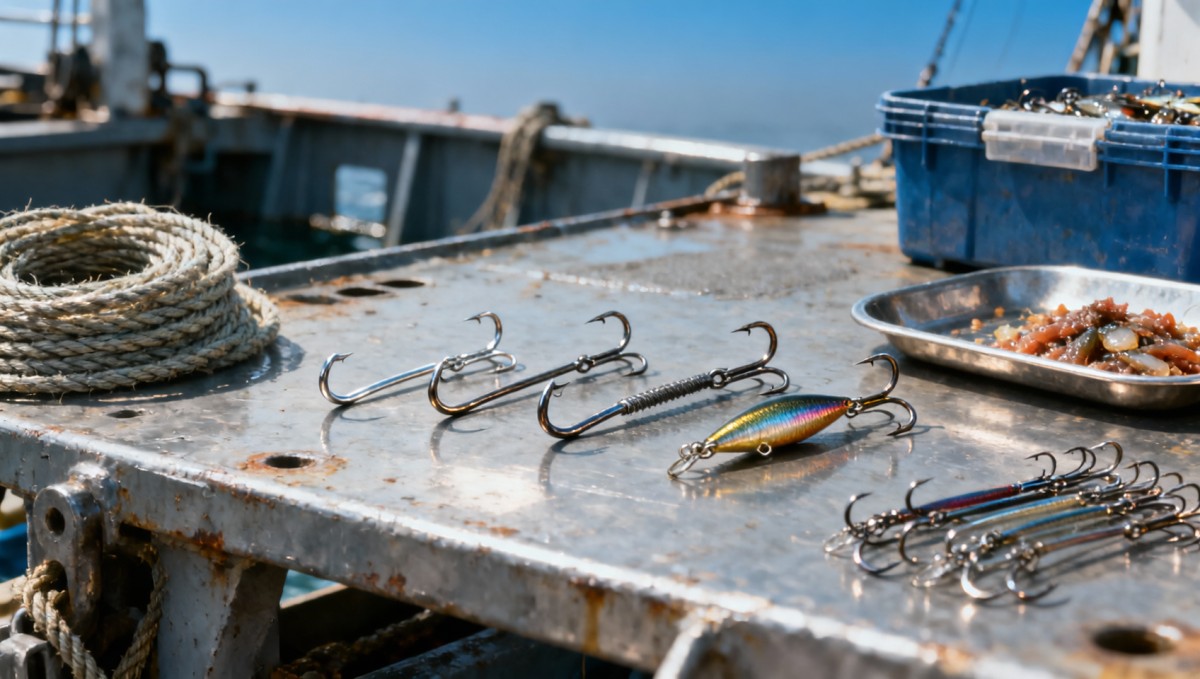
Hook material defines the balance between hardness, elasticity, point retention, and corrosion behavior. In practice, this means two hooks with the same size and shape can perform very differently in tuna, cod, grouper, or catfish operations. A harder material may keep a sharper point after 500 to 1,000 baiting and deployment contacts, while a softer material may resist brittle failure but deform under high drag loads.
For operators, penetration is often the first visible difference. High-carbon steel hooks usually deliver fast point entry because they can be heat-treated for aggressive sharpness. Stainless steel versions often trade some point aggressiveness for corrosion resistance and structural stability. In heavy commercial fishing hooks bulk orders, that trade-off matters because even a 2% to 4% drop in secure hook-ups can materially affect revenue over a 30-day fishing cycle.
Holding power also changes with material stiffness. If a hook opens by just 1 to 2 millimeters under load, retention on fast or twisting species can fall quickly. This is especially relevant in longline systems where soak times may range from 4 hours to 18 hours, and where multiple retrieval stresses occur before fish are landed. Material choice therefore influences both catch rate and hook recovery condition.
In processing-linked operations, material affects more than the catch event. Hooks that rust rapidly can stain bins, contaminate wet work surfaces, and increase sorting or discard time at unloading stations. For facilities that integrate harvest, chilling, grading, and fish processing machinery, reducing oxidation debris and damaged metal fragments is a practical quality-control measure, not just a gear preference.
Key performance variables buyers should compare
- Point retention after repeated contact with bait knives, trays, and deck surfaces over 1 to 3 shifts.
- Bend resistance under species-specific loads, especially where fish commonly exceed 10 kg, 25 kg, or 50 kg.
- Corrosion behavior in freshwater, brackish water, and high-salinity marine environments.
- Failure mode, including gradual opening, tip dulling, coating loss, or sudden breakage.
- Handling safety for crews working at high throughput, often 500 to 5,000 hooks per deployment cycle.
These variables should be measured against target species, bait type, and gear handling pattern. A procurement team choosing commercial fishing hooks bulk for a 12-month plan should always test material fit under actual deployment conditions rather than relying on generic catalog descriptions alone.
Comparing Stainless Steel, High-Carbon Steel, and Coated Alloys
The table below summarizes how the three main hook material categories typically behave in commercial use. These are practical industry ranges rather than fixed universal values, because actual performance depends on wire gauge, heat treatment, hook pattern, and operating environment.
For many commercial fishing hooks bulk programs, stainless steel is favored where corrosion losses are historically high, especially in ports with constant salt fog or where washdown is irregular. High-carbon steel remains attractive where fleets deploy and recover hooks quickly and can rotate inventory within 30 to 90 days. Coated alloys often fill the middle ground but require careful supplier qualification because coating thickness, adhesion, and cure consistency vary significantly.
How material affects total cost
A lower-priced hook is not always cheaper in operation. If one hook type costs 12% less at purchase but needs replacement 25% more often, the annual spend can rise once labor, downtime, emergency replenishment, and spoilage risk are included. This is especially true for fleets processing several tons of catch per shift, where lost time during re-rigging can disrupt both harvest scheduling and downstream chilling or filleting capacity.
Buyers should therefore compare commercial fishing hooks bulk options using a 4-part model: acquisition cost, average usable cycles, failure rate under target species load, and quality impact on landed fish. In many cases, the best choice is not the highest-grade metal, but the material that maintains stable performance through the actual handling environment of the vessel or processing unit.
A practical 5-point comparison checklist
- Request salt-exposure or wet-storage performance details for at least 72 to 240 hours.
- Confirm whether point sharpening is chemical, mechanical, or both.
- Ask for wire hardness and deformation tolerance under expected fish weight ranges.
- Inspect coating integrity after transport, because micro-chips often begin before first use.
- Test at least 2 to 3 hook materials in parallel during one operating cycle before scaling volume.
Selecting the Right Material for Species, Gear, and Workflow
Material selection should start with the fishery profile rather than the catalog page. A hook used for tuna longline gear has different stress patterns than one used in nearshore demersal lines or commercial aquaculture harvest support. Species that strike hard and run fast demand strong point retention and bend resistance. Species with softer mouths may need a sharper, finer point to reduce bounce-off during the first seconds of contact.
Gear configuration also matters. Snood length, line tension, hook spacing, bait type, and retrieval speed all influence how the material behaves. For example, a coated alloy hook may perform well on moderate-soak systems of 4 to 8 hours, yet show accelerated surface damage on high-friction hauling systems running repeated contact through guides and metal rollers. Procurement teams should align material trials with the actual mechanical path of the hook, not only water exposure.
In integrated fishery operations, hook material affects workflow continuity. If rusted or bent hooks must be removed manually before product enters washing, grading, or fish processing machinery zones, labor demand increases. In high-volume facilities, even an extra 10 to 15 seconds per damaged hook can add measurable inefficiency across 1,000 or more units handled in a shift.
Typical selection logic by operating condition
The table below helps technical evaluators and procurement managers link material choice to common commercial scenarios. It can be used as a first-stage screening tool before supplier sampling and field validation.
A useful rule is to match the hook material to the most damaging part of the cycle: storage, deployment, strike force, or retrieval abrasion. The wrong material may still look acceptable in warehouse inspection but fail during one of these stages. That is why commercial fishing hooks bulk evaluations should include both pre-use inspection and post-use damage review after at least 1 full deployment sequence.
Common buyer mistakes
- Choosing solely by price per carton without calculating cost per usable hook cycle.
- Testing hooks in clean water only, while actual use involves bait fluids, salt residue, and deck abrasion.
- Ignoring storage conditions such as humidity above 70% or open-air dock exposure.
- Assuming all coated hooks perform equally, despite major process differences between suppliers.
For distributors and agents, these mistakes can also create warranty disputes and inconsistent customer feedback. Clear material positioning by use case improves reorder confidence and reduces return risk across regional fishery markets.
Procurement, Quality Control, and Delivery Checks for Bulk Orders
Commercial fishing hooks bulk procurement should be managed as a controlled supply decision, especially when annual demand reaches tens of thousands or millions of pieces. Bulk hook performance depends not only on base material but also on batch stability, packaging method, anti-corrosion handling, and dimensional consistency. Small deviations in point angle, barb finish, or wire diameter can become expensive when multiplied across large fleet operations.
A typical B2B sourcing cycle has 5 stages: specification definition, sample validation, supplier audit, pilot order, and scaled contract release. Depending on geography and supplier responsiveness, this process may take 2 to 6 weeks for standard products and 6 to 10 weeks for customized configurations. Buyers under seasonal pressure should build buffer time for testing and incoming inspection instead of approving the first available lot.
Quality teams should establish acceptance criteria before purchase orders are released. Practical checks include visual corrosion status, point alignment, barb uniformity, wire gauge tolerance, coating adhesion, and random bend testing. Even a defect rate of 1.5% can create operational disruption if the hooks are intended for high-throughput longline sets or tightly scheduled harvest campaigns.
Recommended incoming inspection points
- Check packaging integrity and moisture exposure immediately upon arrival, especially after sea freight of 20 to 40 days.
- Inspect random samples from at least 3 cartons or 1% of the lot, whichever is greater.
- Review point sharpness consistency under magnification if hooks are used for high-value species.
- Verify that coating, if present, shows no flaking at bend zones or point transition areas.
- Separate hooks by batch for traceability if the inventory will be consumed over multiple months.
The table below converts these checks into a procurement-oriented control framework suitable for operators, project managers, and finance approvers who need a practical inspection logic.
This inspection discipline helps finance and procurement teams justify slightly higher unit pricing when it reduces hidden costs such as emergency repurchase, rejected catch, labor-intensive sorting, or process interruption. In commercial fishing hooks bulk sourcing, reliable consistency often creates more value than headline price discounts.
Maintenance, Storage, and FAQ for Long-Term Performance
Even the right hook material will underperform if storage and maintenance are neglected. Hooks kept in humid spaces, packed while wet, or mixed with corrosive residues will degrade faster regardless of whether they are stainless steel, high-carbon steel, or coated alloy. For many fleets and distributors, simple handling changes can extend usable life by 15% to 30% over a season.
Storage conditions should be controlled as closely as practical. Dry containers, separated batches, drainage after washdown, and routine visual checks every 7 to 14 days can prevent inventory loss. If hooks are pre-rigged, crews should inspect twist points and knot-contact zones because material wear often begins where metal meets line tension rather than at the hook point itself.
For sites linked to fish processing machinery or chilled product flow, damaged hooks should be removed upstream of handling belts and sorting tables. This protects product quality, reduces metal contamination risk, and supports safer workflow management for operators and quality personnel.
Maintenance actions that reduce replacement frequency
- Rinse and dry hooks before storage if exposed to salt residue or bait acids.
- Use separate bins for new, field-tested, and rejected hooks to avoid cross-mixing.
- Inspect points and bend zones after each deployment or at least every 1 to 2 shifts.
- Rotate older stock first, especially high-carbon steel inventory stored longer than 90 days.
- Record field failures by batch so future commercial fishing hooks bulk purchases can be refined.
Which hook material is best for long-term marine storage?
Stainless steel is usually the safest option for long-term marine storage, especially where inventory may remain in stock for 6 to 12 months or where dockside humidity is consistently high. However, buyers should still verify point quality and mechanical strength, because corrosion resistance alone does not guarantee the best catch performance.
Are coated alloy hooks a reliable middle option?
They can be, particularly for operations that need a balance between cost and corrosion protection. The key issue is coating quality. If adhesion is weak, the protective layer may fail early under abrasion, making performance less stable than expected. A pilot test of 2 to 4 weeks is advisable before committing to large annual volumes.
What should buyers request from suppliers before placing a bulk order?
At minimum, request material specification details, dimensional tolerances, sample availability, packaging method, batch traceability, and guidance on storage life. For high-volume commercial fishing hooks bulk projects, it is also useful to ask about typical lead time, such as 15 to 30 days for standard stock or 30 to 60 days for customized packs.
How should procurement teams make the final decision?
The best decision combines field data, quality inspection, and lifecycle cost review. Compare at least 3 dimensions: catch performance, replacement rate, and handling impact on downstream operations. If one material improves stability across all three, it will usually be the strongest commercial choice even if the initial carton price is higher.
Hook material changes the economics and reliability of commercial fishing far more than many buyers expect. Stainless steel, high-carbon steel, and coated alloys each have a valid place, but only when matched to species, gear stress, storage conditions, and operational workflow. For procurement teams, technical evaluators, distributors, and fishery managers, the most effective commercial fishing hooks bulk strategy is to test material fit in real conditions, control incoming quality, and measure cost over the full usage cycle rather than at purchase alone.
If you are reviewing hook specifications, comparing suppliers, or building a more dependable fishery equipment sourcing plan, now is the right time to request a tailored evaluation. Contact us to discuss your operating conditions, obtain a customized bulk hook selection framework, and explore more practical solutions for aquaculture and fishery technology procurement.
Related Intelligence
- Commercial FishingGaode Launches First Quadruped Robot, ABot-M0 Open-Source Model for Aquaculture & Poultry InspectionABot-M0: Gaode's open-source quadruped robot for aquaculture & poultry inspection—80.5% task success, field-tested in Brazil & Vietnam. Discover how it transforms autonomous farm inspections.
- Commercial FishingGaode Launches First Quadruped Robot, Open-Sources ABot-M0 for Aquaculture & PoultryGaode launches first quadruped robot & open-sources ABot-M0 — an embodied AI model for aquaculture and poultry automation, with 80.5% Libero-Plus task success.
- Commercial FishingLobster Creels Bulk Orders: Where Shipping Costs Get HiddenLobster creels bulk costs can hide in freight, packing, and compliance. Compare suppliers smarter across fish processing machinery, longline fishing gear, and block ice machine for fishery projects.
The Morning Broadsheet
Daily chemical briefings, market shifts, and peer-reviewed summaries delivered to your terminal.
