

The Authority in Global Agricultural Chemistry & Bio-Resources
Wholesale lawn mowers: where low pricing often hides repair costs
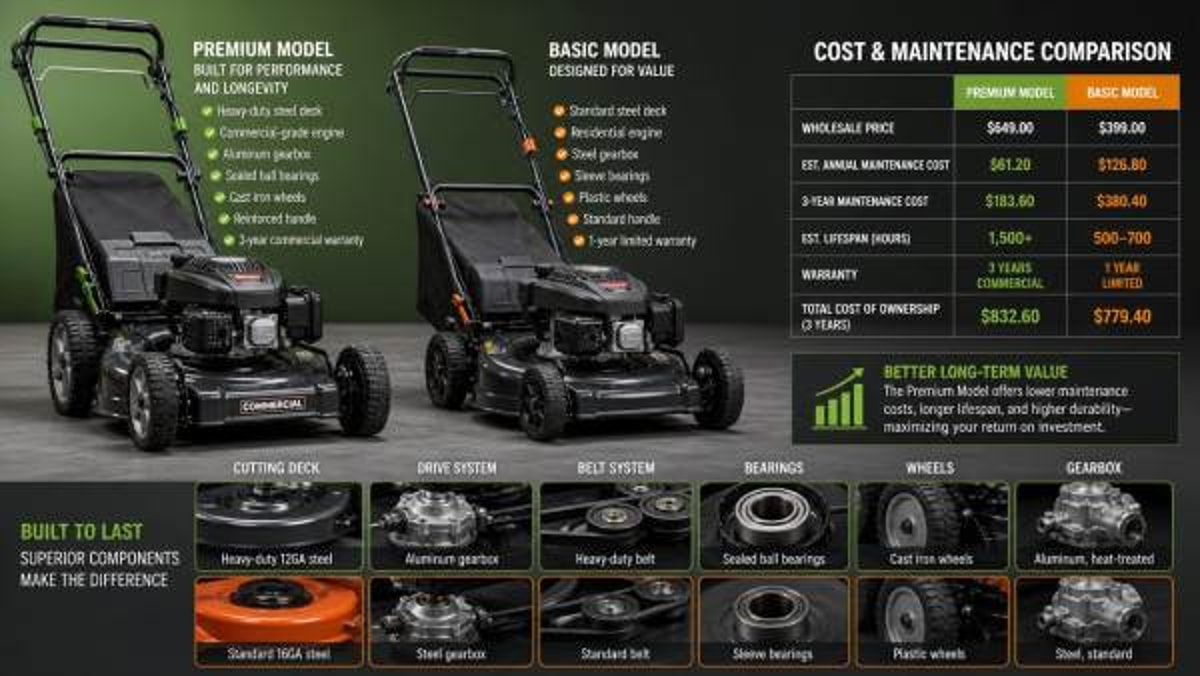
In the market for wholesale lawn mowers, the lowest upfront quote can mask a far higher total cost of ownership. For business evaluators comparing suppliers, hidden repair frequency, parts availability, warranty limits, and service downtime often determine whether a deal protects margins or creates recurring losses. This article examines where low pricing conceals risk and how to assess mower value with greater procurement precision.
Why do wholesale lawn mowers with very low prices attract so much attention?
Low-price offers gain traction because they simplify the first stage of procurement review. A buyer comparing multiple quotes for wholesale lawn mowers may see a double-digit percentage gap and assume the cheapest source creates immediate savings. In budget-controlled organizations, that first impression matters. It can improve apparent cost competitiveness, support short-term purchasing targets, and satisfy internal pressure to reduce capital expense.
However, business evaluators know that equipment pricing is rarely a complete signal of value. In commercial mowing fleets, ownership economics extend far beyond the invoice price. Frame durability, spindle quality, engine consistency, deck corrosion resistance, electrical system reliability, and transmission lifespan all affect how often a machine leaves service. A mower that costs less upfront but fails more frequently can produce a higher annual cost per operating hour than a better-built alternative.
That is why the conversation around wholesale lawn mowers should shift from “Which supplier is cheapest?” to “Which option preserves uptime, serviceability, and resale value?” For evaluators in landscaping contractors, municipal grounds operations, estate maintenance, and equipment distribution, hidden repair exposure is often the real differentiator.
What repair costs are most commonly hidden behind cheap wholesale lawn mowers?
The hidden costs usually appear in five places: early component failure, labor-intensive maintenance, spare parts delays, warranty exclusions, and operational downtime. Each category may seem manageable on its own, but together they can erase the savings promised by a low quote.
First, lower-grade components often fail sooner. Bearings, belts, pulleys, starter systems, blade hubs, and hydrostatic drives are common weak points in low-cost wholesale lawn mowers. If these parts are sourced to meet a price point rather than a service-life target, replacement cycles accelerate. Frequent failures are especially damaging in seasonal peak periods when mowing schedules are fixed and missed service windows create revenue loss or contract penalties.
Second, some machines are inexpensive partly because they are harder to maintain. Poor access to filters, belts, grease points, and deck assemblies increases technician time. Even if parts themselves are cheap, the labor cost rises. For fleet operators, one extra hour of service per mower per month materially changes the ownership model.
Third, parts availability is a major but underestimated risk. Some wholesale lawn mowers are imported under private labels with inconsistent stocking support. When a deck spindle or transmission component is unavailable for several weeks, the owner carries not only repair cost but also idle asset cost. The machine cannot generate value while waiting for basic parts.
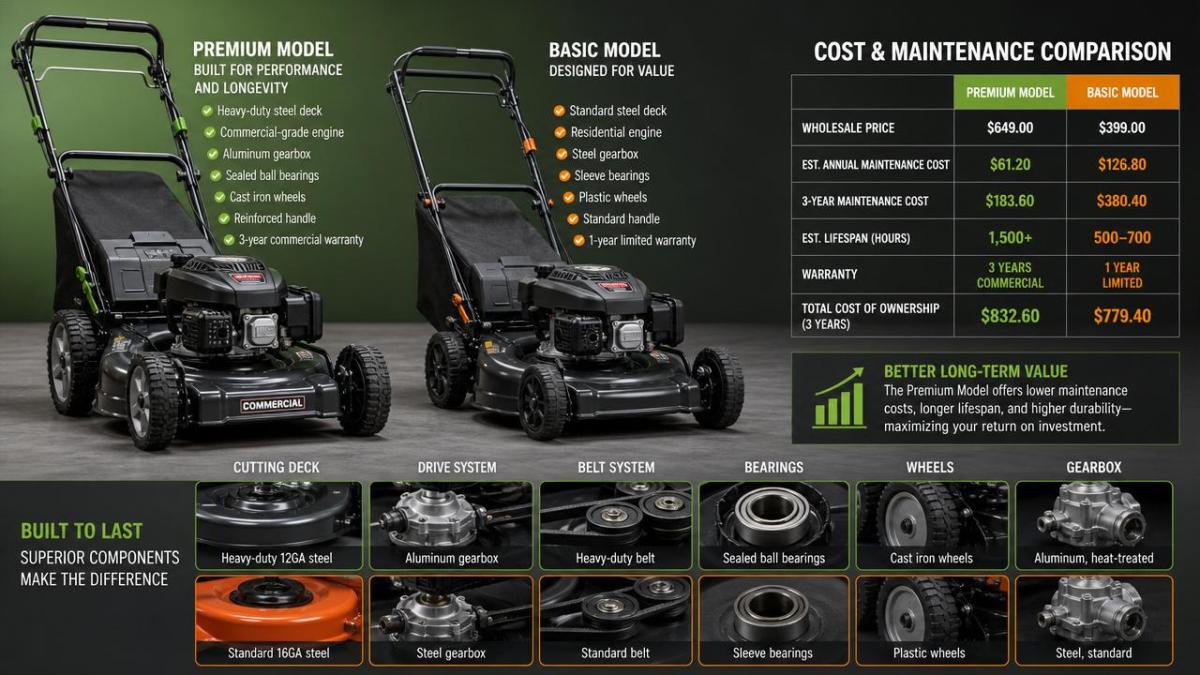
Fourth, warranty terms often look better in headline language than in actual application. A quote may reference “one-year warranty,” but the coverage may exclude wear items, commercial-duty usage thresholds, transport costs, or labor reimbursement. In practice, many low-price units transfer a significant portion of repair burden back to the buyer.
Fifth, downtime costs can exceed the repair invoice itself. If a contractor must rent a replacement unit, reassign crews, or delay jobs, the business impact multiplies. This is where the cheapest wholesale lawn mowers often become the most expensive choice.
How should business evaluators compare wholesale lawn mowers beyond the purchase price?
A practical comparison model should focus on total cost of ownership over a defined operating period, usually 24 to 60 months depending on utilization. For wholesale lawn mowers, evaluators should compare at least six variables: acquisition price, preventive maintenance hours, expected repair frequency, average parts lead time, warranty recovery potential, and residual value at replacement.
Instead of using a simple unit-cost spreadsheet, assign weighted scoring to uptime-critical factors. A mower that operates in a commercial landscaping fleet may justify a higher purchase price if its service intervals are predictable and dealer support is local. Conversely, a low-utilization buyer with in-house mechanics may tolerate a more basic platform if parts are standardized and the risk profile is acceptable.
It is also useful to segment wholesale lawn mowers by duty cycle. Light commercial, mixed commercial, and heavy continuous operation place very different demands on decks, transmissions, cooling systems, and engines. Evaluators sometimes make the mistake of benchmarking only across width, horsepower, or listed cutting capacity. Those specifications matter, but reliability under load matters more.
The procurement process becomes more accurate when each quote is normalized. Ask every supplier to provide the same information set: recommended service intervals, standard parts list, failure history if available, warranty labor policy, turnaround time for critical repairs, and lead time for consumables and major assemblies. When that data is unavailable or vague, risk should be priced into the decision.
Which warning signs suggest that low-cost wholesale lawn mowers may create future losses?
Several red flags appear before purchase if the evaluation is disciplined. The first is incomplete technical documentation. If a supplier cannot provide exploded parts diagrams, maintenance schedules, serial traceability, or clear engine and transmission specifications, after-sales support may be weak. A low quote without documentation is often a signal that long-term service planning has not been built into the offering.
The second warning sign is a warranty that sounds broad but lacks measurable commitments. For wholesale lawn mowers, business buyers should confirm whether warranty claims cover parts only or include labor, whether there is a response-time expectation, and whether commercial-use intensity changes coverage. If the supplier avoids direct answers, evaluators should assume recovery will be difficult.
The third sign is inconsistent component sourcing. A supplier that frequently changes engines, belts, bearings, or electrical modules to chase lower production cost may create parts mismatch problems later. Product consistency matters because fleets need repeatable maintenance procedures and interchangeable stock.
A fourth red flag is the absence of a credible service network. This is particularly relevant in cross-border trade. Cheap wholesale lawn mowers imported into a market without local parts warehousing or trained service partners can become stranded assets when mechanical issues arise. The unit price may look attractive, but the support model is incomplete.
What questions should evaluators ask suppliers before approving wholesale lawn mowers?
The strongest evaluations are driven by precise supplier questioning. Business teams should move beyond generic requests for a catalog and quote. The goal is to identify whether the supplier can sustain performance over the full asset life.
These questions are not procurement formalities. They are filters that distinguish a price-driven seller from a dependable equipment partner. In institutional or fleet settings, the supplier’s ability to answer with documentation is almost as important as the answers themselves.
Are all low-priced wholesale lawn mowers a bad decision?
Not necessarily. Some low-priced wholesale lawn mowers are competitively priced because of manufacturing scale, regional labor efficiency, simpler branding structures, or direct distribution models rather than poor quality. The key issue is not low pricing alone, but unexplained low pricing. If a supplier can demonstrate reliable component sourcing, documented test standards, stable spare parts support, and transparent warranty execution, a low-cost offer may still be commercially sound.
The right decision depends on application. A buyer managing occasional mowing on low-intensity terrain may accept a narrower support model if the utilization rate is modest. By contrast, large groundskeeping operators, municipalities, and commercial contractors usually need wholesale lawn mowers built for frequent use, predictable maintenance, and quick parts access. In those cases, reliability is not a premium feature; it is a profit-protection requirement.
Evaluators should therefore classify mower purchases by business consequence. If failure causes minimal disruption, an aggressive purchase price may be justified. If failure interrupts revenue-generating operations, the low quote should be treated with caution unless support quality is fully validated.
How can procurement teams estimate the true value of wholesale lawn mowers before signing?
A practical method is to convert procurement evaluation into a scenario analysis. Build three cases for each of the wholesale lawn mowers under review: expected case, high-repair case, and peak-season failure case. Estimate annual maintenance labor, average replacement parts spend, and downtime cost per incident. Then compare those totals against the price difference between suppliers. In many cases, a mower that is 10% cheaper upfront becomes 15% to 25% more expensive across two seasons.
It is also valuable to request references from buyers with similar operating conditions. A model that performs acceptably in light residential resale may not survive heavy commercial contracting. Field relevance matters. The more closely the reference environment matches your terrain, climate, crew behavior, and operating hours, the more useful the insight becomes.
Finally, evaluators should consider exit economics. Durable wholesale lawn mowers often retain stronger resale value and create less difficulty at fleet rotation. That recovery value offsets part of the initial cost and should be included in any serious procurement review.
What should be confirmed first before moving forward with a supplier?
Before approving a purchase, confirm four essentials: the duty cycle match, the support infrastructure, the warranty mechanics, and the parts commitment. These factors determine whether wholesale lawn mowers will function as productive assets or recurring maintenance problems. A supplier should be able to explain where the machines fit operationally, how repairs are handled, what inventory is stocked, and how quickly common failures are resolved.
For business evaluators, the best next step is not simply asking for a lower quote. It is asking for a clearer operating picture. If you need to confirm a specific procurement direction, pricing structure, delivery cycle, service arrangement, or OEM cooperation model, prioritize questions about parts lead times, failure history by model, commercial warranty scope, and technician support availability. Those answers will reveal whether the apparent bargain in wholesale lawn mowers is a true value opportunity or a deferred repair liability.
Related Intelligence
- Heavy Agri MachineryRotary tillers wholesale quality checks before placing a large orderRotary tillers wholesale quality checks: verify welds, gearboxes, blades, CE compliance, and batch consistency before large orders to reduce risk and choose suppliers with confidence.
- Heavy Agri MachineryWholesale lawn mowers or ride-ons? Matching mower type to terrainWholesale lawn mowers or ride-ons? Learn how to match mower type to terrain, acreage, labor, and obstacles to stock smarter, reduce service issues, and win more commercial buyers.
- Heavy Agri MachineryManure spreaders wholesale: the maintenance issues worth checking firstManure spreaders wholesale maintenance starts with the right first checks. Discover how to inspect chains, PTO, hydraulics, and corrosion points to reduce downtime and improve spread performance.
The Morning Broadsheet
Daily chemical briefings, market shifts, and peer-reviewed summaries delivered to your terminal.
