
How Fine Should Cassava Grating Machines Process Fresh Roots?
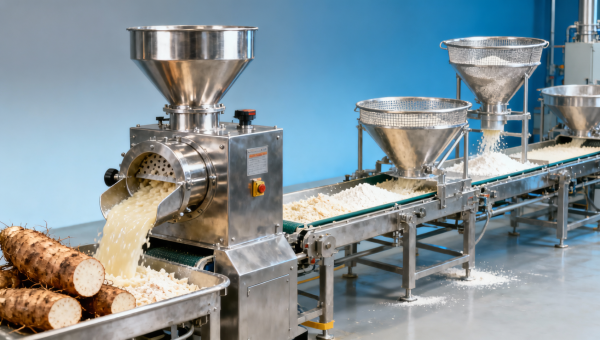
For processors evaluating cassava grating machines, one key question shapes yield, starch recovery, and downstream efficiency: how fine should fresh roots be grated? This article examines the ideal particle size for different production goals while linking performance to broader equipment choices, from palm oil extraction machine systems to commercial flour mill machinery and parboiled rice mill plant operations, helping technical and business readers make practical, standards-aware decisions.
In industrial cassava processing, grating fineness is not a cosmetic setting. It directly affects cell rupture, free starch release, dewatering load, sieve performance, motor demand, and even cleaning frequency. A machine that grates too coarsely can leave starch trapped in fibrous tissue, while an overly aggressive configuration may create excessive fines, increase paste formation, and complicate downstream separation.
That is why technical teams, plant managers, procurement officers, quality supervisors, and financial approvers often evaluate grating machines as part of a wider processing line decision. The correct target is rarely “the finest possible.” It is the most suitable particle profile for the intended product, available utilities, throughput target, and hygiene standard.
What “Fine Enough” Means in Cassava Grating
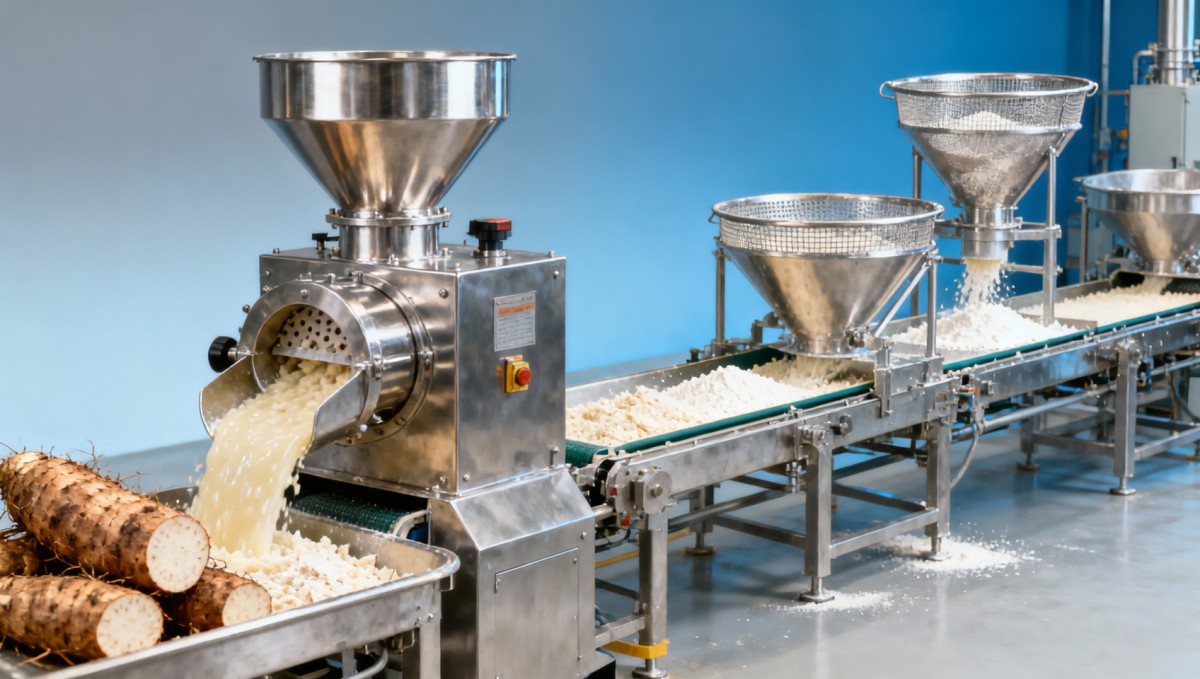
Fresh cassava roots contain starch locked inside parenchyma cells. The main purpose of a cassava grating machine is to rupture as many of these cells as possible in 1 pass or, in some plants, 2 stages. In practical terms, processors usually assess fineness through mash texture, sieve passage behavior, starch milk appearance, and residual starch left in pressed pulp.
For starch-focused applications, a medium-fine to fine mash is generally preferred. In many commercial operations, operators aim for a particle profile where most grated material passes through a 0.8 mm to 2.0 mm effective screen-equivalent range after disintegration, while still preserving manageable fiber structure for extraction and washing. The exact target depends on root variety, moisture, and how quickly the mash is moved to pressing or screening.
If the output is for gari, high-quality flour, fermented mash, or modified cassava products, the ideal grating degree can shift. Flour-oriented lines often benefit from more uniform fine grating because later drying and milling become more stable. Wet starch lines, by contrast, may tolerate a slightly broader particle distribution as long as starch release remains high and fiber separation stays efficient.
A useful field rule is to connect fineness with 3 performance signals: extraction yield, energy draw, and downstream handling. When yield rises by 2% to 4% but power consumption jumps by 15% and screening clogs twice as fast, the machine may be operating beyond the economically optimal point.
Why over-grating can be counterproductive
Excessively fine grating can produce a sticky mash with more liberated cell debris. This may reduce the efficiency of rotary sieves, paddle screens, or hydrocyclone feed preparation. In facilities processing 1 ton to 10 tons per hour, even a modest increase in pulp viscosity can lower practical line capacity by 5% to 12%.
It can also accelerate wear on grating surfaces, bearings, and shaft assemblies. For operations in regions with inconsistent spare-part availability, maintenance intervals matter almost as much as peak throughput. A machine that needs rotor attention every 300 to 500 operating hours may be less attractive than one that runs 800 hours before major wear parts require replacement.
Core indicators operators should monitor
- Residual starch in pulp after first extraction stage.
- Mash temperature rise during grating, ideally controlled to avoid unnecessary quality loss.
- Screen blockage frequency per shift, such as once every 6 hours versus once every 2 hours.
- Specific power consumption in kWh per ton of fresh roots processed.
Recommended Particle Profile by End Product and Line Objective
Different product goals require different grating strategies. A plant designed for native starch, for example, usually seeks high cell disruption and rapid washing. A flour line may prioritize mash uniformity before dewatering, drying, and size reduction. A facility producing food-grade semi-finished material must additionally consider contamination control, oxidation timing, and cleaning turnaround.
The table below summarizes a practical selection framework for processors comparing cassava grating machine settings across common applications. These are not fixed legal standards, but they reflect typical industrial operating ranges and decision logic used in equipment evaluation.
The key conclusion is that “ideal” fineness depends on the line objective, not the machine brochure alone. A processor targeting premium starch recovery may accept higher rotor speed or tighter cutting geometry. A plant focused on low-cost volume output may intentionally choose a less aggressive setup to reduce energy and maintenance cost per ton.
This is similar to decisions seen in commercial flour mill machinery or parboiled rice mill plant design. In each case, the most effective comminution or conditioning stage is the one that improves total line economics, not simply the one that produces the smallest particle size.
Three common operating targets
- Yield-first model: prioritize starch liberation, even if energy rises by 8% to 12%.
- Balanced model: accept slightly lower recovery for better uptime and easier cleaning.
- Cost-first model: lower wear intensity, fewer stoppages, and simpler operator control.
A note on root condition
Fresh roots processed within 24 to 48 hours of harvest usually respond more consistently to fine grating than older, dehydrated, or partially deteriorated roots. If raw material variability is high, adjustable feed rate and grating surface configuration become more important than nominal motor power alone.
Machine Design Factors That Determine Real Grating Performance
Two cassava grating machines with the same stated capacity can produce very different mash quality. Real performance depends on rotor speed, tooth pattern, drum diameter, feed consistency, motor stability, and how the machine handles root pieces with different sizes. In plant audits, inconsistent feeding is one of the most common causes of uneven fineness.
For medium-scale lines in the 1 ton/hour to 5 ton/hour range, processors often compare motors from roughly 7.5 kW to 22 kW. Larger continuous systems may use 30 kW, 45 kW, or more, but installed power alone does not guarantee finer or better grating. The cutting interface and discharge behavior matter just as much.
Rotor peripheral speed must be matched to root hardness and moisture. At very high speed, the machine may produce more smearing and heat. At too low a speed, roots can tear rather than grate efficiently, leading to coarse particles and lower starch release. The most practical approach is to test the machine under real feed conditions for at least 2 to 4 hours, not just a short demonstration run.
Material choice also affects long-term output quality. Stainless steel contact surfaces are preferred in food-oriented and export-sensitive environments because they simplify sanitation and reduce corrosion risk. Bearing protection, splash control, and easy-access cleaning panels further influence whether the machine can maintain its target fineness after weeks of continuous use.
Design features worth checking before purchase
The following comparison helps technical evaluators and procurement teams distinguish between nominal capacity claims and actual line value. It can also be useful when comparing cassava equipment with other primary processing assets such as palm oil extraction machine units or grain preparation systems, where total process stability matters more than one isolated specification.
A practical buyer insight is that machines with easier cleaning and better feeding often outperform “more powerful” alternatives over a 6-month operating cycle. Reduced stoppages, lower contamination risk, and more repeatable particle size usually create better total return than high-capacity claims measured under ideal conditions.
Inspection checklist during technical evaluation
- Check whether fineness remains stable at 70%, 85%, and 100% of rated feed load.
- Ask how long rotor replacement or tooth servicing takes per maintenance event.
- Confirm whether spare parts are standard items or custom-fabricated components.
- Review vibration and noise under continuous operation, especially after 2 hours or more.
How Grating Fineness Affects Downstream Processing and Plant Economics
The right cassava grating machine should be selected as part of a process chain, not as a stand-alone asset. Grating influences pressing, sieving, starch washing, drying, and wastewater load. If a machine produces a mash that looks fine in isolation but increases dewatering time by 20% or pushes more solids into effluent, total plant economics can deteriorate quickly.
For starch plants, better cell rupture can improve first-pass starch liberation and lower residual starch in pulp. However, if the mash becomes too dense, screen cleaning frequency may rise from once per shift to three or four times per shift. The lost labor time and reduced throughput can offset the gain in starch recovery.
For cassava flour lines, fine and consistent grating supports more uniform dewatering and drying. This matters because moisture variation before drying can lead to uneven final particle size and longer residence time in the dryer. In many medium-scale plants, even a 1% to 2% improvement in moisture consistency before drying can reduce rework and stabilize output quality.
This systems view also explains why engineers in broader agro-processing compare particle preparation across sectors. A palm oil extraction machine line balances fruit digestion, pressing, and clarification. A commercial flour mill machinery line balances grinding intensity with sifting load. A parboiled rice mill plant balances soaking, steaming, drying, and milling. Cassava grating should be judged with the same whole-line logic.
Economic trade-offs decision teams should quantify
- Yield effect: estimate whether finer grating improves saleable output by 1% to 5%.
- Energy effect: calculate extra kWh per ton if rotor speed or resistance increases.
- Maintenance effect: compare wear-part life in hours and shutdown frequency per month.
- Labor effect: measure cleaning time, screening intervention, and operator adjustment needs.
- Quality effect: review moisture uniformity, residual starch, and contamination risk.
Where business and technical teams often disagree
Technical staff may favor the configuration that extracts the most starch under controlled conditions. Finance and procurement may prefer the option with lower spare-part cost and simpler upkeep. The best resolution is to compare at least 3 scenarios over a defined period, such as 12 months of expected production, instead of focusing only on purchase price or one-day test yield.
This approach is especially important for distributors, project managers, and OEM integration partners who need a machine that can perform across different raw material conditions and operator skill levels. A slightly less aggressive but more stable configuration may produce better real-world margins for many users.
Selection, Commissioning, and Risk Control for Buyers
When selecting a cassava grating machine, buyers should define performance requirements before comparing suppliers. Capacity in tons per hour is only one criterion. The purchase file should also specify fresh root condition, desired end product, allowable particle spread, cleaning expectation, power supply, labor skill level, and whether the line will run 8, 16, or 24 hours per day.
Commissioning is equally important. A well-built machine can underperform if feed preparation, root washing, or downstream extraction setup is poor. In many projects, the first 7 to 14 days of commissioning determine whether the plant reaches stable performance quickly or spends months making reactive adjustments.
Quality and safety teams should also evaluate food-contact materials, guarding, cleaning access, and lockout procedures. For plants working under stricter customer audits or export-oriented food production, documentation on material selection, operating instructions, and maintenance intervals supports internal compliance even when no single universal cassava-grating regulation governs all markets.
The table below provides a practical procurement framework for decision-makers who need to balance technical merit, operating cost, and project risk.
In most procurement reviews, the safest route is a structured acceptance plan. That plan may include no-load inspection, wet trial with actual roots, 4 to 8 hours of monitored running, and post-run checks on vibration, residue buildup, and cleaning time. This reduces the chance of buying a machine that looks capable on paper but underperforms in routine operation.
Frequently asked questions
How fine should a cassava grating machine process roots for starch extraction?
For starch extraction, the machine should usually produce a medium-fine to fine mash that ruptures most starch-bearing cells without creating excessive paste. In practical plant terms, the right setting is the one that improves starch release while keeping screening, washing, and dewatering stable over a full shift.
Is finer always better for cassava flour production?
Not always. Flour lines often benefit from finer and more uniform grating, but if the mash overheats, compacts, or becomes difficult to dewater, overall quality can decline. The target should support uniform drying and milling, not just visual fineness.
What trial period is reasonable before final acceptance?
A meaningful trial often includes at least one continuous run of 4 to 8 hours under normal feed conditions. Short demonstrations of 15 to 30 minutes can confirm basic operation, but they rarely reveal heat buildup, wear behavior, or cleaning burden.
Which teams should be involved in the purchase decision?
The strongest decisions usually involve 5 groups: operations, engineering, procurement, quality or safety, and finance. This cross-functional review helps prevent conflicts between yield targets, compliance needs, service expectations, and budget limits.
The most effective cassava grating machine is not the one that grates the freshest roots into the smallest possible particles. It is the one that delivers the right degree of cell rupture for the intended product while preserving downstream efficiency, manageable maintenance, hygienic operation, and acceptable cost per ton.
For technical evaluators, that means testing fineness against screening, pressing, washing, and drying performance. For business and financial decision-makers, it means comparing total operating value over months of production, not only initial capital cost. The same disciplined thinking used in palm oil extraction machine selection, commercial flour mill machinery planning, and parboiled rice mill plant design applies here as well.
If you are assessing cassava processing equipment for a new line or an upgrade, now is the time to map target particle profile, throughput, hygiene requirements, and lifecycle cost together. Contact us to discuss your application, request a tailored equipment evaluation framework, or explore more processing solutions aligned with your product and plant goals.
Related Intelligence
- Heavy Agri MachinerySilage Bale Wrapper Machine Issues in Hot WeatherSilage bale wrapper machine issues in hot weather: compare round baler machine and square baler machine setups, reduce film failure, and improve forage quality with smarter buying decisions.
- Heavy Agri MachinerySilage Bale Wrapper Machine Film Waste Comes from SetupSilage bale wrapper machine film waste often starts with setup, not film. Compare round baler machine and square baler machine risks, calibration, and agricultural plastic mulch film compatibility.
- Heavy Agri MachineryHay Balers Wholesale Pricing Is Not the Full PictureHay balers wholesale pricing is only the start. Compare square baler machine and round baler machine value, lifecycle cost, system fit, and service support before you buy.
The Morning Broadsheet
Daily chemical briefings, market shifts, and peer-reviewed summaries delivered to your terminal.
