

The Authority in Global Agricultural Chemistry & Bio-Resources
India BIS Proposes New Tropical Durability Test for Climate Control Devices
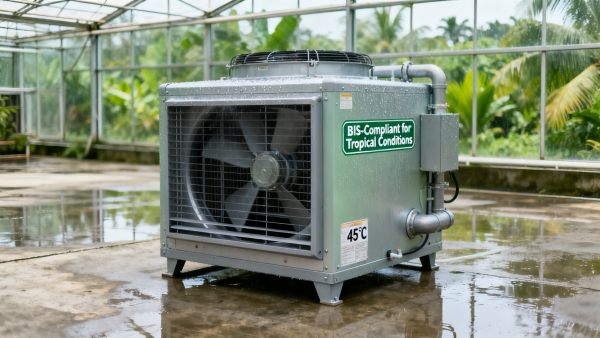
India’s Bureau of Indian Standards (BIS) has issued a draft revision to IS 17892:2026 on May 6, 2026, introducing a mandatory high-temperature–high-humidity durability test for agricultural climate control and ventilation equipment. This development directly affects manufacturers, exporters, and distributors serving India’s tropical agricultural infrastructure — particularly those supplying fans, evaporative coolers, automated ventilation systems, and related hardware. Its significance lies not only in technical compliance but also in the emerging signal of standardized climate resilience as a non-negotiable market access condition.
Event Overview
On May 6, 2026, the Bureau of Indian Standards (BIS) published the draft standard IS 17892:2026 for public consultation. The draft proposes a new mandatory durability requirement: agricultural climate control and ventilation equipment must operate continuously for 72 hours under conditions of 45°C and 95% relative humidity. Additionally, compliant products must bear a label stating ‘BIS-Compliant for Tropical Conditions’. The public comment period ends on June 5, 2026; formal implementation is scheduled for Q3 2026.
Industries Affected by the Revision
Manufacturers of Agricultural Ventilation Equipment
These companies will face direct product redesign and validation requirements. The 45°C/95%RH test imposes stricter thermal and moisture resistance demands than typical IEC or ISO environmental tests — especially for motor insulation, electronic controls, and housing materials. Impact includes extended time-to-market, increased testing costs, and potential requalification of existing models certified under earlier versions of IS 17892.
Exporters and Importers Serving the Indian Agricultural Market
Exporters must now verify whether their current product portfolios meet the proposed tropical durability threshold before shipment. Non-compliant units risk rejection at customs or post-import conformity assessment. Impact manifests in revised pre-shipment documentation, updated technical dossiers, and tighter coordination with Indian import partners on labeling and certification timelines.
Component Suppliers (e.g., Motors, Sensors, Enclosures)
Suppliers providing critical subassemblies — especially temperature- and humidity-sensitive components such as PCBs, relays, and plastic housings — may need to provide new material certifications or accelerated aging data supporting operation under 45°C/95%RH. Impact includes revised technical specifications in supply agreements and potential revalidation of component-level BIS approvals.
Distributors and Aftermarket Service Providers
Distributors handling spare parts or field-service kits must ensure replacement components (e.g., fan blades, control boards) are sourced from BIS-certified batches meeting the tropical durability criteria. Impact includes inventory segregation, updated service manuals, and training for field technicians on verifying compliance labels during maintenance.
What Enterprises and Practitioners Should Monitor and Do Now
Track official BIS updates and final clause wording
The draft remains subject to revision based on stakeholder feedback. Companies should monitor BIS’s official portal for the final version, paying close attention to test methodology details (e.g., preconditioning steps, pass/fail criteria, third-party lab accreditation requirements), which may differ from the draft language.
Identify high-priority SKUs for early verification
Focus initial internal assessment on best-selling or highest-revenue models destined for India’s humid-agricultural zones (e.g., Andhra Pradesh, Kerala, West Bengal). Prioritize units with known thermal stress points — such as those using non-hermetic motors or consumer-grade electronics — for preliminary lab screening.
Distinguish between policy signal and enforceable requirement
While the draft signals BIS’s intent to raise baseline climate resilience, enforcement will depend on notification in the Official Gazette and alignment with the BIS Act, 2016. Until formal gazettal, this remains a regulatory proposal — not a binding obligation. Businesses should avoid premature full-scale re-engineering without confirmation of final scope and transition timelines.
Initiate cross-functional readiness planning
Assign internal ownership across R&D, quality assurance, procurement, and export compliance teams to review current testing protocols, supplier declarations, and labeling workflows. Where feasible, engage an accredited BIS laboratory now for exploratory 72-hour test runs — not for certification, but to benchmark performance gaps and inform timeline estimates.
Editorial Perspective / Industry Observation
Observably, this draft signals a shift toward climate-adapted standards in India’s agricultural infrastructure sector — moving beyond basic safety and performance to include operational reliability under regionally relevant environmental extremes. Analysis shows it functions less as an immediate compliance deadline and more as an early indicator of broader harmonization trends, potentially influencing future revisions to other BIS standards covering HVAC, irrigation controllers, or farm automation hardware. From an industry perspective, the timing — aligned with India’s National Mission on Sustainable Agriculture — suggests growing institutional emphasis on equipment longevity in tropical field conditions. Continued monitoring is warranted, as similar durability clauses may emerge in adjacent standards over the next 12–24 months.
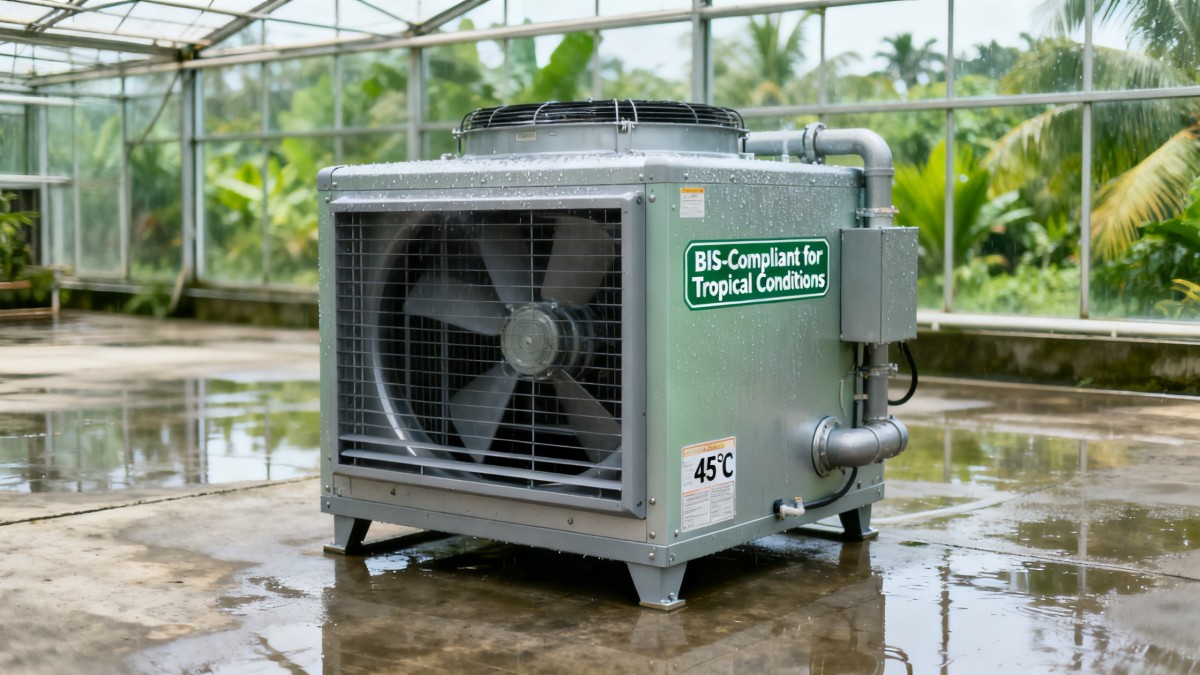
India’s Bureau of Indian Standards (BIS) — official draft notice for IS 17892:2026, published May 6, 2026. Public consultation period open until June 5, 2026. Final implementation expected in Q3 2026. Note: Draft status and exact test protocol details remain subject to official revision prior to gazettal.
Conclusion: This revision represents an evolving regulatory expectation — not yet a finalized mandate. It reflects increasing institutional attention to real-world operating conditions in India’s agricultural value chain. For stakeholders, the current priority is structured awareness and preparatory alignment, rather than reactive compliance.
Related Intelligence
- Climate Control & VentilationIndia BIS Releases IS 17892:2026 for Climate Control EquipmentIndia BIS IS 17892:2026 mandates 45°C/95% RH durability testing for climate control equipment—key for exporters, OEMs & certifiers entering India’s greenhouse market. Act now!
- Climate Control & VentilationIndia BIS Proposes New Tropical Durability Test for Climate Control DevicesIndia BIS proposes new tropical durability test for climate control devices—45°C/95%RH, 72-hour mandate. Key for exporters, manufacturers & suppliers targeting India’s agri-infrastructure.
- Climate Control & VentilationCommercial LED grow lights wholesale: how to judge real efficiencyCommercial led grow lights wholesale: learn how to judge real efficiency beyond headline PPE by comparing PPFD uniformity, driver quality, thermal design, and verified testing.
The Morning Broadsheet
Daily chemical briefings, market shifts, and peer-reviewed summaries delivered to your terminal.
