
FAO Adopts China's GB/T 39021-2025 as Asia-Pacific Benchmark
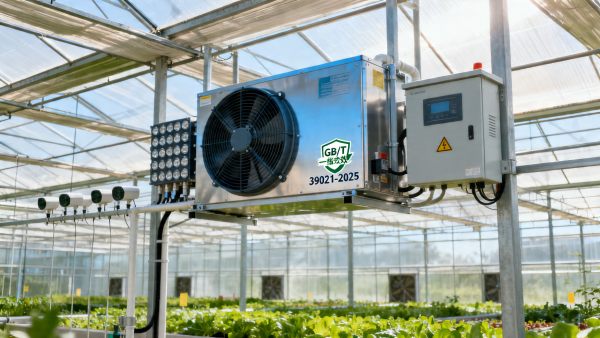
On April 17, 2026, the Food and Agriculture Organization of the United Nations (FAO) released its updated Green Procurement Guidelines for Climate Control & Ventilation Systems in Controlled Environment Agriculture, formally designating China’s national standard GB/T 39021-2025 — Minimum Energy Efficiency Values and Energy Efficiency Grades for Intelligent Environmental Control Equipment — as the recommended technical reference for public procurement and multilateral loan-funded projects across the Asia-Pacific region. This development directly impacts manufacturers, exporters, system integrators, and project implementers involved in climate-controlled agricultural infrastructure.
Event Overview
The FAO published the Climate Control & Ventilation Green Procurement Guidelines on April 17, 2026. The document identifies GB/T 39021-2025 as the preferred technical benchmark for climate control equipment procurement under FAO-supported programs and multilateral financing mechanisms, including those of the International Fund for Agricultural Development (IFAD) and the Asian Development Bank (ADB). The standard sets energy efficiency thresholds 12% stricter than IEC 60335 and has been formally adopted by 11 countries, including Vietnam, Bangladesh, and Sri Lanka.
Industries Affected
Equipment Manufacturers (OEMs & Tier-1 Suppliers)
Manufacturers producing ventilation, heating, cooling, or integrated climate control units for greenhouse or vertical farming applications may face revised technical compliance expectations in public tenders across the Asia-Pacific. Since GB/T 39021-2025 defines mandatory minimum efficiency values and grading criteria, product certification against this standard could become a de facto prerequisite for eligibility in FAO- or ADB-backed infrastructure projects.
Exporters & Trade Service Providers
Companies exporting climate control equipment from China — or sourcing such equipment for re-export to FAO/ADB partner countries — may encounter increased documentation and verification requirements. National adoption of GB/T 39021-2025 by importing countries implies that conformity assessments, test reports, and labeling aligned with this standard will carry greater weight during customs clearance and tender evaluation.
System Integrators & EPC Contractors
Firms designing and delivering turnkey controlled-environment agriculture (CEA) facilities may need to adjust technical specifications in proposals and contracts. With FAO explicitly recommending GB/T 39021-2025, integrators bidding on multilateral projects are likely to be expected to specify equipment compliant with this standard — even if local regulations have not yet been amended.
Financing & Project Development Entities
Development finance institutions (DFIs), government agencies, and NGOs managing agricultural modernization grants or loans may begin incorporating GB/T 39021-2025 into procurement clauses and environmental performance indicators. This could influence equipment selection, lifecycle cost calculations, and reporting on energy efficiency outcomes in funded projects.
What Stakeholders Should Monitor and Do Now
Track official adoption timelines in key markets
While 11 countries have ‘adopted’ GB/T 39021-2025, adoption does not automatically equate to enforcement. Stakeholders should monitor whether Vietnam, Bangladesh, Sri Lanka, and other listed countries issue formal regulatory notices, update national procurement manuals, or revise mandatory testing protocols — as these steps signal imminent implementation pressure.
Verify alignment between existing product certifications and GB/T 39021-2025 requirements
Manufacturers and exporters should compare current CE, CCC, or IEC-based test reports against GB/T 39021-2025’s specific metrics (e.g., COP-based grading, seasonal performance factors, standby power limits). Discrepancies may require recalibration, retesting, or minor hardware/software updates — particularly for variable-speed drive systems or AI-enabled controllers.
Distinguish policy guidance from binding regulation
The FAO guideline is advisory, not legally binding. Its influence derives from institutional weight and linkage to funding conditions — not statutory authority. Companies should avoid assuming automatic compliance obligations; instead, assess each tender or loan agreement individually for explicit references to GB/T 39021-2025 or related technical annexes.
Prepare technical documentation packages for multilateral submissions
For firms targeting IFAD or ADB projects, proactively compiling GB/T 39021-2025-aligned documentation — including test certificates from accredited labs, energy grade labels, and declarations of conformity — can reduce procurement delays and strengthen bid competitiveness, even ahead of formal regulatory mandates.
Editorial Observation / Industry Perspective
This move is best understood as a strong normative signal — not an immediate regulatory shift. Analysis来看, FAO’s endorsement reflects growing recognition of China’s technical leadership in energy-efficient agricultural hardware, especially where standards address real-world operating conditions (e.g., partial-load performance, integration with renewable power sources) rather than lab-only metrics. From industry角度看, it signals a potential consolidation trend: regional procurement frameworks may increasingly converge around technically robust, locally validated benchmarks — rather than defaulting to legacy international standards. Current更值得关注的是 how quickly national procurement agencies operationalize the recommendation, and whether future FAO technical notes extend this precedent to other agri-tech domains (e.g., irrigation pumps or LED lighting).
It is not yet a market access requirement — but it is becoming a competitive differentiator in publicly funded CEA infrastructure.
Conclusion
The FAO’s inclusion of GB/T 39021-2025 marks a notable step toward harmonizing energy efficiency expectations across Asia-Pacific agricultural climate control procurement. For industry stakeholders, this is less about sudden compliance deadlines and more about strategic alignment: understanding where the technical bar is being raised, anticipating downstream specification shifts, and preparing documentation that meets emerging multilateral expectations. It is better interpreted as a directional indicator — one that rewards proactive technical readiness over reactive compliance.
Source Attribution
Main source: Food and Agriculture Organization of the United Nations (FAO), Climate Control & Ventilation Green Procurement Guidelines, published April 17, 2026.
Additional context: Publicly confirmed adoptions of GB/T 39021-2025 by Vietnam, Bangladesh, Sri Lanka, and eight other Asia-Pacific countries — per FAO annex documentation.
Note: Ongoing observation is required regarding national regulatory updates and tender-level implementation by IFAD and ADB project teams.
Related Intelligence
- Climate Control & VentilationFAO Adopts China's GB/T 39021-2025 as Asia-Pacific BenchmarkGB/T 39021-2025 adopted by FAO as Asia-Pacific benchmark—key for climate control manufacturers, exporters & integrators seeking competitive edge in green agri-infrastructure projects.
- Climate Control & VentilationJiangxia Zanglong Island Semiconductor Park Launches Land Acquisition for MEMS Sensor ExpansionJiangxia Zanglong Island Semiconductor Park launches MEMS sensor expansion — boosting domestic high-precision pressure & humidity/temperature chip supply for smart CCV systems.
- Climate Control & VentilationJiangxia Zanglong Island Semiconductor Park Land Acquisition BeginsJiangxia Zanglong Island Semiconductor Park land acquisition begins—boosting domestic MEMS sensor supply for AI-enabled CCV systems. Exporters gain cost & lead-time advantages starting H2 2026.
The Morning Broadsheet
Daily chemical briefings, market shifts, and peer-reviewed summaries delivered to your terminal.
