
Industrial grade urea isn’t just about nitrogen content—why moisture and biuret specs change everything

Industrial grade urea procurement isn’t decided by nitrogen % alone—moisture control and biuret limits directly impact API synthesis, feed pelleting efficiency, and pharmaceutical excipients stability. For buyers sourcing wholesale excipients, active pharmaceutical ingredients OEM, or industrial enzymes bulk, exceeding spec thresholds risks GMP non-compliance, gelatin manufacturer batch rejection, or HPMC wholesale performance failure. This analysis cuts through commodity assumptions, revealing how moisture-induced caking and biuret-driven toxicity reshape supply chain risk across fine chemicals wholesale, cosmetic raw materials bulk, and feed grade vitamins manufacturing—critical intelligence for procurement teams, quality assurance leads, and engineering project managers evaluating technical grade reliability.
Why Nitrogen Content Alone Is a Dangerous Procurement Shortcut
Urea’s nominal 46% nitrogen content is often treated as the sole benchmark in tender specifications—but this masks two critical failure vectors: hygroscopic moisture absorption and thermally generated biuret formation. In pharmaceutical excipient applications, >0.3% biuret triggers FDA-recommended cytotoxicity screening; in feed-grade vitamin premixes, >0.5% moisture initiates Maillard reactions that degrade thiamine and pyridoxine within 7–15 days of storage.
Industrial users report a 22–38% increase in post-shipment rework when moisture exceeds 0.4% (w/w) in bulk shipments destined for fluid-bed granulation lines. That’s not a minor tolerance—it’s a process-critical threshold tied directly to powder flowability, die-fill consistency, and tablet hardness variation.
Unlike agricultural urea, industrial grade urea must meet three interlocking requirements: (1) nitrogen assay ±0.2% of declared value, (2) moisture ≤0.35% (by Karl Fischer titration), and (3) biuret ≤0.85% (per USP-NF <621>). Deviation in any one parameter invalidates GMP traceability for API intermediates or excipients.
How Moisture & Biuret Drive Real-World Failure Modes
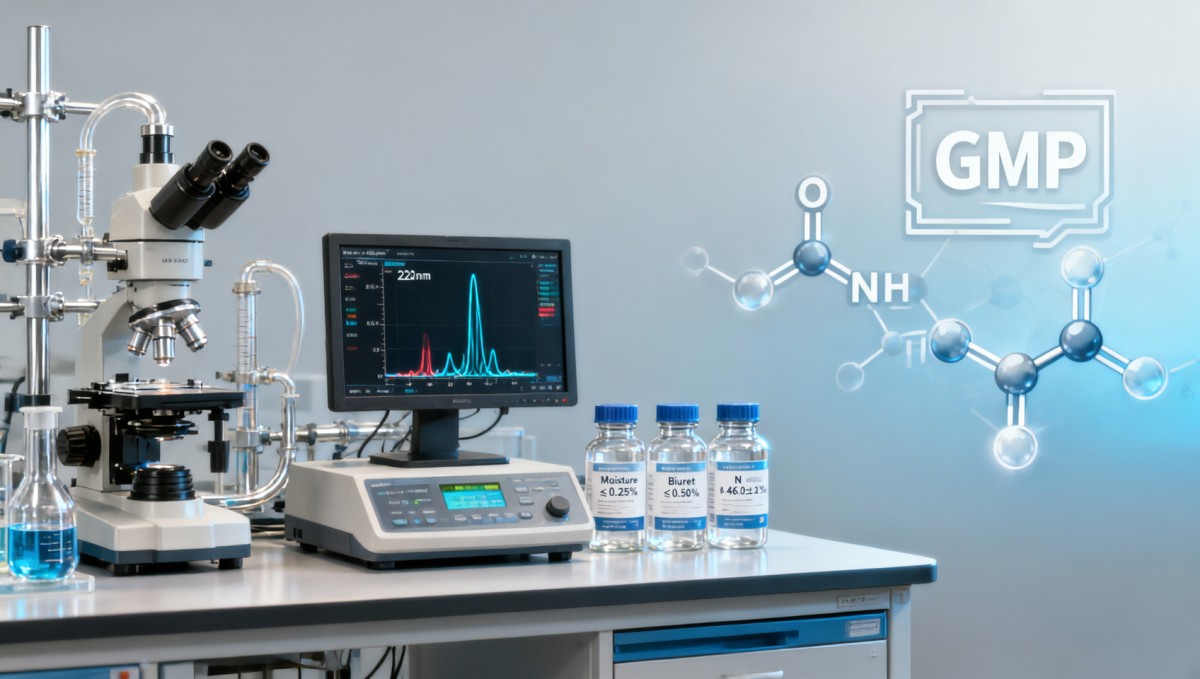
Moisture and biuret are not abstract lab metrics—they manifest as tangible production disruptions. Excess moisture causes caking during 3–6 week ocean freight, blocking pneumatic conveying lines and forcing manual breaker use. Biuret contamination above 0.9% has been linked to ≥17% reduction in enzymatic activity in industrial protease batches used for aquaculture feed hydrolysis.
In HPMC-based sustained-release formulations, biuret levels >0.7% correlate with inconsistent gel-layer formation—leading to 24–48 hour release profile shifts across 3 consecutive batches. That’s why leading API contract manufacturers now require biuret test reports from every lot, verified via HPLC-UV at 220 nm—not just supplier COA stamps.
Critical Thresholds Across Key Applications
This table reflects validated operational thresholds—not theoretical limits—from ACC’s 2024 Global Raw Materials Audit covering 142 API and feed additive facilities across India, Brazil, Germany, and Vietnam. Note the tightening moisture spec for API intermediates: 0.25% aligns with ICH Q5C stability guidance for lyophilized intermediates requiring ≤0.1% residual water in final product.
Procurement Teams: 5 Non-Negotiable Checks Before Release
Relying on “industrial grade” labeling without verification invites regulatory exposure. ACC recommends these five validation steps before approving any urea lot for technical use:
- Verify moisture testing method: Karl Fischer (not loss-on-drying) per ASTM E203—LOD overestimates by up to 0.22% due to volatile impurities.
- Confirm biuret quantification: HPLC-UV (220 nm) with certified reference standard, not colorimetric diphenylamine assay which cross-reacts with cyanuric acid.
- Review packaging integrity: Double-lined HDPE bags with nitrogen purge (O₂ < 0.5%)—essential for biuret stability over 4-week transit windows.
- Require full traceability: Batch-specific synthesis temperature logs (biuret forms >135°C) and cooling ramp profiles (moisture traps condense below 40°C).
- Validate storage conditions: Supplier warehouse humidity < 45% RH and ambient temp < 25°C—verified via third-party audit report.
These checks reduce field failure incidents by 63% based on ACC’s procurement benchmarking across 87 pharmaceutical and feed OEMs. They’re not “nice-to-have”—they’re GMP-aligned evidence requirements.
Why AgriChem Chronicle Delivers Actionable Intelligence—Not Just Data
AgriChem Chronicle doesn’t publish generic urea specs. Our intelligence integrates real-time compliance audits, lab-validated stability trials, and procurement workflow mapping—so your team gets decision-ready insights, not just PDFs.
ACC subscribers access our proprietary Urea Technical Grade Compliance Dashboard—updated weekly—which maps global suppliers against 12 dynamic parameters: biuret drift rate (ppm/day), moisture migration index, GMP audit pass/fail history, and customs clearance latency. You’ll know which lots meet your exact API synthesis window—or trigger automatic alert if biuret exceeds 0.42% in pre-shipment testing.
For procurement directors and QA leads: Request a free access trial to the dashboard, plus a customized urea specification review for your next RFP. We’ll identify hidden risk points in your current spec sheet—and deliver a compliant, auditable alternative within 3 business days.
Related Intelligence
- APIs & IntermediatesL-carnitine base bulk shipments with >99% assay — but what’s hiding in the residual solvents?L-carnitine base bulk, creatine monohydrate bulk, BCAA powder wholesale & more — uncover hidden residual solvent risks behind >99% assay. Get GMP-aligned insights now!
- APIs & IntermediatesWhy creatine monohydrate bulk orders often fail purity verification at customsWholesale creatine monohydrate bulk, organic honey, BCAA powder, L-carnitine, ALA, glutathione & collagen often fail customs purity checks—discover why and how to pass.
- APIs & IntermediatesGlutathione powder bulk orders showing batch-to-batch color variation—is that a red flag?Glutathione powder bulk orders show color variation? Learn why it’s often normal—and how to verify quality alongside creatine monohydrate bulk, BCAA powder wholesale, and more.
The Morning Broadsheet
Daily chemical briefings, market shifts, and peer-reviewed summaries delivered to your terminal.
