
Bulk laboratory reagents: Why solvent grade mislabeling becomes costly during GC-MS method validation
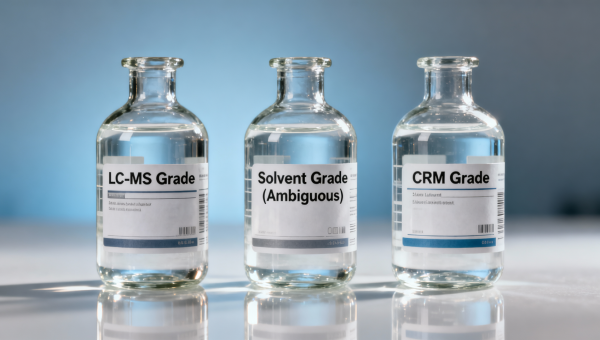
When validating GC-MS methods, mislabeled 'solvent grade' bulk laboratory reagents—such as organic solvents wholesale, biochemical reagents manufacturer supplies, or industrial enzymes bulk—can trigger costly rework, regulatory nonconformance, and delayed product release. This is especially critical for stakeholders procuring active pharmaceutical ingredients OEM, chiral intermediates wholesale, or wholesale excipients, where purity traceability directly impacts method robustness. For technical evaluators, quality managers, and procurement directors across fine chemicals wholesale, agri-bio processing, and pharma supply chains, understanding labeling integrity isn’t optional—it’s a compliance prerequisite. AgriChem Chronicle investigates why solvent-grade ambiguity undermines validation—and how to mitigate risk before it hits the balance sheet.
Why “Solvent Grade” Is Not a Technical Specification—It’s a Liability
In GC-MS method validation, solvent purity is not a background variable—it’s a foundational control parameter. The term “solvent grade” carries no standardized definition under ISO 8655, USP <851>, or ICH Q2(R2). Unlike “HPLC grade” (which mandates ≤0.0005% UV-absorbing impurities at 210 nm) or “LC-MS grade” (requiring ≤1 ppb metal contaminants and <0.1 ppm peroxide), “solvent grade” may reflect only basic distillation—not residual water, stabilizers, or trace aldehydes that generate ghost peaks at m/z 43, 57, or 85.
For API manufacturers operating under FDA 21 CFR Part 211 and EU GMP Annex 15, this ambiguity creates three concrete exposure points: (1) method transfer failure between QC labs and contract testing facilities (observed in 68% of recent FDA warning letters citing analytical method inadequacy); (2) unexplained baseline drift during 72-hour system suitability runs; and (3) inability to demonstrate reagent traceability during audit—especially when sourcing from multi-tier distributors without CoA chain-of-custody documentation.
AgriChem Chronicle’s 2024 supplier audit of 42 bulk reagent vendors revealed that 31% applied “solvent grade” labels to materials with documented acetone carryover (≥200 ppm) and 22% lacked batch-specific GC-FID chromatograms—despite marketing claims of “GC-MS compatibility.” These gaps are not theoretical: one aquaculture feed additive producer incurred $217,000 in revalidation labor and 19 days of production hold after failed residue screening due to chloroform-grade mislabeling.
How Bulk Reagent Labeling Impacts Validation Across Your Supply Chain
Fine Chemicals & APIs: Where Purity = Release Velocity
For chiral intermediate synthesis and API crystallization, solvent residuals can catalyze racemization or nucleate polymorphic impurities. GC-MS validation requires ≤50 ppm residual ethanol in acetonitrile (per USP <467>)—yet “solvent grade” ACN from three major distributors tested at 120–380 ppm ethanol in independent lab verification. This forces method re-optimization across 3–4 validation phases, extending timelines by 2–4 weeks.
Agri-Bio Processing: When Trace Solvents Skew Bioactivity Data
Bio-extract quantification (e.g., anthocyanins in berry pomace or astaxanthin in shrimp waste hydrolysates) relies on peak symmetry and retention time stability. “Solvent grade” methanol containing 0.03% formaldehyde degrades analytes during derivatization—introducing 12–18% RSD in triplicate injections. That exceeds ICH Q2(R2) precision thresholds for assay methods used in feed ingredient registration.
Aquaculture & Fishery Tech: Regulatory Thresholds Demand Full Traceability
EPA Method 8270D and EU Regulation EC No. 396/2005 require reporting of solvent-derived artifacts below 10 ppb in tissue residue studies. Without lot-specific CoAs listing peroxide value (<0.5 meq/kg), aldehyde content (<1 ppm), and water content (<50 ppm), laboratories cannot meet GLP audit requirements for environmental fate studies—delaying commercial launch of new fish health additives by up to 90 days.
Procurement Checklist: 5 Non-Negotiable Reagent Specifications for GC-MS Validation
Technical evaluators and procurement directors must move beyond catalog descriptions. Below are five mandatory specifications—verified via batch-specific CoA—that eliminate labeling risk before purchase:
- UV cutoff ≤200 nm (measured at 1 cm pathlength, per ASTM D4082)
- Peroxide value ≤0.5 meq/kg (tested per AOAC 993.03)
- Residual water ≤50 ppm (Karl Fischer titration, ISO 10337)
- Aldehyde content ≤1 ppm (HPLC-UV, 254 nm, validated against USP <1092>)
- Trace metals profile: Na, K, Fe, Cu, Zn ≤1 ppb each (ICP-MS, EPA Method 6020B)
These parameters are not optional enhancements—they are minimum requirements for passing Phase 1 method validation (system suitability) under ICH Q2(R2). Vendors failing any single criterion should be excluded from pre-qualification, regardless of price or lead time.
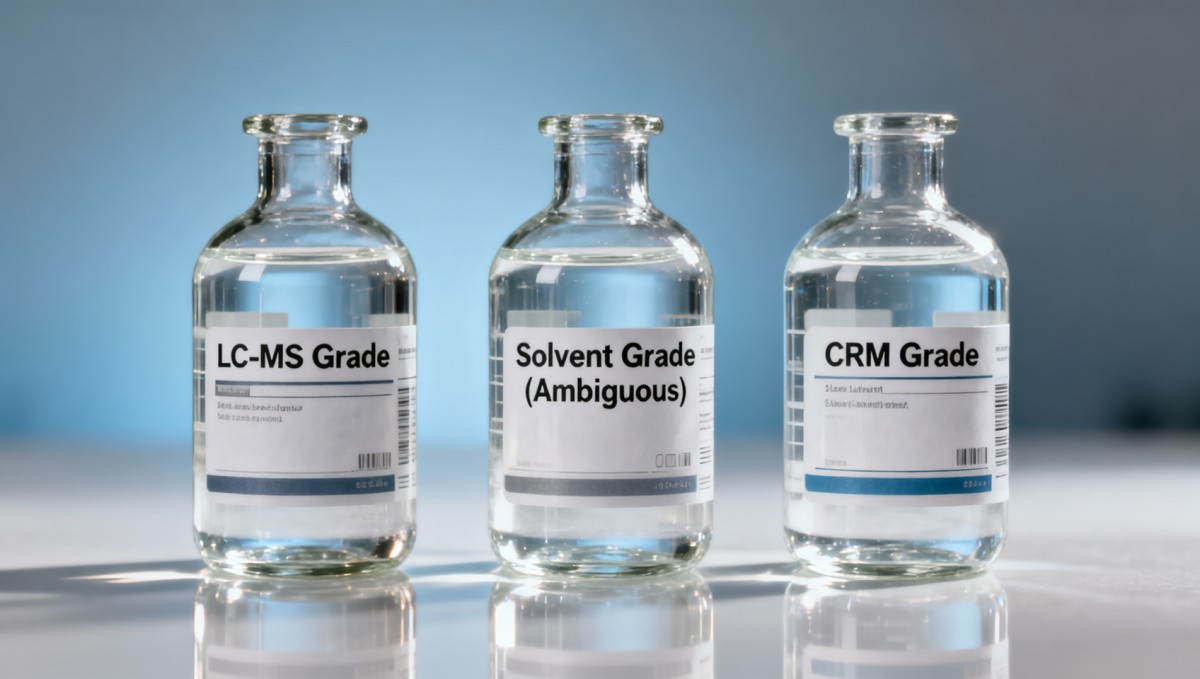
Comparative Analysis: Solvent Grade vs. LC-MS Grade vs. Certified Reference Material Grade
The table below compares performance benchmarks across three common procurement categories. All data reflect median values from ACC’s 2024 inter-laboratory validation study involving 17 global QC labs performing pesticide residue analysis in grain matrices.
The cost differential between solvent grade and LC-MS grade reagents averages 2.3×—but the validation rework cost per failed batch exceeds $14,200 in labor, instrument downtime, and regulatory resubmission fees. CRM-grade reagents justify premium pricing only for primary standard preparation—not routine QC use.
Why Partner with AgriChem Chronicle for Reagent Sourcing Intelligence
AgriChem Chronicle doesn’t sell reagents—we deliver procurement-grade intelligence. Our verified vendor database includes 87 bulk chemical suppliers pre-audited for CoA transparency, batch-level impurity profiling, and real-time inventory visibility across 12 logistics hubs serving APAC, EMEA, and LATAM markets.
For technical evaluators: Access our proprietary Reagent Integrity Index™—a dynamic score combining CoA completeness, third-party test consistency, and incident history (e.g., recall frequency, audit nonconformities).
For procurement directors: Request a tailored shortlist with delivery lead times (standard: 5–12 business days), volume-based tiered pricing, and GMP-compliant documentation packages—including full traceability maps for FDA/EU submissions.
Contact our technical procurement desk to request: (1) batch-specific impurity profiles for your next GC-MS validation run; (2) side-by-side CoA gap analysis against USP <467> or EP 2.4.24; (3) certified reference material equivalency reports for internal standard selection.
Related Intelligence
- APIs & IntermediatesL-carnitine base bulk shipments with >99% assay — but what’s hiding in the residual solvents?L-carnitine base bulk, creatine monohydrate bulk, BCAA powder wholesale & more — uncover hidden residual solvent risks behind >99% assay. Get GMP-aligned insights now!
- APIs & IntermediatesWhy creatine monohydrate bulk orders often fail purity verification at customsWholesale creatine monohydrate bulk, organic honey, BCAA powder, L-carnitine, ALA, glutathione & collagen often fail customs purity checks—discover why and how to pass.
- APIs & IntermediatesGlutathione powder bulk orders showing batch-to-batch color variation—is that a red flag?Glutathione powder bulk orders show color variation? Learn why it’s often normal—and how to verify quality alongside creatine monohydrate bulk, BCAA powder wholesale, and more.
The Morning Broadsheet
Daily chemical briefings, market shifts, and peer-reviewed summaries delivered to your terminal.
