
Cold Press or Hot Press? Choosing a Sunflower Oil Press Machine
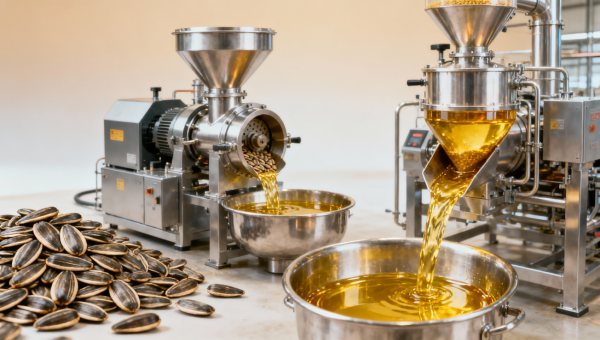
Selecting the right sunflower oil press machine starts with understanding whether cold press or hot press technology best fits your production goals, quality standards, and operating costs. For buyers comparing a cold press oil machine commercial setup with broader processing options such as a palm oil extraction machine, this guide outlines the technical, commercial, and quality factors that matter most.
For research teams, plant operators, quality managers, procurement specialists, distributors, and investment decision-makers, the question is rarely just “cold or hot.” It usually involves yield targets, seed condition, utility costs, labor skill levels, downstream refining needs, food safety controls, and expected payback periods. A machine that works well for a boutique edible oil line producing 0.5–2 tons per day may be a poor fit for an industrial plant targeting 20–100 tons per day.
In sunflower oil processing, pressing temperature directly affects oil flavor, color, oxidation stability, filtration load, and cake value. Cold press systems typically prioritize premium positioning and minimal thermal exposure, while hot press systems are often selected for higher extraction efficiency and larger-volume economics. The best choice depends on how your business balances quality premium against throughput and operating intensity.
This article examines the operating principles, performance trade-offs, quality implications, procurement criteria, and implementation checkpoints that matter when selecting a sunflower oil press machine for commercial or industrial use.
Cold press vs hot press: the core processing difference
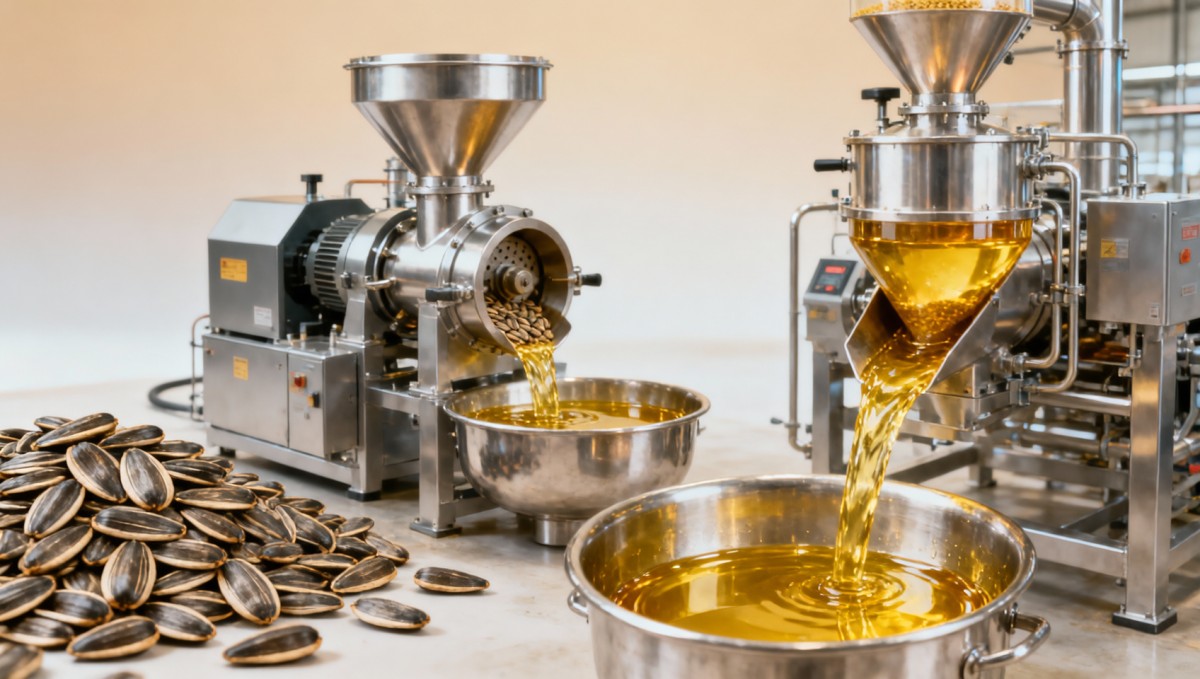
The main distinction between cold press and hot press lies in pretreatment temperature before or during mechanical extraction. In a cold press process, sunflower seeds are cleaned, possibly dehulled, conditioned lightly, and pressed at relatively low temperatures, often keeping the oil mass below about 50°C–70°C depending on process design. In hot press processing, seeds are cooked or roasted before pressing, commonly in the 80°C–120°C range, to improve oil release and reduce residual oil in the cake.
A cold press oil machine commercial line is usually favored when the target product is marketed as natural, less processed, and flavor-retentive. This can be attractive for direct-to-consumer brands, specialty food processors, and premium distributors. However, lower temperatures often mean lower extraction efficiency, so more oil may remain in the cake unless a second press or solvent stage is added.
Hot press systems, by contrast, are widely used where yield and capacity matter more than a premium “cold pressed” label. Heat softens the cell structure, lowers viscosity, and increases throughput consistency. In practice, this can improve total oil recovery by several percentage points, which becomes commercially significant once production moves beyond 5–10 tons per day.
For technical evaluators, the real decision is not ideological but operational. Seed moisture, foreign matter level, hull percentage, required residual oil in cake, and availability of steam or thermal equipment all influence which process is viable. Plants operating in regions with unstable utilities may prefer a simpler cold press line, while integrated processors with boilers, cookers, and refining equipment often gain more value from hot press.
How the process path changes machine selection
The press itself is only one part of the line. Cold press setups often require precise seed cleaning, magnetic separation, controlled feeding, gentle pressing, and efficient filtration. Hot press lines add more thermal components such as conditioning kettles, cookers, steam pipes, and temperature control instruments. That means capital cost, footprint, operator training, and maintenance workload can all increase.
A useful way to compare both routes is to assess typical process requirements side by side.
The table shows why many buyers start with product positioning and throughput target before comparing machine specifications. If premium retail oil is the main goal, cold press has a strong case. If the business model depends on maximizing extraction rate and processing larger seed volumes with predictable output, hot press often provides a better economic fit.
Quality, yield, and cost: what each buyer group should evaluate
For quality control teams, the key issue is not only how much oil is produced, but what happens to peroxide development, sediment load, phospholipid carryover, and color stability. Cold-pressed sunflower oil often needs careful filtration because lower processing temperatures may leave more suspended solids. Hot-pressed oil can be easier to release from the seed matrix, but thermal treatment may deepen color and increase the burden on subsequent refining if the target is a light, neutral product.
For operators and project managers, yield and machine stability are usually top priorities. A well-configured hot press line may reduce residual oil in cake to a lower range than a single-pass cold press system, especially when seeds are conditioned correctly. Yet this benefit comes with added energy consumption, more process controls, and higher dependence on temperature discipline. If moisture drifts outside the preferred operating window, capacity and oil quality can decline quickly.
For commercial and finance reviewers, the decision often comes down to three numbers: capital expenditure, operating cost per ton, and selling price premium. A cold press sunflower oil press machine may have lower utility complexity and a simpler startup path, but if oil recovery is 2%–6% lower than a hot press alternative, the lost recoverable oil can outweigh the branding advantage unless the market pays a meaningful premium.
Distributors and end-product brands should also consider customer expectations. In many channels, “cold pressed” supports stronger shelf storytelling, especially for small bottles, organic positioning, and health-focused retail formats. In bulk ingredient markets, however, buyers usually care more about consistency, specification conformity, and supply stability than label language.
A practical comparison of operational outcomes
The following matrix helps different stakeholders compare the two technologies against typical procurement and production criteria.
The central takeaway is that quality, yield, and cost cannot be reviewed separately. A plant producing 3 tons per day for premium bottled oil may favor cold press despite lower extraction efficiency. A processor supplying wholesalers, feed users, or further refiners may gain more value from hot press because even small yield improvements matter across 300 operating days per year.
Common misjudgments in economic evaluation
Ignoring downstream cost
A cheaper press can create a more expensive line if filtration, refining loss, labor hours, or spare-part consumption rise beyond plan. Buyers should model at least 12 months of operating cost, not only purchase price.
Overestimating market premium
Not every regional market rewards cold-pressed labeling equally. Before investing, compare likely sales price uplift against expected recovery loss and packaging costs.
Key machine specifications and line design criteria
When evaluating a sunflower oil press machine, technical teams should move beyond headline capacity. Real performance depends on seed variety, moisture level, kernel-to-hull ratio, impurity content, pretreatment stability, and whether pressing is single-stage or double-stage. A machine quoted at 15 tons per day under ideal feed conditions may perform materially lower if raw material cleaning is inconsistent or if operators must process mixed seed lots.
The most important mechanical parameters usually include motor power, screw diameter, press chamber configuration, wear-part metallurgy, feeder stability, gearbox durability, and discharge adjustability. For commercial lines, power demand may range from around 5 kW for smaller units to 30 kW or more for higher-capacity presses. However, power alone does not indicate oil quality or extraction effectiveness.
Feed preparation is equally important. Effective cleaning should remove stones, dust, metal fragments, and oversized impurities before they enter the press. Many processors target seed moisture in a narrow operating band, often around 6%–10%, though the exact range depends on the seed condition and line design. Too much moisture can reduce pressing efficiency; too little can increase fines, wear, and unstable cake discharge.
For plants comparing sunflower systems with a palm oil extraction machine or other oilseed equipment, it is essential to remember that sunflower seeds require a different pretreatment logic. Palm oil relies on fruit sterilization and digestion, while sunflower oil pressing depends far more on seed preparation, controlled thermal exposure, and screw press optimization. Cross-category comparison is useful for investment benchmarking, but not for direct process duplication.
Core specification checklist
- Rated throughput under defined raw material conditions, preferably with moisture and impurity assumptions clearly stated.
- Residual oil target in cake after one pass and after optional second pressing.
- Wear-part replacement interval, which may range from 3–12 months depending on operating hours and seed abrasiveness.
- Filtration method, such as settling, vacuum filtration, or filter press, and the expected solids load.
- Startup, shutdown, and cleaning time per shift, especially for food-grade operations with frequent batch changes.
Recommended line matching by project stage
Buyers often benefit from aligning machine configuration with project maturity rather than buying the largest possible line on day one.
This staged approach reduces overspending and helps match equipment with realistic sales growth, staffing, and utility capability. It is often more economical to build upgrade points into the line than to overinvest in idle capacity during the first 12–24 months.
Procurement, commissioning, and risk control in B2B projects
A sunflower oil press machine purchase should be treated as a process project, not a standalone equipment order. Technical evaluators should confirm raw material specs, expected oil grade, local power supply, sanitation requirements, operator skill level, and available maintenance support before approving a machine type. Procurement teams should also ask whether the supplier scope includes feeders, cookers, filter units, control cabinets, spare parts, installation guidance, and commissioning support.
Commissioning risk is often underestimated. Many startup problems occur not because the press is defective, but because seed moisture is uncontrolled, pretreatment is skipped, or the line is run at full load before stabilization. A sensible ramp-up plan may take 3–7 days for a small line and 1–3 weeks for a more integrated plant, especially when hot press conditioning and filtration need tuning.
Quality and safety managers should also verify food-contact materials, cleaning access, guarding, emergency stops, lubrication points, and maintenance procedures. If the operation serves regulated food or ingredient markets, document control and traceability from incoming seed lot to final packed oil are as important as the press itself. Unplanned contamination or inconsistent records can quickly erode customer trust.
For business reviewers, supplier responsiveness matters. Spare-part lead times of 2–6 weeks may be acceptable in low-season operations, but not for a plant running near full capacity. Machines with specialized wear parts should be ordered with startup stock, especially screws, rings, cages, seals, and filtration consumables.
Five-step procurement workflow
- Define raw material and product targets, including seed type, daily throughput, and expected oil specification.
- Compare cold press and hot press routes against yield, utility load, and market positioning.
- Request technical quotations with stated assumptions, not only nameplate capacity.
- Review installation scope, training plan, wear-part list, and commissioning timeline.
- Run acceptance checks on capacity, oil clarity, cake condition, vibration, temperature control, and safety devices.
Typical project risks and how to reduce them
- Raw material variability: use seed cleaning and moisture checks for every lot, not just initial batches.
- Overloaded operation: start at partial load and increase in stages rather than jumping directly to 100% capacity.
- Missing spare parts: maintain at least 3–6 months of critical wear items for continuous production sites.
- Weak training: ensure operators know how to identify overheating, unstable cake discharge, and abnormal motor load.
FAQ and final decision guidance for sunflower oil press buyers
Decision-makers often want a short answer, but the right machine depends on product strategy, volume, and operating discipline. Cold press is usually stronger for premium edible oil positioning and lower thermal impact. Hot press is often stronger for larger-scale output, higher recovery, and more industrial cost control. Neither is universally better; each is better in the right context.
If your business is still validating demand, start with a realistic assessment of sales volume over the next 12 months, not only long-term ambitions. If your main buyers are supermarkets, specialty food stores, or health-focused channels, the commercial value of a cold-pressed label may justify a lower extraction rate. If your buyers are wholesalers, refiners, or ingredient processors, throughput and recovery often dominate the evaluation.
Plants with limited steam infrastructure, small technical teams, or fluctuating utility availability often benefit from a simpler cold press line. Plants with established thermal systems, tighter process control, and larger daily tonnage usually extract more value from hot press. In both cases, performance improves significantly when seed preparation, filtration, and operator training are treated as part of the machine investment.
The most reliable buying decision comes from matching processing technology to actual business model rather than chasing the highest capacity or the most marketable label.
How do I choose between cold press and hot press for a new project?
Use three filters: target market, daily capacity, and utility capability. If you are producing 1–5 TPD for premium packaged oil, cold press is often the first option to examine. If you are planning 10 TPD or more with strong yield expectations and available heating systems, hot press deserves closer evaluation.
Is a cold press oil machine commercial line always more profitable?
Not always. Profitability depends on whether the selling price premium offsets lower oil recovery and any added packaging or branding cost. In some markets, premium oil can justify the difference; in others, yield loss reduces margin.
What should quality teams inspect before acceptance?
Check oil appearance, sediment behavior after settling, temperature control, abnormal vibration, motor load stability, leak points, ease of cleaning, and consistency of cake discharge over several hours, not just a short demo run.
Final recommendation
Choose cold press when brand premium, natural positioning, and moderate capacity matter most. Choose hot press when output scale, higher extraction efficiency, and integrated plant economics are the priority. For the best result, evaluate the complete line, not only the press, and compare projected performance over a full operating year. If you are planning a new sunflower oil project or upgrading an existing line, contact us to discuss your production targets, request a tailored equipment recommendation, or explore broader oil processing solutions.
Related Intelligence
- Milling MachineryWhy After Sales Terms Matter in Rice Milling Machines WholesaleRice milling machines wholesale success depends on after-sales terms. Compare support, warranty, and spares for parboiled rice mill plant and commercial flour mill machinery before you buy.
- Milling MachineryRice Milling Machines Wholesale: What Changes at Larger Order VolumesRice milling machines wholesale guide: learn how larger orders affect pricing, QA, lead times, and support across parboiled rice mill plant, commercial flour mill machinery, and more.
- Milling MachineryHow to Spot Steam and Drying Bottlenecks in a Parboiled Rice Mill PlantParboiled rice mill plant guide: spot steam and drying bottlenecks, improve throughput, and compare rice milling machines wholesale for better quality and lower operating cost.
The Morning Broadsheet
Daily chemical briefings, market shifts, and peer-reviewed summaries delivered to your terminal.
