

The Authority in Global Agricultural Chemistry & Bio-Resources
Global Shipping Alliances Adjust Asia-Europe Capacity; Feed Pellet Freight Up 18%
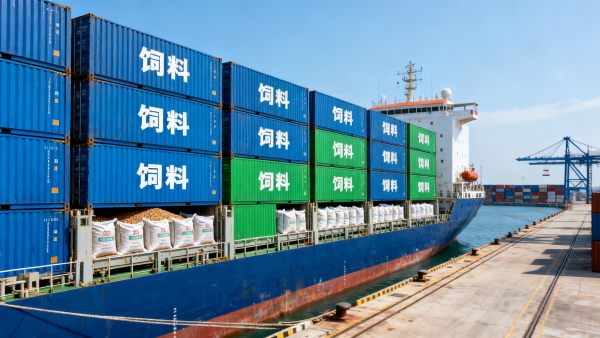
Major container shipping alliances — Maersk, MSC, and CMA CGM — implemented dynamic slot allocation on key Asia-Europe routes (FE2/FE4/NEU) effective May 15, 2026, driving an 18% increase in spot freight rates for Commercial Feed Pellets to Europe. This development directly impacts agricultural exporters, feed manufacturers, and logistics planners reliant on predictable maritime capacity and cost structures.
Event Overview
On May 6, 2026, Maersk, Mediterranean Shipping Company (MSC), and CMA CGM jointly announced that, effective May 15, 2026, they would introduce dynamic slot allocation across core Asia-Europe services (FE2, FE4, NEU). The measure follows the normalization of Red Sea rerouting and a recent increase in Suez Canal transit fees. Under the new regime, bulk agricultural commodities — specifically Commercial Feed Pellets — have been assigned lower booking priority. Spot freight rates for these goods rose by 18% compared to April 2026 averages, and a Green Fuel Surcharge (GFA) of USD 320 per TEU has been added.
Industries Affected
Direct Exporters of Commercial Feed Pellets
Exporters shipping feed pellets from Asia (e.g., China, Vietnam, Thailand) to European markets face immediate pressure on landed cost competitiveness. Lower booking priority means longer wait times for confirmed sailings and higher reliance on spot-market pricing — both of which reduce margin visibility and contract enforceability.
Feed Ingredient Procurement & Blending Firms
Firms sourcing raw materials (e.g., soybean meal, wheat bran) for pellet production may experience cascading cost effects if upstream suppliers pass on higher export logistics costs. Delayed or fragmented shipments can also disrupt just-in-time blending schedules, especially for EU-registered facilities subject to strict delivery windows under feed safety regulations.
Integrated Agri-Processing & OEM Feed Manufacturers
Manufacturers operating under OEM agreements with European distributors are exposed to contractual risk: fixed-price supply contracts may no longer be viable without renegotiation, as the 18% freight increase — plus GFA — materially alters landed cost benchmarks. This may trigger commercial discussions around cost-sharing clauses or revised Incoterms.
Freight Forwarders & NVOCCs Serving Agri-Commodity Clients
Third-party logistics providers handling Commercial Feed Pellet shipments must now manage tighter capacity windows and more volatile rate quotes. Their ability to secure space and provide reliable ETAs is diminished, increasing operational complexity and client service expectations around contingency planning.
What Stakeholders Should Monitor and Do Now
Track official alliance communications for route-specific implementation details
The announcement references ‘dynamic slot allocation’ but does not define frequency, algorithmic criteria, or appeal mechanisms. Stakeholders should monitor carrier portals and alliance bulletins for updates on how slot prioritization is applied per vessel, port pair, and cargo type — particularly whether pellet shipments are excluded from certain sailings entirely.
Assess exposure by shipment lane and contract term
Not all Asia-Europe lanes are equally affected: FE2 (Far East–North Europe) and NEU (North Europe Loop) carry higher volumes of agri-bulk than FE4 (Far East–Mediterranean). Companies should map current export lanes against the three named services and prioritize renegotiation or alternative routing where possible — especially for time-sensitive or high-margin orders.
Distinguish between surcharge applicability and base-rate inflation
The USD 320 GFA is a separate, transparently labeled fee — distinct from the 18% base freight increase. For financial reporting and cost modeling, stakeholders should isolate GFA as a regulatory/compliance-related cost, while treating the base-rate hike as structural market adjustment. This separation supports accurate P&L attribution and future scenario planning.
Review and update contingency plans for Q3 2026 bookings
Given the May 15 implementation date, Q3 2026 shipments are already entering the new regime. Exporters should finalize alternative arrangements — such as staggered loading, partial air-freight for urgent orders, or pre-booking under long-term contracts — before mid-June, when carrier slot calendars for July departures typically close.
Editorial Perspective / Industry Observation
Observably, this move signals a structural shift — not a temporary spike. The formalization of ‘dynamic slot allocation’ reflects carriers’ strategic pivot toward yield management over volume maximization, especially for low-yield, high-volume commodity cargoes. Analysis shows that the combination of permanent Red Sea diversions and green fuel mandates is accelerating capacity rationalization on major east-west corridors. From an industry perspective, this is less a short-term cost shock and more an early indicator of how decarbonization policies and geopolitical risk are being operationalized within liner shipping’s commercial framework. Continuous monitoring is warranted, as further adjustments to GFA levels or slot rules may follow IMO 2027 carbon intensity targets.
Conclusion
While the 18% freight increase for Commercial Feed Pellets is quantifiable, its broader significance lies in the institutionalization of differentiated access to maritime capacity. This development underscores a growing divergence in shipping terms between premium, time-sensitive cargo and standardized bulk commodities. Stakeholders are advised to treat this not as an isolated tariff change, but as a signal of evolving carrier strategy — one where predictability, priority, and environmental compliance are increasingly priced as distinct service attributes.
Information Sources
Primary source: Joint carrier advisory issued by Maersk, MSC, and CMA CGM on May 6, 2026, referencing implementation effective May 15, 2026. Route designations (FE2/FE4/NEU), cargo classification (Commercial Feed Pellets), and surcharge amount (USD 320/TEU) are confirmed in the announcement. Ongoing observation is recommended for potential revisions to GFA application scope or slot allocation methodology beyond the initial rollout period.
Related Intelligence
- Commercial Feed PelletSingapore’s Aquaculture Tech FastTrack Extends to Commercial Feed PelletsAquaculture Tech FastTrack now covers Commercial Feed Pellets — unlock 72-hour Singapore clearance with CNAS test reports. Key for China-Singapore feed exporters, labs & importers.
- Commercial Feed PelletFeed & Grain processing technology that cuts raw material lossFeed & Grain processing technology that cuts raw material loss helps processors improve yield, moisture control, traceability, and ROI—see which systems deliver measurable savings.
- Commercial Feed PelletSinking fish feed machine and the cost of poor water stabilitySinking fish feed machine selection affects feed waste, water quality, and ROI. Learn how better pellet stability cuts hidden aquaculture costs and improves long-term performance.
The Morning Broadsheet
Daily chemical briefings, market shifts, and peer-reviewed summaries delivered to your terminal.
