
The Authority in Global Agricultural Chemistry & Bio-Resources
Feed & Grain processing technology that cuts raw material loss
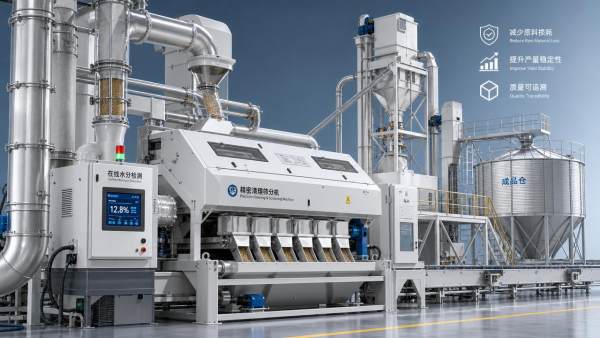
In a market where input costs, compliance pressure, and supply chain volatility directly affect margins, Feed & Grain processing technology has become a strategic lever for reducing raw material loss. For enterprise decision-makers, understanding how advanced systems improve yield, traceability, and operational consistency is essential to protecting profitability and strengthening procurement performance across modern processing operations.
For most buyers and operators searching for Feed & Grain processing technology that cuts raw material loss, the question is not whether better equipment exists. The real question is which technologies measurably reduce shrink, dust, moisture-related spoilage, handling loss, and formulation inconsistency without creating unacceptable capital burden or operational disruption.
The short answer is that loss reduction is no longer driven by one machine alone. It comes from an integrated processing approach that combines raw material intake control, precision cleaning, optimized grinding, intelligent batching, controlled thermal treatment, efficient conveying, and data-led quality assurance. Businesses that treat these elements as one system usually achieve better yield protection than those that upgrade isolated assets.
For enterprise leaders, the decision should therefore be framed in commercial terms: where loss occurs today, which technologies address the largest sources of waste, how quickly savings can be verified, and what operational risks are removed at the same time. That is where Feed & Grain processing technology delivers its strongest value.
What enterprise buyers actually need from Feed & Grain processing technology
Decision-makers in feed mills, grain handling operations, integrated farming groups, and ingredient processing businesses are typically not looking for abstract innovation. They want technology that protects expensive raw materials from avoidable loss while supporting throughput, compliance, and product consistency.
In practical terms, that means answering five business-critical concerns. First, how much raw material is currently being lost between intake and finished output. Second, whether the root causes are mechanical, procedural, or quality-related. Third, which technology upgrades will produce the fastest payback. Fourth, whether the new system improves traceability and audit readiness. Fifth, whether implementation can be managed without damaging supply commitments.
This search intent is strongly commercial and evaluative. Readers want a framework for judging value, not a generic overview of processing. They are trying to identify which investments genuinely reduce waste and which vendor claims are difficult to verify in real production environments.
That is why the most useful way to assess Feed & Grain processing technology is through the lens of loss points. Once loss is mapped across receiving, storage, cleaning, grinding, dosing, conditioning, pelleting, drying, cooling, and packaging, investment priorities become much easier to defend internally.
Where raw material loss really occurs in feed and grain operations
Raw material loss is often underestimated because it is dispersed across multiple stages and recorded under different categories. Some losses are visible, such as spillage, dust, broken kernels, and rejected batches. Others are hidden, including moisture deviation, over-processing, formulation drift, cross-contamination, and unplanned downgrading of finished product quality.
At intake, poor sampling and weak segregation practices can allow wet, contaminated, or inconsistent loads to enter the system. That creates downstream yield loss long before materials reach the grinder or mixer. In storage, inadequate aeration and monitoring can lead to insect activity, mold growth, caking, or moisture migration, all of which reduce usable volume and increase rejection risk.
During cleaning and pre-processing, loss may arise from overly aggressive separation settings that remove acceptable material with impurities. In grinding, the wrong screen size, hammer wear, or unstable feed rate can create excess fines, uneven particle size, and higher dust loss. In batching and mixing, poor dosing accuracy results in giveaway, inconsistent nutrient levels, or expensive rework.
Thermal processing stages such as conditioning, pelleting, extrusion, drying, and cooling can also erode value. Excess heat, poor moisture control, and inadequate residence time may reduce nutritional quality, damage fragile ingredients, or require more raw material input to hit output specifications. Finally, conveying and packaging systems contribute their own losses through leakage, retention, segregation, and product breakage.
For management teams, this means loss reduction should not be viewed as a maintenance issue alone. It is a cross-functional margin management issue involving procurement, quality, production, engineering, and compliance.
Technologies that deliver the biggest reduction in raw material loss
Not every technology upgrade has equal financial impact. The best-performing investments are usually those that improve control over raw material variability and stabilize process parameters at critical points. In many operations, the highest-return technologies are advanced cleaning systems, automated moisture management, precision dosing, smart grinding controls, and enclosed conveying solutions.
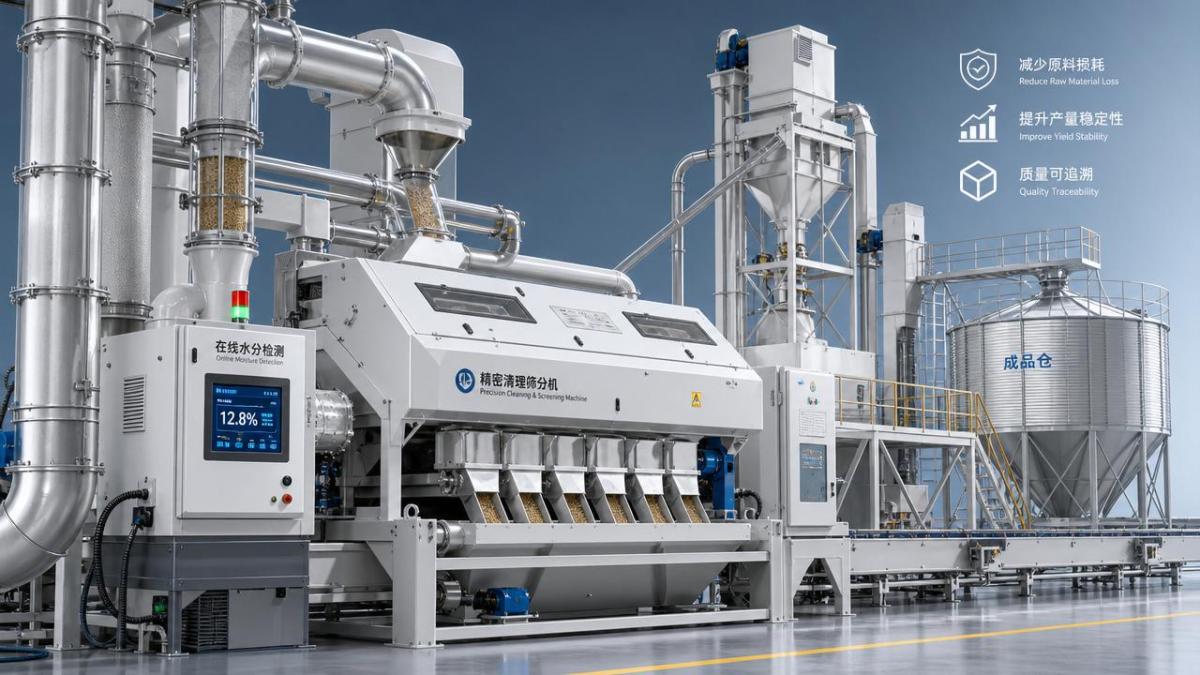
Modern cleaning and separation equipment helps reduce loss by removing stones, metal, husks, and foreign matter without unnecessarily discarding usable grain. Optical sorting and sensor-assisted separation are especially valuable where incoming quality is inconsistent or where contamination events carry major financial or regulatory consequences.
Moisture control systems are another priority area. Grain and feed ingredients are highly sensitive to water content. Too much moisture increases spoilage risk and storage instability; too little may cause avoidable weight loss and product brittleness. Inline moisture analyzers, automated tempering, and controlled drying systems allow processors to preserve usable mass while keeping product within specification.
Grinding technology has a direct effect on yield, digestibility, energy use, and downstream stability. Variable-speed drives, automated load balancing, wear monitoring, and particle size measurement help operators avoid over-grinding and unnecessary fines. These features reduce dust, improve pelleting behavior, and protect nutritional uniformity.
In batching and mixing, loss is often created by inaccurate inclusion rates or excessive safety margins. High-precision dosing systems, recipe automation, and real-time verification tools reduce ingredient giveaway and lower the chance of costly off-spec production. This is especially important when using high-value additives, enzymes, premixes, oils, or specialty proteins.
Conveying also deserves more attention than it often receives. Pneumatic and mechanical conveying systems that are poorly sealed or incorrectly configured can generate continuous, low-visibility loss. Enclosed conveyors, optimized transfer points, dust recovery systems, and reduced-drop handling layouts can significantly improve mass retention while creating cleaner and safer facilities.
Why data visibility now matters as much as machine performance
Many companies already own reasonably capable processing equipment but still experience unexplained loss because they lack reliable process visibility. Feed & Grain processing technology creates the most value when hardware is connected to measurement, alarms, analytics, and traceability tools that turn loss into something observable and manageable.
For example, inline sensors can monitor moisture, temperature, throughput, particle size, and energy use in real time. When these signals are integrated into supervisory control systems, operators can intervene before small deviations become material losses. Instead of discovering shrink after a production run, teams can identify the exact point where conditions moved outside target range.
For executives, this data layer matters because it supports stronger procurement and financial control. If certain suppliers or crop origins consistently create more cleaning waste, more moisture correction, or lower conversion efficiency, purchasing teams can renegotiate specifications or diversify sourcing. If certain formulas generate chronic giveaway, formulation and production teams can adjust parameters with confidence.
Traceability is another major advantage. In increasingly regulated markets, it is not enough to produce efficiently. Businesses must also prove what happened, when it happened, and which lot was affected. Digital records tied to Feed & Grain processing technology make internal audits easier, support customer assurance requirements, and reduce the commercial damage of disputes or recalls.
How to evaluate ROI without relying on optimistic vendor assumptions
Executives should resist evaluating new systems on throughput claims alone. The stronger method is to build a loss-based business case using current operating data. Start by quantifying annual raw material loss across categories such as intake rejection, moisture shrink, dust extraction, spillage, fines generation, formulation giveaway, rework, and downgraded finished product.
Next, assign value to each category using actual material cost, not average assumptions. A one percent loss in corn or wheat has a different impact than a one percent loss in amino acids, oils, or specialized functional ingredients. A realistic ROI model should also include indirect savings such as lower cleaning labor, fewer shutdowns, reduced pest incidents, lower complaint rates, and improved production scheduling.
Then compare technology options based on measurable intervention points. A moisture control system should show expected improvement in target moisture retention and spoilage prevention. A grinding upgrade should show expected reduction in fines and energy waste. A dosing system should show projected reduction in ingredient giveaway. If the benefit cannot be linked to a defined loss mechanism, the investment case is probably too weak.
Implementation cost must also be assessed honestly. This includes installation downtime, training, integration with existing controls, spare parts strategy, calibration requirements, and service support availability. The right Feed & Grain processing technology is not simply the most advanced solution. It is the solution that can be sustained operationally and verified financially within the site’s real constraints.
Many enterprise buyers find that a phased approach produces the best return. Rather than replacing an entire line, they target the highest-loss nodes first, validate results, and scale improvements using plant-specific data. This reduces risk and strengthens internal capital approval.
Risk reduction and compliance benefits that strengthen the business case
Raw material loss is not only a cost issue. It often correlates with compliance exposure, quality failures, and customer confidence problems. Technologies that improve containment, consistency, and monitoring therefore generate value beyond direct yield protection.
Dust control systems, for instance, reduce housekeeping burden and product loss, but they also improve worker safety and lower explosion risk. Better cleaning and metal detection reduce contamination exposure and support food and feed safety protocols. Stable conditioning and thermal control improve pathogen management and process repeatability, which is increasingly important in regulated and export-oriented markets.
From a board-level perspective, this matters because operational volatility can damage more than monthly margin. It can disrupt contracts, trigger claims, undermine brand trust, and increase scrutiny from customers or regulators. When Feed & Grain processing technology reduces both loss and variability, it improves resilience across the entire commercial model.
For multinational or multi-site businesses, standardization is another strategic benefit. Common control architecture, data definitions, and quality checkpoints make it easier to benchmark plants, transfer best practice, and maintain procurement discipline across regions. This is especially valuable in periods of volatile commodity pricing, when small differences in yield performance can materially affect enterprise-wide profitability.
What a strong technology selection process looks like
The most successful procurement decisions are made by combining technical review with commercial discipline. First, establish a baseline: current loss rates, throughput, downtime, quality deviation frequency, and cost of non-conformance. Second, prioritize the top three loss drivers by economic impact rather than by visibility or internal frustration.
Third, ask suppliers to address those exact loss drivers with site-specific proposals. Generic brochures are not enough. Vendors should be able to explain the mechanism of improvement, expected performance range, maintenance profile, and data outputs. They should also clarify which results depend on upstream material quality or operator behavior.
Fourth, validate with references from facilities handling similar formulations, grain types, climate conditions, and production volumes. A technology that performs well in one context may not deliver the same savings in another. Fifth, define post-installation verification metrics before purchase. If success is not measured in advance, claimed savings may remain anecdotal and difficult to defend.
Finally, involve the right internal stakeholders early. Operations, maintenance, quality, procurement, finance, and compliance teams all see different parts of the value equation. Their alignment is essential if the business wants to capture the full benefit of Feed & Grain processing technology rather than simply adding equipment complexity.
Conclusion: the best loss-reduction strategy is a systems strategy
For enterprise decision-makers, the most important conclusion is clear: raw material loss in feed and grain processing is rarely caused by a single weak asset, and it is rarely solved by a single equipment purchase. The strongest results come from a systems strategy that identifies where value is leaking, applies the right control technologies, and verifies gains through data.
In that context, Feed & Grain processing technology should be evaluated as a profit-protection tool, not just a production upgrade. The right investment can reduce shrink, improve formulation accuracy, strengthen compliance, increase traceability, and create more stable procurement outcomes. Those advantages become especially significant when raw material markets are volatile and customer expectations are rising.
Businesses that act early and selectively tend to gain the most. By focusing first on the highest-cost loss points, building a measurable ROI case, and choosing technologies that fit operational reality, processors can convert waste reduction into a durable competitive advantage.
Related Intelligence
- Commercial Feed PelletSingapore’s Aquaculture Tech FastTrack Extends to Commercial Feed PelletsAquaculture Tech FastTrack now covers Commercial Feed Pellets — unlock 72-hour Singapore clearance with CNAS test reports. Key for China-Singapore feed exporters, labs & importers.
- Commercial Feed PelletFeed & Grain processing technology that cuts raw material lossFeed & Grain processing technology that cuts raw material loss helps processors improve yield, moisture control, traceability, and ROI—see which systems deliver measurable savings.
- Commercial Feed PelletSinking fish feed machine and the cost of poor water stabilitySinking fish feed machine selection affects feed waste, water quality, and ROI. Learn how better pellet stability cuts hidden aquaculture costs and improves long-term performance.
The Morning Broadsheet
Daily chemical briefings, market shifts, and peer-reviewed summaries delivered to your terminal.
