
CMA CGM Launches Feed-PelletShield on Asia-Africa Routes
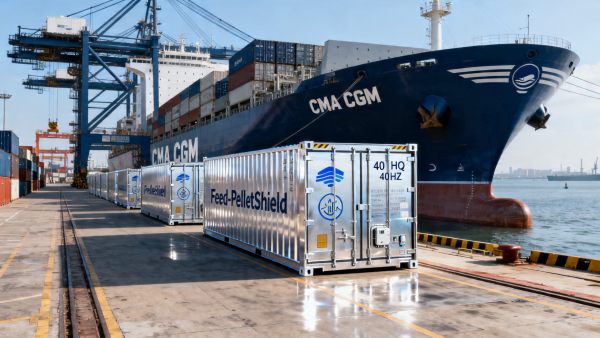
On April 19, 2026, CMA CGM announced the full deployment of its new ‘Feed-PelletShield’ container — a humidity-controlled, hermetically sealed unit designed specifically for commercial feed pellet shipments — on its Shanghai–Jeddah–Mombasa–Durban service. The move follows renewed Red Sea disruptions and directly impacts feed exporters, freight buyers, and logistics planners across Asia and Africa.
Event Overview
On April 19, 2026, CMA CGM confirmed the operational launch of the ‘Feed-PelletShield’ container across its Asia–Africa route (Shanghai–Jeddah–Mombasa–Durban). The unit features active dehumidification and modified-atmosphere sealing technology. As a result, 40HQ freight rates on this lane rose by 8.3% week-on-week. Capacity is now subject to allocation quotas. Exporters of commercial feed pellets in South and East China have begun receiving initial booking confirmations, with cargo cut-off windows tightened to five business days.
Industries Affected
Direct Exporters (Feed Pellet Manufacturers)
These companies face tighter scheduling and higher landed costs. The quota system and shortened 5-day delivery window constrain production planning and inland transport coordination. Rate increases also compress export margins unless passed on — which may affect competitiveness in price-sensitive African markets.
Freight Forwarders & NVOCCs Serving Feed Trade
Forwarders handling feed pellet shipments must now manage dual constraints: limited slot availability and stricter documentation timelines. Pre-booking lead times have effectively shortened, and real-time visibility into Feed-PelletShield allocations becomes operationally critical.
Logistics Providers (Inland Haulage, Warehousing)
With cargo cut-off compressed to five business days, inland hauliers and bonded warehouses near Shanghai, Ningbo, and Guangzhou ports face intensified pressure on yard turn times, customs clearance sequencing, and container staging. Delays at any node risk automatic slot cancellation under the new regime.
African Importers & Feed Mill Operators
Importers in Jeddah, Mombasa, and Durban may experience reduced shipment frequency and less flexibility in order batching. The controlled environment improves pellet quality retention but does not offset potential supply volatility introduced by quota-based allocation.
What Stakeholders Should Monitor and Do Now
Track official allocation updates from CMA CGM’s regional feeder desks
CMA CGM has not published public quota thresholds or weekly release calendars. Exporters and forwarders should proactively engage local CMA CGM offices for slot forecast visibility — especially given the absence of open booking channels for Feed-PelletShield units.
Confirm eligibility and documentation requirements before tendering cargo
The Feed-PelletShield is designated exclusively for commercial feed pellets. Mixed or non-compliant cargo may be rejected without recourse. Shippers must verify product classification (e.g., HS 2309.90) and moisture content certifications prior to booking.
Reassess inland transit timelines and buffer stock levels
A five-business-day cut-off window reduces margin for error in factory dispatch, customs filing, and port entry. Exporters should review current inland lead times and consider holding minimal safety stock at origin terminals to avoid missed sailings.
Differentiate between rate impact and service reliability signals
The 8.3% freight increase reflects infrastructure cost and capacity restriction — not general market-wide inflation. It applies only to Feed-PelletShield bookings on this specific lane. Other commodity types or alternate routes remain unaffected unless similarly specialized equipment is rolled out.
Editorial Perspective / Industry Observation
From an industry perspective, this initiative is better understood as a targeted infrastructure response — not a broad tariff shift. The Feed-PelletShield addresses documented quality loss in feed pellets during prolonged maritime transit through humid, high-salinity zones like the Red Sea and Indian Ocean. Analysis来看, the quota system and compressed cut-off window suggest CMA CGM is prioritizing service consistency over volume scalability in the short term. Observation来看, this is less a pricing signal than a capacity recalibration: it reveals how carriers are segmenting equipment by cargo sensitivity rather than applying blanket surcharges. Current more relevant interpretation is that temperature- and humidity-sensitive agri-exports are entering a new tier of containerized logistics — one where equipment specification, not just vessel space, defines booking eligibility.
This development underscores a structural shift: specialized container solutions are becoming operational prerequisites — not optional upgrades — for certain agricultural exports. It signals growing carrier involvement in cargo integrity management, particularly where spoilage risk affects end-market viability. For stakeholders, the priority is not whether the model spreads, but how quickly similar specifications may emerge on other lanes serving moisture-sensitive commodities (e.g., starches, certain fertilizers, or animal proteins).
Conclusion
The launch of the Feed-PelletShield is not merely a freight adjustment — it reflects an evolving carrier role in preserving cargo quality across volatile trade corridors. Its significance lies in operational specificity: it affects only a narrow set of shippers, on one route, for one cargo type. It is best interpreted not as a market-wide trend, but as an early indicator of how ocean carriers may increasingly differentiate service by technical capability — not just schedule or price. Stakeholders should treat it as a case study in adaptive logistics, not a precedent requiring immediate replication.
Source Attribution
Main source: Official CMA CGM service announcement dated April 19, 2026. No third-party data, analyst commentary, or supplementary background has been incorporated. Quota mechanics, exact moisture thresholds, and future route expansion plans remain unconfirmed and require ongoing monitoring.
Related Intelligence
- Commercial Feed PelletCMA CGM Launches Feed-PelletShield on Asia-Africa RoutesFeed-PelletShield by CMA CGM launches on Asia–Africa routes—humidity-controlled, hermetically sealed containers for feed pellets. Boost quality, secure slots, act now.
- Commercial Feed PelletIndia’s Feed Pellet Machinery Import Shift Impacts Global SuppliersIndia’s feed pellet machinery import shift drives 210% surge in Chinese exports—key insight for global suppliers navigating tariffs, tech transfer, and localization.
- Commercial Feed PelletRed Sea Crisis Drives Up Asia-Europe Freight Costs, Feed Pellet FOB Prices Rise 8–12%Red Sea Crisis drives Asia-Europe freight costs up—Commercial Feed Pellet FOB prices rise 8–12%. Critical insight for exporters, traders & importers navigating supply chain volatility.
The Morning Broadsheet
Daily chemical briefings, market shifts, and peer-reviewed summaries delivered to your terminal.
