
FAO Launches Global Ventilation Supplier Registry
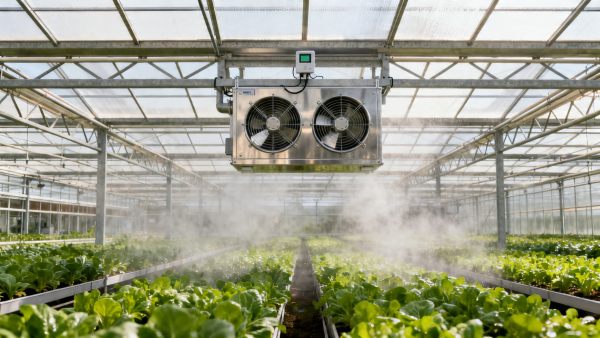
On April 17, 2026, the Food and Agriculture Organization of the United Nations (FAO) launched the ‘Climate-Smart Agri-Ventilation Global Supplier Registry’ — a new procurement reference framework for climate-resilient agricultural ventilation systems. The initiative directly impacts manufacturers, exporters, and project implementers in climate control & ventilation equipment, particularly those engaged in international development-funded infrastructure projects in Africa and Latin America.
Event Overview
On April 17, 2026, FAO officially initiated the ‘Climate-Smart Agri-Ventilation Global Supplier Registry’. The first published list includes 37 ventilation equipment suppliers globally that meet both ISO 50001 (energy management) and IEC 60335-2-80 (safety) certification requirements. Of these, 12 are based in China — including three recognized leaders in the Climate Control & Ventilation segment. The registry is designated as the preferred supplier source for FAO-funded agricultural infrastructure projects in Africa and Latin America, and remains valid for three years.
Industries Affected
Direct Exporters & Trade Enterprises
Export-oriented ventilation equipment manufacturers — especially those targeting public-sector or multilateral-funded projects — face an immediate shift in procurement gateways. Inclusion in the registry signals eligibility for FAO-backed tenders; non-inclusion may restrict access to a growing share of climate-adaptation infrastructure budgets in priority regions.
Manufacturing & OEM Producers
Producers supplying components or assembled units for ventilation systems must verify whether their end-product certifications align with the dual ISO 50001 + IEC 60335-2-80 requirement. Certification gaps may delay integration into registered suppliers’ supply chains or trigger requalification efforts.
Supply Chain & Distribution Intermediaries
Distributors and channel partners serving FAO-eligible markets may experience tightening specification requirements from downstream buyers. Procurement documentation increasingly references registry compliance, raising due diligence demands on product traceability and certification validity.
What Enterprises and Practitioners Should Monitor and Do Now
Track official updates on registry expansion and renewal criteria
The current list covers only the initial cohort. FAO has not yet published timelines or thresholds for future additions or annual reviews. Stakeholders should monitor FAO’s official procurement portals and technical guidance documents for procedural clarity beyond the April 2026 launch.
Verify certification scope and regional applicability
ISO 50001 and IEC 60335-2-80 certifications must explicitly cover ventilation equipment for agricultural applications — not generic industrial use. Enterprises should confirm certificate scope language and ensure test reports reflect applicable climatic and operational conditions (e.g., high-humidity tropical environments).
Distinguish between policy signal and procurement reality
While the registry is designated as a ‘specified procurement basis’, actual tender documents issued by FAO implementing partners may retain discretion in evaluation weightings. Analysis来看, inclusion does not guarantee award — but omission significantly reduces competitive standing in FAO-aligned bids.
Prepare documentation for potential pre-qualification submissions
Suppliers not yet listed — especially those with certified products — should compile audit reports, test certificates, and energy performance data now. FAO may introduce streamlined application windows; readiness reduces time-to-response if future cohorts open.
Editorial Observation / Industry Perspective
From industry angle, this registry is less a finalized procurement mandate and more a structured signal of FAO’s institutional pivot toward standardized, verifiable climate-smart hardware in agricultural infrastructure. It formalizes technical due diligence previously handled ad hoc across country offices. Observation来看, its three-year validity suggests FAO intends it as a stable reference — not a pilot — but scalability depends on uptake by regional implementing agencies and donor alignment. Current more suitable interpretation is: a threshold-setting mechanism gaining operational traction, not yet a closed ecosystem.
Conclusion: The FAO registry marks a procedural consolidation in how climate-resilient ventilation equipment enters multilateral agricultural projects. Its significance lies not in immediate market share shifts, but in establishing a replicable, certification-based benchmark — one that prioritizes energy efficiency and safety as non-negotiable entry criteria. For stakeholders, it is best understood as an evolving procurement anchor point requiring ongoing verification, not a one-time qualification.
Source: Food and Agriculture Organization of the United Nations (FAO), official announcement dated April 17, 2026. Note: Future cohort timelines, application procedures, and implementation guidelines remain pending official publication and are subject to observation.
Related Intelligence
- Climate Control & VentilationFAO Launches Global Ventilation Supplier RegistryFAO Launches Global Ventilation Supplier Registry — Get listed now to access FAO-funded climate-smart agri-ventilation projects in Africa & Latin America.
- Climate Control & VentilationFAO Adopts China's GB/T 39021-2025 as Asia-Pacific BenchmarkGB/T 39021-2025 adopted by FAO as Asia-Pacific benchmark—key for climate control manufacturers, exporters & integrators seeking competitive edge in green agri-infrastructure projects.
- Climate Control & VentilationJiangxia Zanglong Island Semiconductor Park Launches Land Acquisition for MEMS Sensor ExpansionJiangxia Zanglong Island Semiconductor Park launches MEMS sensor expansion — boosting domestic high-precision pressure & humidity/temperature chip supply for smart CCV systems.
The Morning Broadsheet
Daily chemical briefings, market shifts, and peer-reviewed summaries delivered to your terminal.
