
Aksu Cotton Mills at Full Capacity; Cottonseed Protein Export Stability Rises
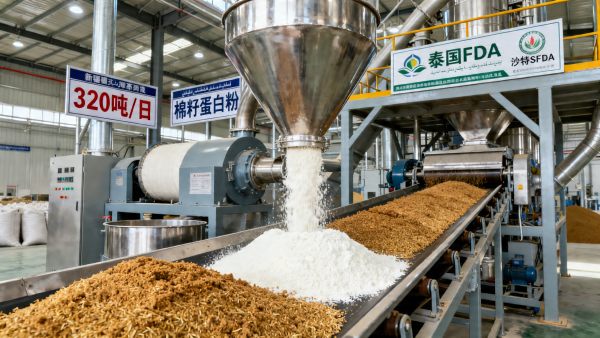
On April 1, 2026, key cotton spinning enterprises in Aksu Prefecture, Xinjiang, achieved 100% capacity utilization. Daily output of cottonseed protein powder and cottonseed meal rose to 320 metric tons. With regulatory approvals secured from Thailand’s FDA and Saudi Arabia’s SFDA, this plant-based protein source is increasingly adopted by commercial feed pellet manufacturers in Southeast Asia and the Middle East as a fishmeal alternative — supported by a 99.2% delivery reliability rate (Q1 2026 customs data). Feed ingredient buyers, international traders, and compound feed producers should monitor supply consistency, regional registration status, and formulation adaptability closely.
Event Overview
As of April 1, 2026, major cotton textile mills in Aksu, Xinjiang, operated at full (100%) production capacity. Daily output of cotton-derived by-products — specifically cottonseed protein powder and cottonseed meal — reached 320 tonnes. These products have completed import registration with Thailand’s Food and Drug Administration (FDA) and Saudi Arabia’s Saudi Food and Drug Authority (SFDA). According to Q1 2026 customs data, on-time delivery performance for these exports stood at 99.2%.
Impact on Specific Industry Segments
Direct Export-Trading Firms
These firms face increased demand visibility for cottonseed protein in regulated markets. The dual-country registrations (Thailand and Saudi Arabia) reduce pre-shipment compliance risk for shipments to those jurisdictions — but do not automatically extend to other ASEAN or GCC members. Delivery stability data (99.2%) signals improved operational predictability, though it reflects only one quarter and one origin region.
Feed Ingredient Procurement Teams
Purchasers sourcing plant-based alternatives to fishmeal — especially for aquafeed and poultry feed formulations — now have a more stable, registered supply option from Northwest China. However, cottonseed protein’s amino acid profile differs from fishmeal; formulation recalibration may be needed before full substitution. Current volume (320 t/day) remains modest relative to regional feed pellet production scales.
Commercial Feed Pellet Manufacturers (Southeast Asia & Middle East)
For pellet producers in Thailand, Vietnam, Saudi Arabia, and UAE, this development offers a new, locally registered raw material channel. Regulatory alignment lowers documentation lead time and customs clearance uncertainty. Yet, consistent inclusion requires verification of batch-to-batch nutritional consistency, mycotoxin screening, and storage stability under tropical or arid conditions — none of which are addressed in the available information.
Supply Chain & Logistics Service Providers
Firms managing cold-chain-optional, dry-bulk agricultural ingredient logistics between Xinjiang and key feed hubs (e.g., Laem Chabang, Jubail) may see incremental tender volume. The 99.2% delivery reliability figure applies to shipped weight and schedule adherence — not quality conformance or documentation accuracy. Service providers should verify whether current contracts include clauses covering origin-specific phytosanitary certification or residual pesticide testing requirements.
What Relevant Enterprises or Practitioners Should Monitor and Act On
Track regulatory expansion beyond Thailand and Saudi Arabia
Current registrations apply only to two markets. Analysis来看, broader adoption hinges on additional country-level approvals — particularly in Indonesia, Malaysia, Egypt, and Morocco, where feed import volumes are high and fishmeal substitution pressure is rising. Monitor official announcements from China’s General Administration of Customs and importing-country food/agriculture authorities.
Validate technical specifications against formulation needs
From industry角度看, cottonseed protein powder is not a drop-in replacement for fishmeal due to lysine/methionine ratios and fiber content. Current public data does not specify protein concentration, solvent residue levels, or gossypol limits. Procurement teams should request updated Certificates of Analysis (CoA) per shipment and conduct small-batch trials before scaling usage.
Assess supply scalability against stated capacity
Observation来看, 320 tonnes/day equals ~117,000 tonnes/year — sufficient for several mid-sized feed mills but insufficient to displace regional fishmeal imports at scale. Firms planning long-term contracts should clarify whether this output level reflects sustained capacity or short-term peak operation, and whether further upstream cottonseed processing investments are underway.
Prepare for documentation harmonization across markets
Current registrations required separate dossiers per jurisdiction. For firms targeting multiple countries, it is advisable to consolidate labeling, traceability records, and analytical methods now — rather than adapting post-approval. This includes aligning with Codex Alimentarius standards for feed ingredients where applicable.
Editor Perspective / Industry Observation
This development is better understood as an early-stage supply chain signal — not yet a structural shift. The combination of full mill utilization, registered market access, and high delivery reliability indicates growing operational maturity in Xinjiang’s cotton by-product valorization. However, analysis来看, it remains a niche-volume, dual-market entry point. Its significance lies less in immediate volume impact and more in demonstrating replicable pathways for regulatory acceptance of inland Chinese agricultural co-products in competitive feed ingredient markets. Sustained relevance will depend on transparency in quality parameters, consistency in export documentation, and responsiveness to downstream formulation feedback.
Conclusion
This update reflects progress in stabilizing and formalizing one specific agro-industrial supply link: cottonseed-derived protein from Aksu into regulated feed markets. It does not signal broad-based displacement of marine or soy-based proteins, nor does it imply automatic scalability. Rather, it marks a measurable step toward institutionalized cross-border trade in a traditionally under-monetized textile by-product. For stakeholders, the current takeaway is pragmatic: treat it as a newly viable, low-risk option for targeted formulation trials — not as a wholesale raw material pivot.
Information Sources
Main source: Official production and export data released by Xinjiang Uygur Autonomous Region Department of Industry and Information Technology (April 2026); supporting customs reliability metrics from General Administration of Customs of China (Q1 2026 summary). Note: Ongoing observation is required for regulatory status in markets beyond Thailand and Saudi Arabia, and for publicly disclosed quality specifications (e.g., crude protein %, gossypol content, aflatoxin levels).
Related Intelligence
- Commercial Feed PelletAksu Cotton Mills at Full Capacity; Cottonseed Protein Export Stability RisesAksu cotton mills hit 100% capacity; cottonseed protein exports surge with Thailand & Saudi FDA approvals—99.2% delivery reliability drives feed ingredient buyers’ interest.
- Commercial Feed PelletChina’s LiFePO4 Battery Recycling Enters Deep WaterLiFePO4 battery recycling in China now recovers food-grade phosphate—cutting carbon by 42%. Discover how this breakthrough impacts feed, aquaculture & EU procurement.
- Commercial Feed PelletAksu Cotton Mill Boosts Feed Pellet Protein SupplyAksu Cotton Mill boosts feed pellet protein supply with certified 52%+ cottonseed meal—ideal for Southeast Asia & Middle East feed producers seeking soybean meal alternatives.
The Morning Broadsheet
Daily chemical briefings, market shifts, and peer-reviewed summaries delivered to your terminal.
