
2026 CHINASHOP Introduces 'Low-Alcohol Zone' for Botanical Extracts
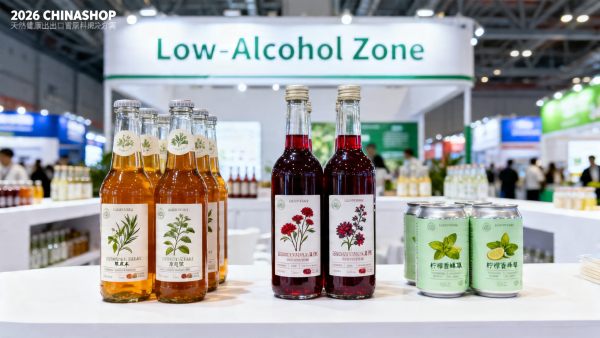
At the 2026 CHINASHOP exhibition held April 9–11, the debut of a dedicated ‘Low-Alcohol Zone’ spotlighted emerging demand for botanical extracts in low-alcohol beverages — particularly among Gen Z consumers in China and expanding export markets. This development signals shifting priorities for ingredient suppliers, natural product formulators, and cross-border trade operators.
Event Overview
The 2026 CHINASHOP exhibition took place from April 9 to 11. For the first time, it featured a dedicated ‘Low-Alcohol Zone’, focusing on craft fruit wines, herbal sparkling drinks, and plant-based low-alcohol beverages. Over 200 suppliers of botanical extracts and natural ingredients participated. According to exhibitor surveys conducted at the event, demand for customized botanical extract blends rose by 37% — driven by formulation needs in this category.
Impact on Specific Industry Segments
Direct Exporters & Trade Enterprises
These firms are affected because the ‘Low-Alcohol Zone’ reflects an observable pivot in buyer sourcing behavior — away from bulk commodity extracts toward application-specific, functionally tuned blends. Impact manifests as tighter specification requirements, shorter lead times for sample validation, and increased requests for regulatory documentation aligned with target markets (e.g., ASEAN, Middle East, Latin America).
Raw Material Procurement Teams
Procurement functions face heightened pressure to qualify new botanical sources and verify traceability across multi-tier supply chains. The 37% rise in custom blend demand — per exhibitor survey — implies greater scrutiny of supplier capability in analytical standardization, batch consistency, and scalable extraction protocols — not just volume pricing.
Contract Manufacturers & Beverage Formulators
Manufacturers supporting low-alcohol beverage brands must now accommodate more complex input matrices: pH-sensitive botanical actives, volatile terpene profiles, and carbonation-compatible solubilizers. This affects process design, stability testing timelines, and co-packing compliance workflows — especially where alcohol content straddles regulatory thresholds (e.g., <0.5% ABV vs. >0.5% ABV).
Distribution & Channel Operators
Channel partners handling specialty beverage launches report accelerated shelf-life expectations and narrower margin bands for trial SKUs. The Gen Z-targeted positioning of these products correlates with higher velocity in experiential retail formats (e.g., pop-up bars, lifestyle boutiques), requiring agile inventory allocation and localized marketing support — not just broad-line logistics.
What Relevant Businesses or Practitioners Should Focus On Now
Monitor official classification updates in key export markets
Current regulatory treatment of low-alcohol beverages varies significantly across Southeast Asia, the Middle East, and Latin America — especially regarding labeling, taxation, and distribution licensing. While CHINASHOP signals commercial interest, actual market access depends on evolving national interpretations of ‘alcoholic’ vs. ‘non-alcoholic’ thresholds.
Track formulation trends in priority categories — not just raw material volumes
The 37% increase in custom botanical blend demand (per exhibitor survey) reflects a shift toward functional synergy — e.g., adaptogenic herbs paired with citrus-derived terpenes for aroma lift. Companies should prioritize technical engagement with R&D teams over transactional purchasing — especially when sourcing from multi-origin botanicals.
Distinguish between show-floor momentum and operational readiness
The ‘Low-Alcohol Zone’ is a trade-show signal — not yet evidence of scaled production adoption. Firms should assess whether their current QC infrastructure, allergen controls, and shelf-life validation protocols meet the stricter expectations of premium low-alcohol beverage brands — before committing to long-term supply agreements.
Prepare for upstream coordination on harvest timing and processing windows
Botanicals used in low-alcohol formats (e.g., hibiscus, schisandra, lemon balm) often require narrow seasonal windows for optimal phytochemical profile. Suppliers should initiate early dialogue with growers on harvest scheduling and post-harvest stabilization — particularly if targeting Q3–Q4 product launches in overseas markets.
Editor Perspective / Industry Observation
From industry perspective, the introduction of the ‘Low-Alcohol Zone’ at CHINASHOP 2026 is best understood as an early-stage demand signal — not yet a mature market outcome. It reflects growing alignment between Chinese ingredient innovation capacity and global consumer preferences around functional lightness, botanical authenticity, and social ritual without intoxication. However, analysis shows that commercial scalability remains constrained by inconsistent regulatory frameworks abroad and limited standardization in botanical extract benchmarking. Current relevance lies less in immediate sales impact and more in its utility as a forward-looking indicator for R&D prioritization and supply chain agility planning.
It is more accurately interpreted as a directional marker than a fully formed trend — one that gains weight only as formulation partnerships mature and export compliance pathways clarify.
Conclusion
This initiative underscores how trade exhibitions increasingly serve as barometers for downstream formulation shifts — not just platforms for product display. For stakeholders across the botanical supply chain, the value lies not in reacting to the zone itself, but in using it to calibrate responsiveness to functional beverage innovation cycles. At present, it is better understood as a catalyst for internal capability assessment — not a trigger for large-scale strategic redirection.
Information Source
Main source: Official CHINASHOP 2026 exhibition program and exhibitor survey data (released April 2026).
Note: Regulatory developments in ASEAN, Middle East, and Latin American markets remain under observation and are not yet reflected in finalized policy texts.
Related Intelligence
- Botanical Extracts2026 CHINASHOP Introduces 'Low-Alcohol Zone' for Botanical ExtractsDiscover the 2026 CHINASHOP 'Low-Alcohol Zone' — where botanical extracts meet Gen Z demand for functional, low-alcohol beverages. Explore trends, compliance insights & formulation shifts.
- Botanical Extracts2026 CHINASHOP Highlights Botanical Extracts & Clean-Label FoodBotanical extracts & clean-label food take center stage at 2026 CHINASHOP — discover certified suppliers, low-alcohol innovations, and global OEM/ODM opportunities.
- Botanical ExtractsAbsolute Oils Wholesale: What Purity Claims Often Leave OutAbsolute oils wholesale explained: uncover what purity claims miss in co2 supercritical extracts, oleoresins wholesale, floral waters bulk, and botanical powders for smarter B2B sourcing.
The Morning Broadsheet
Daily chemical briefings, market shifts, and peer-reviewed summaries delivered to your terminal.
