

The Authority in Global Agricultural Chemistry & Bio-Resources
Aquaculture drum filters and the solids load they often miss
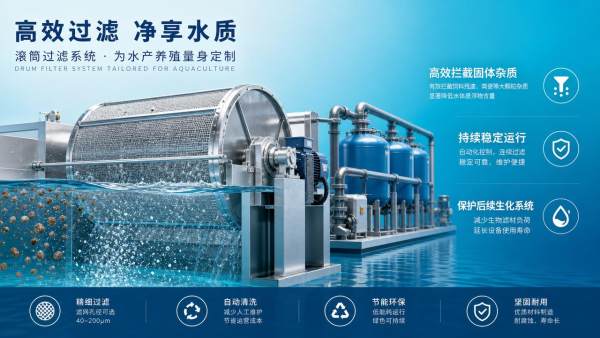
Aquaculture drum filters are often treated as the primary barrier for suspended solids in recirculating and flow-through systems, but technical evaluators know the real question is not whether a drum filter removes solids, but which solids it leaves behind. In practice, many units perform well on larger particles while allowing a significant fine fraction to remain in circulation. That missed load can influence water clarity, oxygen demand, nitrification stability, pathogen pressure, sludge handling, and the performance of downstream treatment stages.
For procurement teams and system designers, the implication is straightforward: specifying aquaculture drum filters by nominal screen size alone is rarely enough. A better evaluation requires understanding particle size distribution, solids characteristics, hydraulic loading, cleaning dynamics, and how the filter interacts with biofilters, degassers, foam fractionation, ozone, or polishing steps. The most useful buying question is not “What micron rating is offered?” but “What solids profile is actually removed under my operating conditions?”
Why aquaculture drum filters miss more solids than many specifications suggest
The core search intent behind this topic is highly practical. Readers are not looking for a basic definition of drum filtration. They want to know where filtration performance falls short, how serious the gap is, and how to judge whether a proposed filter package is adequate for a real production system. For technical assessment personnel, that means separating brochure claims from likely field performance.
Most aquaculture drum filters remove solids through mechanical screening, typically using a rotating drum wrapped in mesh or screen panels. Water passes through the screen while particles larger than the effective opening are retained and then removed by backwash. On paper, this seems simple. In operation, however, capture is affected by more than nominal mesh size.
Fine particles below the screen opening will obviously pass through, but even particles near or above the stated opening may escape depending on particle shape, deformability, velocity, turbulence, solids concentration, screen cleanliness, and whether particles fragment before capture. Fish feces, biofloc fragments, uneaten feed fines, mucus-rich solids, and bacterial aggregates do not behave like rigid test particles. Their geometry and mechanical properties change how they interact with the mesh.
Another issue is that nominal micron ratings can be misunderstood. A 60-micron screen does not mean all particles above 60 microns are captured and all smaller particles pass. Real separation is probabilistic. Capture efficiency varies across a particle size range, and the actual cut point depends on system hydraulics, drum submergence, screen condition, and loading rate. This is one reason two filters with the same advertised micron size can deliver noticeably different water quality outcomes.
Backwash behavior also matters. If the screen loads too quickly, cleaning frequency increases. Aggressive spray cleaning can break fragile solids into smaller particles, effectively converting settleable or screenable waste into a more persistent fine suspended load. Once fragmented, those particles can circulate into the biofilter loop or become more difficult to remove downstream.
Which solids are commonly missed, and why that missed fraction matters
The solids load most often missed by aquaculture drum filters is the fine suspended fraction: particles small enough to pass through the screen or unstable enough to fragment during transport and cleaning. Depending on species, feed type, culture density, and hydraulics, this can include fecal fines, uneaten feed dust, sloughed biofilm, microbial flocs, colloidal organic matter, and precipitated mineral particles.
From a technical standpoint, the concern is not only total suspended solids but the size distribution of those solids. Larger particles are usually easier to capture and easier to settle. Finer particles remain in suspension longer, travel deeper into the treatment train, and create a broader range of secondary effects. They can elevate turbidity, reduce UV transmittance, raise oxygen demand as they degrade, and increase dissolved organic loading.
In recirculating aquaculture systems, these missed fines often become an indirect biofilter issue. As particles are retained within the loop, they undergo mechanical and biological breakdown. Some are mineralized into dissolved compounds, increasing the treatment burden on nitrification and oxidation processes. Others accumulate within media beds or bead filters, reducing hydraulic performance and increasing maintenance frequency.
The fine fraction also has biosecurity implications. Particulate matter can shield microorganisms from disinfection by UV or ozone and can provide surfaces for microbial attachment. Even if a drum filter is not intended as a biosecurity device, the solids it misses can reduce the effectiveness of actual disinfection stages. This matters in hatcheries, broodstock systems, high-value juvenile production, and any operation with tight disease-control requirements.
For sludge management, the issue is equally relevant. If too much fine material bypasses the front-end mechanical stage, less solids mass is concentrated early, and more is dispersed throughout the system. That weakens sludge capture efficiency downstream and can increase the cost of polishing, dewatering, and wastewater handling. What looks like acceptable filter performance at the drum stage may produce higher operating expense elsewhere.
How technical evaluators should assess real capture performance
The most useful procurement mindset is to treat drum filtration as a performance system rather than a component purchase. That means assessing removal efficiency under representative conditions, not just comparing mesh ratings, flow capacities, and motor specifications. A well-structured technical review should begin with the solids characteristics expected in the facility.
Start with particle size distribution. If the system generates a high proportion of fine solids, especially below 100 microns, then standard aquaculture drum filters may need support from downstream polishing technologies. Evaluators should ask suppliers whether capture data is based on rigid test materials or on aquaculture-relevant solids. Performance data using actual fish waste or comparable surrogate solids is more valuable than generic filtration claims.
Next, review hydraulic loading. Filtration efficiency can drop when the flow per unit screen area is too high, when surge events are common, or when bypass pathways exist within the housing. Ask for design loading in terms of both volumetric flow and solids loading. A filter may be hydraulically large enough for average flow while still being undersized for peak feed events or cleaning cycles that release concentrated waste pulses.
Screen type and panel construction deserve close attention. Woven mesh, wedge wire, and synthetic panels differ in open area, durability, cleaning response, and effective particle capture behavior. The open area percentage influences head loss and fouling rate, while the mechanical smoothness of the surface affects solids release during backwash. These factors can materially change lifecycle performance.
Backwash design is another critical evaluation point. Spray pressure, nozzle arrangement, cleaning frequency logic, and waste trough geometry all influence whether captured solids are removed intact or reintroduced as fines. Technical evaluators should ask whether backwash water demand rises sharply under high loading, whether cleaning events are sensor-driven or timer-based, and how the unit prevents wash water cross-contamination or carryover.
Finally, request field data tied to outcomes that matter: total suspended solids reduction, turbidity trends, downstream biofilter cleaning intervals, UV transmittance, and sludge solids concentration. A supplier able to connect drum filter performance to whole-system results is usually offering more credible engineering support than one focused only on headline micron claims.
Common specification mistakes during procurement and upgrade planning
A frequent mistake is using micron size as the primary selection criterion without considering the tradeoff between capture and operability. Finer screens can improve solids retention, but they may also increase blinding, cleaning frequency, maintenance burden, and backwash water use. In some systems, a smaller micron screen improves apparent filtration while creating instability or excessive labor costs.
Another mistake is ignoring solids fragility. Fish waste is not static from the point of generation to the point of capture. Long transport lines, pump shear, elevation drops, and turbulent sumps can fragment solids before they ever reach the drum. If the process layout degrades particles upstream, then improving drum filter mesh alone may not solve the problem. In those cases, hydraulic redesign may deliver more value than a tighter screen.
Technical teams also sometimes underestimate the importance of peak feeding conditions. Solids generation is not constant. Feed timing, biomass distribution, fish behavior, and oxygen control strategies can create concentrated loading windows. Filters specified against daily average flow or average feed input may underperform during the very periods when solids control matters most.
Another weak point is evaluating a drum filter in isolation from downstream unit operations. If the system relies on UV, ozone, foam fractionation, bead filtration, or microscreen polishing, the unresolved question is how much residual solids each stage can tolerate before efficiency drops. A drum filter may be acceptable as a first stage but still inadequate for the intended treatment train if no polishing barrier is included.
Lastly, there is often too little attention paid to waste removal quality. It is not enough for a filter to capture solids; those solids must be exported quickly and cleanly. If captured waste remains in the housing too long, is repeatedly rewetted, or is partially washed back into the process stream, the practical separation efficiency will be lower than the theoretical one.
When drum filters are sufficient, and when polishing is necessary
Aquaculture drum filters remain highly valuable and, in many facilities, entirely appropriate as the main solids interception stage. They are effective for removing a substantial share of larger suspended material with relatively compact footprint and automated operation. For many grow-out and moderate-recirculation systems, they form a sensible first barrier and can significantly reduce total solids burden.
However, they should not always be expected to deliver final water polishing. If the culture objective demands low turbidity, strong UV transmission, tight pathogen control, or high recirculation rates with sensitive life stages, then the missed fine fraction becomes more consequential. In such cases, evaluators should consider whether the drum filter is being asked to do more than its process role allows.
Polishing options may include foam fractionation for fine organics, settling or lamella clarification for certain particle classes, sand or bead filtration for secondary solids capture, dissolved air flotation in selected applications, or optimized ozone and disinfection steps where particulate shielding is a concern. The right combination depends on species, system architecture, water reuse rate, and discharge requirements.
The best engineering outcome is often a staged approach: preserve larger solids through gentle hydraulics, capture them early with an appropriately loaded drum filter, and then target the remaining fine fraction with a secondary treatment step chosen for the actual residual profile. This approach usually outperforms attempts to force a single mechanical screen to achieve all solids management objectives.
A practical evaluation framework for technical decision-makers
For technical assessment personnel comparing aquaculture drum filters, a disciplined checklist can improve procurement quality. First, define the solids challenge quantitatively: feed rate, species, expected fecal characteristics, recirculation ratio, target total suspended solids, and downstream treatment sensitivity. Without this baseline, equipment comparisons remain too generic.
Second, ask suppliers for performance information in context. What is the tested removal efficiency by particle band? Under what flow, loading, and backwash conditions was that measured? How does efficiency change during peak feed events? What are the likely operating limits before bypass, blinding, or excessive wash frequency occurs?
Third, examine process integration. Where is the drum filter located relative to fish tanks, pumps, oxygenation, and biofiltration? Does the layout preserve solids for capture, or does it shear them first? Is there enough hydraulic residence control to minimize fragmentation? Does the waste line remove concentrated sludge fast enough to avoid re-entrainment?
Fourth, model cost beyond capital expenditure. Include backwash water consumption, nozzle and screen wear, labor for cleaning and panel replacement, downstream maintenance impacts, and any effect on energy or chemical use in later treatment stages. Filters that appear economical at purchase may become costly if they pass too much fine material into the rest of the system.
Fifth, define acceptance by outcomes, not brochure values. Better criteria include stable turbidity targets, lower biofilter fouling, improved UV performance, reduced sludge handling complexity, and less frequent maintenance in polishing stages. If the supplier cannot link the proposed unit to these operational outcomes, the evaluation is incomplete.
Conclusion: the real question is not whether a drum filter works, but what it leaves behind
Aquaculture drum filters are essential tools in modern solids management, but they are not absolute barriers. The solids load they often miss is usually the fine suspended fraction, and that fraction can have disproportionate effects on water quality, biosecurity, biological treatment stability, and downstream operating cost. For technical evaluators, this is the central insight that should guide specification and upgrade decisions.
The most reliable procurement approach is to evaluate drum filters in terms of actual separation behavior under realistic solids and hydraulic conditions. Nominal micron size is only one variable. Capture efficiency, solids fragility, backwash design, peak loading performance, and compatibility with downstream treatment are what determine real value. When those factors are assessed rigorously, buyers can distinguish between equipment that merely screens water and systems that materially improve process performance.
In short, the right question is not “Which aquaculture drum filters have the finest screen?” It is “Which filtration strategy removes enough of my actual solids load, at stable operating cost, to protect the rest of the production system?” That shift in evaluation criteria leads to better technical decisions, fewer performance surprises, and more resilient aquaculture operations.
Related Intelligence
- RAS SystemsFAO Updates Global RAS Procurement Guide, Chinese Modular Systems Recommended for AfricaFAO recommends Chinese modular RAS systems for Africa — discover how this global procurement shift unlocks export opportunities and ODA financing.
- RAS SystemsRAS aquaculture systems: when modular design saves moneyRAS aquaculture systems can cut costs through modular design when projects need phased expansion, faster commissioning, and lower site risk. See when modular RAS really pays off.
- RAS SystemsAquaculture drum filters and the solids load they often missAquaculture drum filters often miss fine solids that impact water clarity, biofilter stability, and biosecurity. Learn how to assess real capture performance before you buy.
The Morning Broadsheet
Daily chemical briefings, market shifts, and peer-reviewed summaries delivered to your terminal.
