

The Authority in Global Agricultural Chemistry & Bio-Resources
2026 World Intelligent Industry Expo Opens in Tianjin
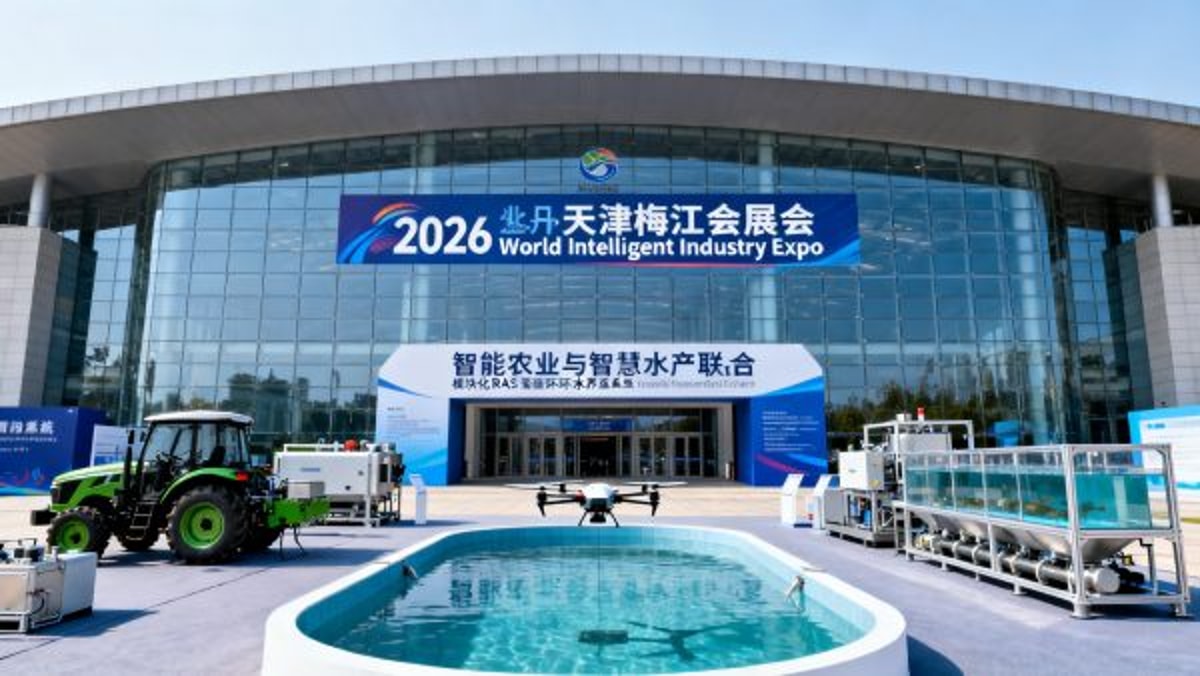
From May 28 to 31, 2026, the 2026 World Intelligent Industry Expo will take place in Tianjin, China — marking the first time the event features a dedicated joint exhibition zone for intelligent connected agricultural machinery and smart aquaculture farms (RAS + low-altitude inspection). This development signals growing institutional recognition of AI- and automation-driven upgrades across primary-sector supply chains, particularly for export-oriented technology providers in precision agriculture and sustainable aquaculture.
Event Overview
The 2026 World Intelligent Industry Expo will be held in Tianjin from May 28 to 31, 2026. The exhibition will include a newly established joint zone focused on intelligent connected agricultural machinery and smart aquaculture farms integrating Recirculating Aquaculture Systems (RAS) with low-altitude drone-based inspection. Confirmed exhibits include BeiDou-enabled autonomous driving kits for farm machinery, AI-powered feeding decision systems, and underwater robot swarm control platforms — all designed for international market compatibility. The first two days (May 28–29) are designated for professional visitors only, with targeted technical matchmaking sessions for overseas procurement delegations.
Industries Affected
Export-Oriented Equipment Manufacturers
Manufacturers developing agricultural or aquaculture automation hardware face direct implications: the joint zone’s emphasis on ‘export-adapted solutions’ indicates that regulatory alignment, certification readiness (e.g., CE, FCC, regional RAS compliance), and interoperability with global GNSS standards (beyond BeiDou) are now threshold requirements for market access. Participation may serve as an early signal of upcoming national export support mechanisms for such equipment.
Smart Farming System Integrators
Integrators deploying end-to-end solutions for overseas clients — especially in emerging markets with evolving digital infrastructure — may encounter heightened demand for modular, interoperable subsystems (e.g., feeding AI paired with water quality telemetry and drone-based pond monitoring). The co-location of农机 and aquaculture technologies suggests convergence opportunities, but also requires integrators to broaden technical validation scope beyond single-domain use cases.
Agri-Tech & Aquaculture SaaS Providers
Providers of cloud-based decision-support platforms (e.g., feeding optimization, health analytics) must assess compatibility with hardware showcased at the event — particularly those involving underwater robotics or multi-sensor fusion at the edge. The focus on ‘AI decision systems’ implies increasing client expectations for explainable, audit-ready logic — not just predictive outputs — especially where food safety or environmental compliance is regulated.
International Procurement & Trade Service Firms
Firms supporting cross-border technology procurement — including certification consultants, logistics partners specializing in sensitive electronics, and localization service providers — should note the dedicated professional-access window (May 28–29). Early registration and pre-event technical briefings with exhibitors are likely to become more critical, as the format prioritizes efficiency over broad public engagement.
What Relevant Enterprises or Practitioners Should Focus On
Monitor official guidance on export facilitation policies
Analysis shows that the explicit labeling of showcased solutions as ‘export-adapted’ may precede formal policy updates — such as streamlined customs procedures for certified agri-tech exports or updated national guidelines for RAS system certification. Stakeholders should track announcements from China’s Ministry of Commerce and the State Administration for Market Regulation following the event.
Assess hardware-software interface specifications for key categories
Observably, the joint zone highlights three priority technical interfaces: (1) GNSS middleware compatibility (BeiDou + GPS/Galileo fallback), (2) API standardization between feeding AI and RAS control layers, and (3) data schema alignment across surface drones, underwater robots, and cloud platforms. Companies should audit current integration documentation against these vectors.
Distinguish between demonstration intent and commercial readiness
From the industry perspective, many showcased systems — particularly underwater robot swarm control platforms — remain at pilot or pre-commercial stage. Buyers and partners should verify deployment references, third-party validation reports, and after-sales support coverage before committing to joint development or distribution agreements.
Prepare for technical matchmaking logistics ahead of May 2026
Current more practical preparation includes securing professional visitor credentials well in advance, identifying up to five priority exhibitors by Q4 2025, and preparing concise technical capability summaries (in English) aligned with the three core solution types highlighted: autonomous navigation kits, AI feeding logic engines, and multi-domain robotic coordination platforms.
Editorial Perspective / Industry Observation
This event is better understood as a policy-signaling milestone, not yet a commercial inflection point. The creation of a joint zone for intelligent agriculture and aquaculture reflects a deliberate effort to consolidate fragmented innovation streams under shared infrastructure and export frameworks. However, observable traction — such as volume orders, bilateral MOUs, or new certification pathways — remains to be confirmed post-event. The emphasis on ‘low-altitude inspection’ alongside RAS also suggests growing attention to airspace regulation harmonization for dual-use drone applications in rural settings — a layer of complexity beyond pure hardware performance.
Industry stakeholders should treat this as a calibration opportunity: it reveals where national priorities align with real-world technical bottlenecks (e.g., edge-AI latency in underwater comms, or GNSS-denied operation resilience), rather than signaling immediate market expansion.
Conclusion
The 2026 World Intelligent Industry Expo in Tianjin does not represent a sudden market opening, but rather a structured articulation of strategic direction for intelligent systems in land- and water-based food production. Its value lies not in immediate transaction volume, but in clarifying the technical, regulatory, and interoperability thresholds that export-facing developers and integrators must now actively address — especially across the intersecting domains of autonomous machinery, AI-driven operations, and distributed robotic sensing.
Information Sources
Main source: Official announcement of the 2026 World Intelligent Industry Expo (Tianjin Municipal Government & China Electronics Society, confirmed as of March 2024). Areas requiring ongoing observation include post-event policy releases related to agri-tech export incentives and formal adoption timelines for RAS-related national standards currently under drafting.
Related Intelligence
- RAS SystemsFAO Updates Global Aquaculture Equipment List, 3 Chinese RAS Integrators IncludedFAO updates Global Aquaculture Equipment List — 3 Chinese RAS integrators added, including ISO 22000 & ASC certified leaders. Discover implications for procurement, certification & global market access.
- RAS Systems2026 World Intelligent Industry Expo Opens in TianjinDiscover the 2026 World Intelligent Industry Expo in Tianjin — featuring groundbreaking intelligent connected agricultural machinery and smart aquaculture farms (RAS + low-altitude inspection). Key for global agri-tech exporters & integrators.
- RAS SystemsAquaculture & Fishery Systems: Where Water Quality Costs StartAquaculture & Fishery cost drivers start earlier than treatment. Learn how design, monitoring, compliance, and biological performance shape lifetime expenses and smarter investment decisions.
The Morning Broadsheet
Daily chemical briefings, market shifts, and peer-reviewed summaries delivered to your terminal.
