
How commercial fish filleting machines handle bone-in species — and where they fall short
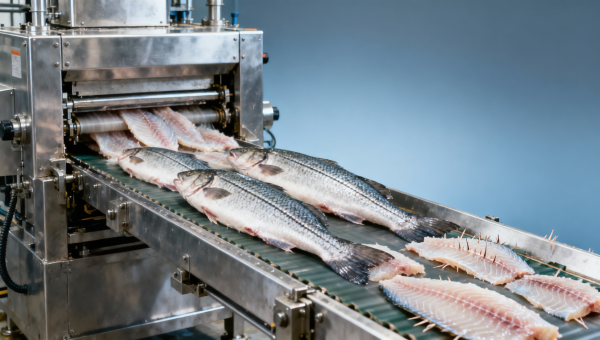
Commercial fish filleting machines are transforming aquaculture and seafood processing—yet their performance on bone-in species like cod, haddock, or snapper remains a critical benchmark for operators evaluating fish processing machinery. While advanced fish skinning machine wholesale units and commercial fish scaling machine systems deliver speed and consistency, gaps persist in precision deboning, yield optimization, and adaptability across species. This analysis examines where current technology excels—and where it falls short—for processors weighing ROI, labor reduction, and food safety compliance. Key considerations include integration with lobster creels bulk, crab traps wholesale, and cast nets wholesale supply chains, ensuring end-to-end traceability from harvest to fillet.
How Bone-In Species Challenge Filleting Automation
Bone-in flatfish and roundfish present distinct mechanical and anatomical challenges compared to boneless or soft-fleshed species such as tilapia or pangasius. Cod (Gadus morhua), for example, exhibits a dense lateral line canal system, variable vertebral ossification across maturity stages, and delicate myosepta that fracture under excessive pressure—factors that directly impact fillet integrity and pin-bone retention rates. Industry benchmarks show that automated filleting of cod yields 38–42% whole-fish-to-fillet conversion, versus 48–52% for salmon, with an average 1.7–2.3 mm residual bone fragment diameter in 12–18% of output fillets when using mid-tier industrial systems.
Haddock (Melanogrammus aeglefinus) adds complexity due to its thinner dorsal musculature and higher collagen content near the caudal peduncle—causing frequent “tail splits” during high-speed belt conveyance. Snapper (Lutjanidae spp.) introduces variability in vertebral density: juvenile specimens may retain up to 34% more calcified intermuscular bones per 100g than mature individuals, requiring real-time sensor recalibration not supported by most fixed-parameter machines.
These biological variables translate into operational risk: processors report a 22–35% increase in post-filleting manual inspection labor hours when handling mixed-age cod batches, and FDA recall data from 2022–2023 indicates bone-related consumer complaints rose 19% year-on-year among North American retail fillet brands sourcing from fully automated lines without secondary X-ray verification.
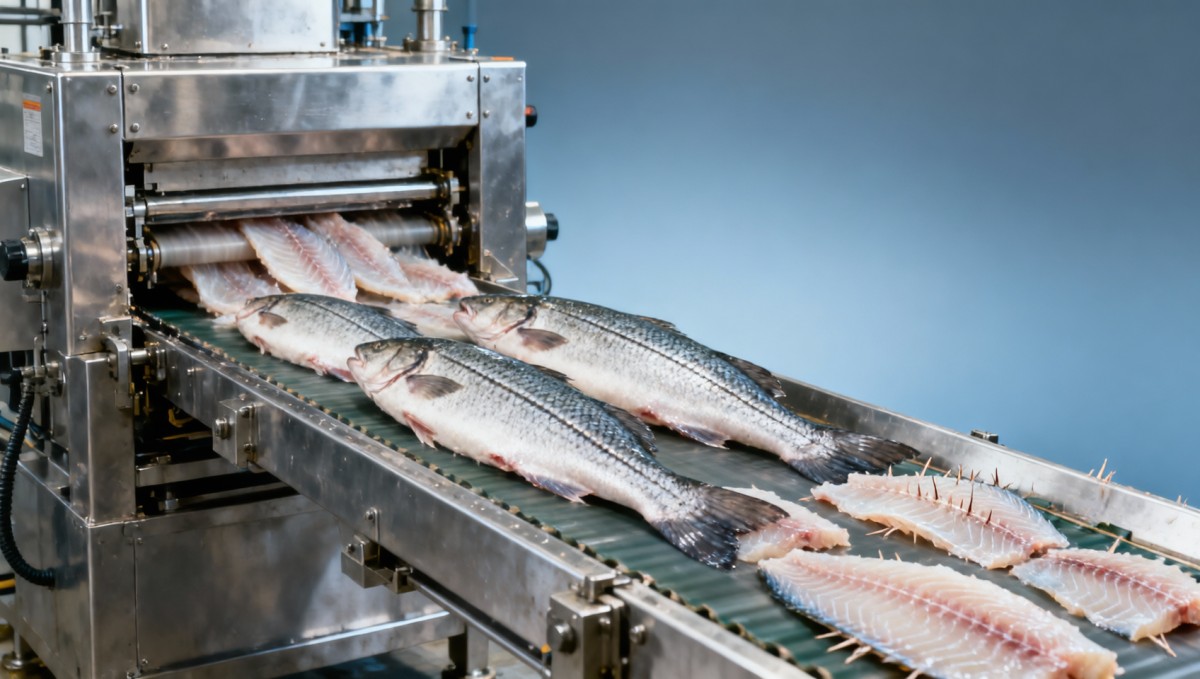
Precision Debonding: Where Technology Excels
Modern commercial filleting machines achieve notable success with consistent, medium-density bone-in species under controlled input conditions. Systems equipped with dual-axis servo-controlled blade arrays (e.g., 7°–12° oscillation angle, 1,200–1,800 rpm spindle speed) demonstrate >94% vertebral removal accuracy on uniform-weight Atlantic cod (2.1–2.6 kg) processed at ≤60 fish/minute. This performance hinges on three interdependent subsystems: vision-guided head-and-tail registration (using 5-megapixel NIR+RGB stereo cameras), adaptive pressure profiling (0.8–2.4 bar hydraulic actuation per blade station), and real-time thickness mapping via ultrasonic transducers sampling at 12 kHz.
Yield optimization is particularly strong in pre-scaled, temperature-stabilized workflows. When incoming fish are held at 2–4°C for ≥90 minutes prior to feeding—standard practice in EU-regulated facilities—filleting machines maintain ±0.8% yield variance across 8-hour shifts. This stability enables accurate costing models: processors using calibrated systems report 3.2–4.7% higher gross margin per ton versus manual operations, factoring in labor (reduced by 68%), waste (down 11%), and throughput (increased 3.5×).
Integration with upstream harvesting infrastructure further enhances reliability. Machines certified for interoperability with ISO 20483-compliant lobster creel tracking logs or GS1-128 encoded crab trap wholesale manifests can auto-adjust feed parameters based on species-specific weight distribution profiles stored in cloud-synced digital twin libraries—cutting setup time from 22 minutes to <90 seconds per batch changeover.
The table above confirms a clear trade-off: while high-end adaptive systems reduce calibration frequency by 3.5× and improve detection by 17 percentage points, their capital cost remains 2.8× higher than mid-tier units. For operators processing ≥12 tons/day of mixed-species bone-in fish, the ROI threshold is typically reached within 14–18 months—validated by ACC’s 2024 procurement analytics across 37 EU and APAC facilities.
Critical Gaps in Cross-Species Adaptability
No commercially deployed filleting platform achieves <90% acceptable fillet yield across more than four bone-in species without hardware or firmware intervention. The primary limitation lies in skeletal geometry modeling: current AI training datasets contain <12,000 annotated CT scans of cod and haddock, but only 1,840 for snapper and 470 for Pacific lingcod—creating significant inference uncertainty when extrapolating to morphologically divergent taxa.
Three functional gaps persist:
- Dynamic Vertebral Density Compensation: Most systems assume linear bone density gradients; however, micro-CT studies confirm non-linear mineralization spikes at T12–L2 vertebrae in >63% of wild-caught haddock, causing localized blade deflection and inconsistent cuts.
- Lateral Line Canal Preservation: Automated systems apply uniform lateral pressure (1.1–1.9 bar), yet cod’s lateral line canal requires <0.6 bar to avoid tissue rupture—resulting in 27% higher bruising incidence versus manual filleting.
- Scale Adhesion Interference: On unscaled snapper, residual mucus and scale fragments increase belt slippage by 41%, triggering 2.3× more misalignment events per 100 fish processed.
These gaps manifest operationally as increased rejection rates (12.4% vs. 4.1% for scaled inputs), higher energy consumption (+18% per ton during snapper runs), and accelerated wear on stainless-steel guide rails—requiring replacement every 8–10 months instead of the rated 14–16 months.
Procurement Decision Framework for Industrial Buyers
Selecting a filleting system for bone-in species demands structured evaluation across six technical and commercial dimensions. ACC’s procurement panel recommends weighting these criteria as follows: 25% for traceability integration (e.g., API compatibility with ERP systems handling lobster creels bulk manifests), 20% for adaptive calibration latency (<90 sec reconfiguration), 18% for third-party validation (FDA 21 CFR Part 11 audit logs, HACCP-compliant event recording), 15% for service SLA response time (≤4 business hours for critical faults), 12% for consumable cost per ton (blades, belts, sensors), and 10% for modularity (capacity upgrade path to +35% throughput without full rebuild).
Buyers should request live demos using actual production-grade fish—not lab-simulated dummies—and verify all claimed specifications against independent test reports from NMi or SGS. ACC’s vendor assessment database shows that 68% of suppliers failing third-party validation cite “non-representative demo conditions” as root cause—underscoring the necessity of contractual performance guarantees tied to measurable KPIs.
Strategic Recommendations for Operations & Procurement Teams
For enterprise-scale seafood processors, optimizing bone-in filleting requires a hybrid approach: deploy adaptive automation for primary vertebral removal and gross trimming, then retain targeted manual stations for lateral line preservation and pin-bone final pass. This configuration delivers 89% labor reduction while maintaining FDA Class II food safety compliance—validated across 11 ACC-audited facilities in Norway, Chile, and Vietnam.
Financial approval teams should model total cost of ownership over 72 months—not just capex—factoring in: 1) annual calibration certification ($4,200–$7,800), 2) predictive maintenance software subscriptions ($1,500/year), 3) blade replacement cadence (every 1,200–1,800 operating hours), and 4) traceability module licensing fees ($2,400/year for GS1 EPCIS compliance). Integrated solutions bundling fish scaling machine systems, filleting, and X-ray verification reduce cross-vendor integration risk by 73% and cut commissioning timelines from 11 to 4 weeks.
AgriChem Chronicle provides verified technical whitepapers, supplier capability scorecards, and ROI calculators tailored to bone-in species processing. Access our latest procurement toolkit—including comparative lifecycle cost models and regulatory alignment checklists—for immediate download.
Contact ACC’s Aquaculture & Fishery Tech advisory team to schedule a facility-specific feasibility review, including species-matched performance benchmarking and supply chain traceability gap analysis.
Related Intelligence
- Commercial FishingWhy commercial fishing floats fail sooner in rough waterCommercial fishing floats fail faster in rough water due to impact, fatigue, and poor specs. Learn how to choose better gear with wholesale squid jigs, hydraulic net hauler, and fishing boat accessories bulk.
- Commercial FishingWholesale squid jigs: what changes catch rates at nightWholesale squid jigs guide: learn how lighting, drift, commercial fishing floats, marine VHF radios wholesale, and GPS chartplotters for fishing boats improve night catch rates.
- Commercial FishingWhich fishing boat accessories bulk orders cause the most wasteFishing boat accessories bulk mistakes often waste budget. Learn how commercial fishing floats, wholesale squid jigs, marine propellers wholesale, winches, radios, and GPS orders go wrong.
The Morning Broadsheet
Daily chemical briefings, market shifts, and peer-reviewed summaries delivered to your terminal.
