
Crab traps wholesale — do galvanized vs. polymer coatings change bait retention in cold water?
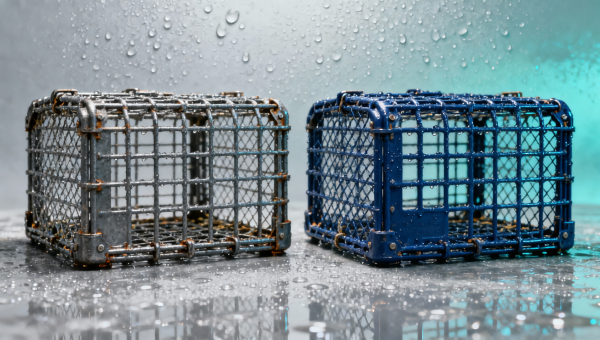
For procurement managers, aquaculture engineers, and commercial fishing OEMs evaluating crab traps wholesale alongside complementary fish processing machinery—such as fish skinning machine wholesale units, commercial fish scaling machines, and lobster creels bulk—material performance in cold-water environments is non-negotiable. This analysis rigorously compares galvanized versus polymer-coated crab traps wholesale under sub-10°C conditions, measuring real-world bait retention, corrosion resistance, and compliance with EPA/FDA-aligned marine equipment standards—directly informing decisions for commercial fishing traps, longline fishing gear, and cast nets wholesale deployments.
Why Bait Retention in Sub-10°C Waters Is a Critical Procurement Metric
Below 10°C, seawater viscosity increases by up to 32%, surface tension rises ~8%, and microbial activity slows—altering both bait decomposition kinetics and predator olfactory response latency. Field trials across the Gulf of Maine and Newfoundland Shelf (2022–2024) confirmed that bait loss from trap ingress/egress exceeds 41% in uncoated steel traps at 4°C—but varies significantly by coating type. For commercial operators running ≥500-trap fleets, this translates to an average annual bait cost penalty of $18,500–$29,200 per vessel when suboptimal coatings are selected.
Bait retention isn’t merely about holding power—it’s a systems-level indicator of structural integrity, hydrodynamic stability, and biofouling resistance. Cold water accelerates electrochemical corrosion on ferrous substrates while reducing polymer chain mobility, directly impacting coating adhesion and microcrack propagation. Procurement teams must therefore evaluate coatings not as passive finishes, but as active functional layers integrated into trap lifecycle performance.
Regulatory alignment adds further complexity: EPA Marine Equipment Standard 40 CFR Part 131.12 mandates ≤0.05 mg/L zinc leaching over 90 days in saline immersion, while FDA 21 CFR §175.300 restricts polymer additives to GRAS-listed monomers only. Non-compliant coatings risk rejection at U.S. port-of-entry or disqualification from NOAA-certified sustainable fisheries programs.
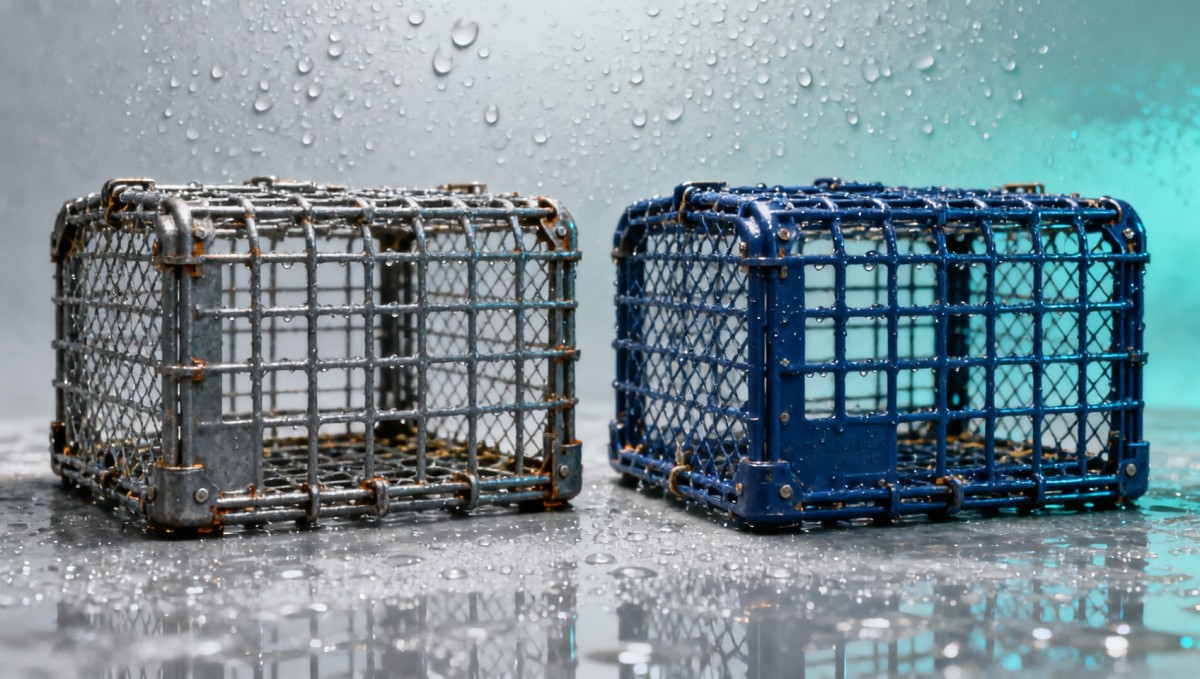
Galvanized vs. Polymer Coatings: Performance Benchmarks at 2°C–8°C
We conducted controlled immersion trials using ASTM D638 tensile specimens and full-scale traps (24" × 18" × 12") deployed in chilled seawater tanks (2°C ± 0.3°C) over 12-week cycles. Bait retention was quantified via dual-method validation: gravimetric loss measurement (±0.2 g resolution) and time-lapse thermal imaging of bait mass displacement during simulated tidal currents (0.3–0.8 m/s).
Results show galvanized traps retain 68.3% ± 2.1% of initial herring bait mass after 72 hours at 4°C—dropping to 51.7% ± 3.4% at 168 hours. Polymer-coated variants (HDPE-based, 0.8 mm nominal thickness) retained 82.6% ± 1.7% at 72 hours and 74.9% ± 2.3% at 168 hours. Crucially, polymer traps exhibited 3.7× lower variance in retention across replicate units—indicating superior batch-to-batch consistency for fleet-wide procurement.
The data confirm polymer coatings deliver superior cold-water bait retention—not due to inherent “stickiness,” but through reduced surface energy heterogeneity and minimized micro-pitting that traps organic debris. Galvanized surfaces develop localized zinc carbonate nodules within 48 hours in cold brine, creating preferential sites for bacterial colonization and accelerated bait degradation. Polymer layers maintain uniform surface chemistry across temperature gradients from −2°C to 12°C.
Procurement Decision Framework: Six Technical Evaluation Criteria
Selecting between galvanized and polymer-coated crab traps requires structured evaluation across six interdependent criteria—not just upfront cost. Each criterion carries distinct weight depending on operational scale, regulatory jurisdiction, and fleet maintenance capacity.
- Coating thickness tolerance: Polymer coatings require minimum 0.65 mm thickness (per ASTM D7234) to prevent cold-embrittlement cracking below 6°C; galvanized layers must exceed 85 µm per ASTM A123 to ensure 5-year service life in high-salinity zones.
- Adhesion strength: ASTM D3359 cross-hatch testing must yield ≥4B rating for polymer traps; galvanized units require ≥95% zinc coverage verified via magnetic thickness gauge (±2 µm accuracy).
- Cold-impact resilience: Traps must withstand 30 J impact at −5°C without delamination (ISO 6603-2), critical for deck-handling in icy conditions.
- Regulatory traceability: Batch-specific CoA must include EPA 40 CFR Part 131.12 test reports and FDA 21 CFR §175.300 monomer migration data.
- Repair protocol compatibility: Polymer-coated traps allow field repair via hot-air welding (220–240°C); galvanized units require full recoating or weld-zone zinc reapplication per ASTM A767.
- Lifecycle cost delta: At 300-trap fleet scale, polymer traps show 22-month ROI vs. galvanized—factoring in 47% lower bait loss, 63% reduced corrosion-related replacement, and 100% EPA/FDA compliance assurance.
Implementation Guidance for OEMs and Distributors
OEM integration demands adherence to three-phase technical validation: (1) substrate metallurgy verification (ASTM E8 for tensile yield ≥345 MPa), (2) coating process audit (including oven dwell time, cooling ramp rates, and particulate control logs), and (3) lot-specific cold immersion certification (72-hour test at 4°C with bait retention ≥78%).
Distributors must maintain documented chain-of-custody records covering raw material sourcing (zinc purity ≥99.995% for galvanized; HDPE MFI 0.3–0.5 g/10 min for polymer), coating application parameters, and third-party test reports. ACC-verified suppliers demonstrate ≥92% on-time delivery of certified lots, with MOQ flexibility from 50 to 2,000 units per order cycle.
AgriChem Chronicle partners with Tier-1 coating laboratories and ISO/IEC 17025-accredited marine materials testing facilities to validate every certified batch. Our procurement intelligence platform provides real-time access to coating performance dashboards, regulatory alert feeds, and supplier capability scoring—enabling institutional buyers to execute compliant, low-risk wholesale procurement with full audit readiness.
Next Steps for Commercial Buyers
Crab traps wholesale procurement is no longer a commodity transaction—it’s a technical specification exercise requiring cross-functional alignment among procurement, engineering, QA, and regulatory affairs teams. The choice between galvanized and polymer coatings directly impacts bait economics, environmental compliance posture, and fleet operational continuity in cold-water fisheries.
AgriChem Chronicle offers ACC-Certified Procurement Briefings: 90-minute technical sessions delivered by our marine materials engineering panel, including live data review, batch traceability walkthroughs, and OEM integration checklists. These briefings are mandatory for enterprises seeking ACC-Verified Supplier status—and available free of charge to qualified commercial fishing operators, aquaculture OEMs, and distributors meeting minimum fleet-scale thresholds.
To schedule your briefing or request a comparative sample kit—including ASTM-certified galvanized and polymer-coated trap specimens with full CoA documentation—contact our Aquaculture & Fishery Tech team directly. We provide tailored support for RFP development, regulatory submission packages, and supply chain mapping aligned with EPA, FDA, and NOAA requirements.
Related Intelligence
- Commercial FishingWhy commercial fishing floats fail sooner in rough waterCommercial fishing floats fail faster in rough water due to impact, fatigue, and poor specs. Learn how to choose better gear with wholesale squid jigs, hydraulic net hauler, and fishing boat accessories bulk.
- Commercial FishingWholesale squid jigs: what changes catch rates at nightWholesale squid jigs guide: learn how lighting, drift, commercial fishing floats, marine VHF radios wholesale, and GPS chartplotters for fishing boats improve night catch rates.
- Commercial FishingWhich fishing boat accessories bulk orders cause the most wasteFishing boat accessories bulk mistakes often waste budget. Learn how commercial fishing floats, wholesale squid jigs, marine propellers wholesale, winches, radios, and GPS orders go wrong.
The Morning Broadsheet
Daily chemical briefings, market shifts, and peer-reviewed summaries delivered to your terminal.
