

The Authority in Global Agricultural Chemistry & Bio-Resources
When Wholesale Manganese Sulfate Quality Affects Field Results
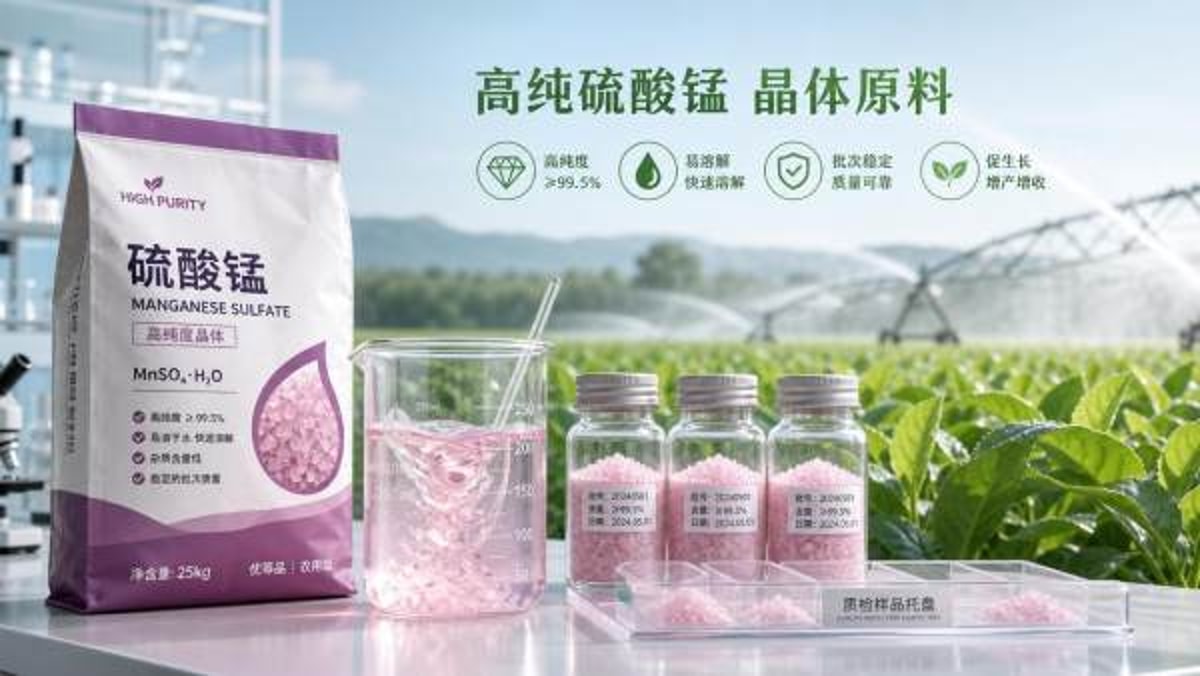
In crop nutrition and soil correction, wholesale manganese sulfate is not a simple commodity purchase—it is a quality variable that can directly shape field performance. From solubility and purity to trace contaminant control and batch consistency, small differences in specification can influence nutrient uptake, application reliability, and agronomic outcomes. For researchers and procurement-focused readers, understanding these quality factors is essential to making better sourcing and performance decisions.
Why does wholesale manganese sulfate quality matter so much in field performance?
The main reason is simple: crops do not respond to labels, they respond to chemistry. A bag sold as wholesale manganese sulfate may appear commercially equivalent to another, yet differences in manganese content, water solubility, impurity levels, particle size, moisture, and manufacturing consistency can lead to very different results after application. In foliar nutrition, for example, poor dissolution can clog nozzles, create uneven spray distribution, and reduce leaf uptake. In soil use, low-quality material may release manganese unpredictably or interact poorly with pH-sensitive soils.
For institutional buyers, agronomists, and technical evaluators, the issue is not only whether manganese sulfate is present, but whether it performs consistently under real operating conditions. A low purchase price may look attractive in procurement terms, but if it increases mixing time, application failures, crop variability, or respray frequency, the total cost rises quickly. That is why wholesale manganese sulfate should be evaluated as an agronomic input with measurable performance consequences, not merely as a bulk chemical line item.
What specifications should buyers check first when comparing wholesale manganese sulfate?
The first screen should focus on practical performance indicators rather than marketing language. Product data sheets often highlight manganese percentage, but technical buyers should go further and ask whether that manganese is reliably available in the intended application system. A useful evaluation starts with a short checklist.
This is where wholesale manganese sulfate sourcing becomes a cross-functional decision. Procurement may prioritize price and logistics, but field teams need predictable behavior in mixes and applications. Laboratory teams may want certificates of analysis, while compliance teams may ask for traceability, origin declarations, and documentation aligned with local regulations. The best buying process connects all three perspectives before volume commitments are made.
How can purity and contaminants change agronomic results?
Purity is often misunderstood as a narrow laboratory metric, but in practice it affects both efficacy and risk. When wholesale manganese sulfate contains higher-than-expected insolubles or contaminant residues, growers may see issues that are wrongly blamed on weather, water quality, or spraying technique. Poor purity can reduce the amount of plant-available manganese delivered, especially in precision foliar programs where concentration and compatibility must be tightly controlled.
Contaminants matter for another reason: they can create downstream compliance problems. Depending on region and crop market, heavy metal thresholds and fertilizer input rules may be closely monitored. A supplier that cannot document impurity control may expose buyers to avoidable commercial and reputational risk. For this reason, technical purchasers of wholesale manganese sulfate should not treat purity as a secondary detail. It is part of field performance, regulatory preparedness, and long-term supplier qualification.
In real use, the most important question is not whether a sample passes one isolated test, but whether the supplier maintains controlled impurity levels batch after batch. A single clean certificate is useful; a stable production system is far more valuable.
Is all wholesale manganese sulfate suitable for foliar spray, fertigation, and soil application?
No, and this is one of the most common sourcing mistakes. Buyers sometimes assume that all wholesale manganese sulfate can move freely across different use cases, but application systems place different demands on the material. Foliar spray programs usually require fast dissolution, low insoluble residue, stable pH behavior in the tank, and predictable compatibility with adjuvants or other micronutrients. Fertigation systems add concerns around injector performance, precipitation risk, and line cleanliness. Soil application can be more forgiving in some cases, but even there, particle behavior and consistency still affect spreading and field uniformity.
That is why product-fit questions should be raised early. If a supplier sells wholesale manganese sulfate primarily into industrial channels, the product may technically meet a general assay target while still being poorly optimized for agricultural spraying. Likewise, a grade that performs well in dry blending may not be ideal for liquid nutrient manufacturing. Buyers who clarify the intended application before qualification are more likely to avoid avoidable reformulation, equipment issues, and field complaints.
A practical application check
Before ordering commercial volume, ask the supplier to confirm the intended use environment: crop type, delivery method, water quality range, mixing partners, and storage conditions. Small pilot tests often reveal whether the wholesale manganese sulfate behaves as expected in a specific program. This step is especially important when changing origin, production plant, or crystal grade.
What are the biggest red flags when evaluating a supplier?
Several warning signs appear repeatedly in the market. The first is incomplete technical documentation. If a supplier offers wholesale manganese sulfate with only a basic sales sheet and no recent certificate of analysis, no impurity profile, and no explanation of manufacturing controls, the buyer is being asked to accept uncertainty. The second red flag is inconsistent language around grade and use. Terms like “high purity,” “agricultural grade,” or “premium quality” are not meaningful unless supported by measurable specifications.
A third red flag is price that sits well below normal market logic without a clear operational reason. While cost competitiveness is real, unusually low pricing may signal weaker quality control, off-spec lots, unstable sourcing, or limited traceability. Finally, reluctance to discuss batch variation, complaint history, or retained sample policy should concern technical buyers. Reliable suppliers understand that wholesale manganese sulfate is part of a performance chain and should be able to answer questions about consistency, not just availability.
How should buyers balance cost, consistency, and long-term supply risk?
The most effective approach is to evaluate wholesale manganese sulfate on total value, not unit price alone. Cost matters, but for agronomic inputs the real measure is cost per reliable field outcome. If one product delivers cleaner dissolution, lower rejection rates, more stable blending, and fewer application disruptions, it may outperform a cheaper alternative by a wide margin over a season. This is especially relevant for distributors, large farming operations, and formulation businesses that depend on repeatable input behavior.
Consistency should be treated as a cost control tool. Every variable introduced by inconsistent wholesale manganese sulfate creates hidden expenses: extra quality checks, formulation adjustments, operator troubleshooting, storage losses, or customer complaints. Long-term risk also includes origin concentration, shipping delays, regulatory documentation quality, and the supplier’s willingness to support investigations if a field issue occurs. A strong vendor relationship is not built on price alone; it is built on reproducibility and accountability.
For procurement teams, a useful method is dual evaluation: commercial scoring plus technical scoring. Commercial scoring can include price, lead time, payment terms, and logistics flexibility. Technical scoring should include assay reliability, impurity control, solubility behavior, traceability, and response speed on quality questions. This framework makes wholesale manganese sulfate sourcing more resilient and less reactive.
What common misconceptions lead to poor buying decisions?
One misconception is that all manganese deficiency corrections will respond similarly as long as the label states manganese sulfate. In reality, nutrient response depends on application timing, crop demand, soil conditions, and the quality of the input itself. Another misconception is that certificate values alone guarantee field success. A certificate is important, but it does not replace compatibility testing, dissolution checks, or supplier reliability review.
Buyers also sometimes assume that a previously acceptable source will remain stable indefinitely. Yet manufacturing changes, raw material variation, and supply chain shifts can alter wholesale manganese sulfate performance over time. Requalification should therefore be periodic, not only reactive after complaints arise. Finally, some teams underestimate documentation. In a regulated and quality-sensitive supply environment, records on source, analysis, lot identification, and handling guidance are not bureaucratic extras—they are part of operational control.
What should be confirmed before moving forward with sourcing or application?
Before approving a new or replacement source of wholesale manganese sulfate, buyers should confirm five things. First, the grade matches the intended agricultural use, whether foliar, fertigation, blending, or soil correction. Second, recent batch data supports the stated manganese level, solubility, and impurity limits. Third, logistics and packaging fit the storage and handling realities of the end user. Fourth, the supplier can provide traceability and respond to technical inquiries with speed and substance. Fifth, the material has been tested in a realistic operational context, not only reviewed on paper.
For information researchers and procurement-minded readers, the key lesson is that wholesale manganese sulfate quality cannot be separated from agronomic performance. Better sourcing decisions come from connecting product chemistry with application reality, supplier discipline, and total cost of use. If further evaluation is needed, it is wise to begin by discussing target crop systems, preferred grade, solubility expectations, impurity thresholds, batch documentation, trial quantity, delivery cycle, and how quality issues would be handled after shipment.
Related Intelligence
- AgrochemicalsChina’s Hazardous Chemicals Safety Law Takes Effect May 2026China’s Hazardous Chemicals Safety Law (2026) mandates GS1 digital labels for agrochemical exports—ensuring traceability, EU CLP compliance & temperature control. Act now to avoid port delays!
- AgrochemicalsWholesale Copper Sulfate: Crystal Form Can Change HandlingWholesale copper sulfate handling depends heavily on crystal form. Learn how size and moisture affect flow, dust, dissolution, safety, and smarter bulk purchasing decisions.
- AgrochemicalsWholesale Potassium Nitrate and the Timing Mistake to AvoidWholesale potassium nitrate buying at the wrong season can raise costs and disrupt supply. Learn the timing mistake to avoid and how smarter planning protects efficiency.
The Morning Broadsheet
Daily chemical briefings, market shifts, and peer-reviewed summaries delivered to your terminal.
