
How to pick a grain pre cleaner machine?
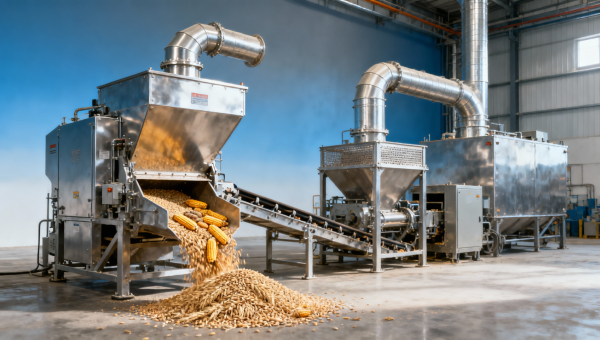
Choosing the right grain pre cleaner machine is essential for efficient grain handling, lower impurity levels, and better downstream performance. Whether you also need a gravity separator grain system, grain destoner machine, rotary drum sieve grain unit, magnetic separator for feed, feed grading sieve, feed pellet cooler, double roller crumbler, liquid adding machine feed setup, or enclosed belt conveyor, understanding selection criteria helps buyers and operators reduce waste, improve quality control, and maximize investment value.
In commercial grain and feed processing, a pre cleaner is not just an entry-level machine. It influences dust load, moisture consistency, equipment wear, and the final efficiency of sorting, destoning, drying, cooling, or pellet processing. For procurement teams, plant operators, quality managers, and project leaders, the wrong choice can create recurring losses through clogged lines, elevated maintenance, and unstable product grading.
This guide explains how to evaluate a grain pre cleaner machine from the perspective of throughput, impurity profile, plant layout, safety, downstream compatibility, and total ownership cost. It is written for B2B readers who need practical selection criteria rather than generic claims.
Understand What a Grain Pre Cleaner Must Remove
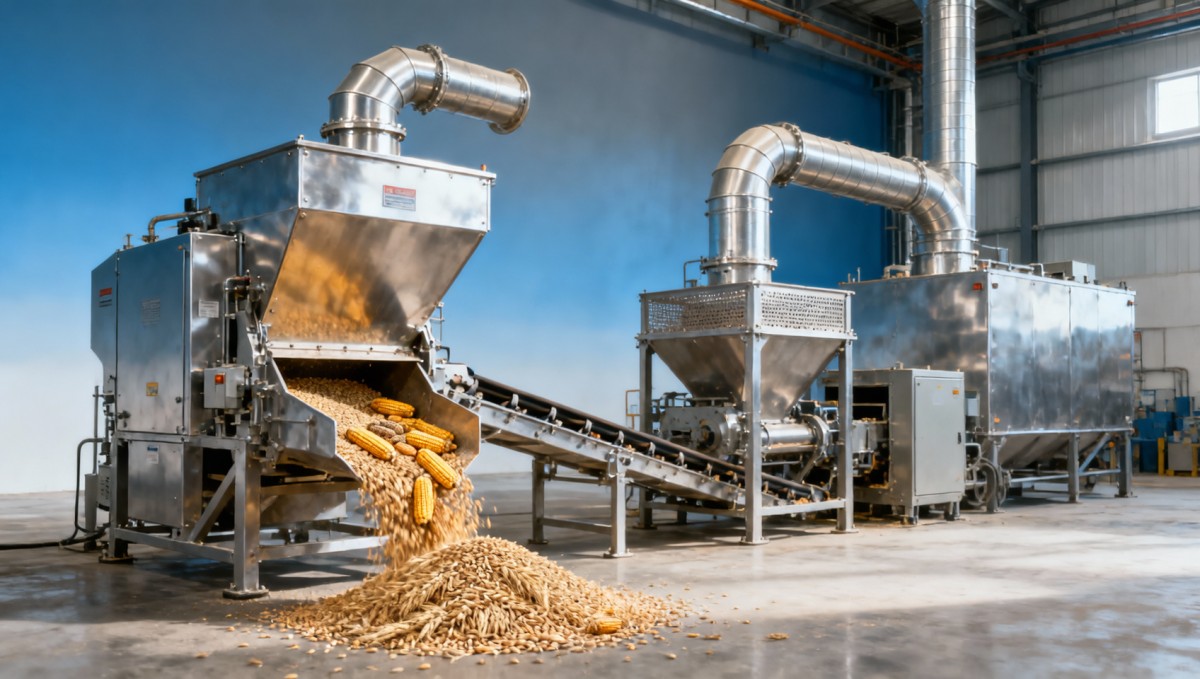
A grain pre cleaner machine is designed to remove large, light, and coarse contaminants before grain enters more sensitive equipment. In most plants, the first-stage target is not laboratory-grade purity. It is stable bulk cleaning that protects conveyors, elevators, dryers, gravity separators, and storage systems. Typical materials removed include straw, husk, dust, string, stones above screen size, and broken foreign particles.
Selection starts with the raw material profile. Corn, wheat, paddy, soybeans, sunflower seeds, and feed ingredients behave differently in screen cleaning. A machine that performs well on dry wheat at 12% to 13.5% moisture may behave differently on paddy at 14% to 16% moisture or on feedstock with higher fiber and dust content. This is why capacity alone is an incomplete purchasing metric.
Buyers should also define impurity categories by size and percentage. For example, some facilities receive grain with less than 1% coarse trash, while others handle seasonal intake with 3% to 8% mixed impurities. The higher the impurity load, the more critical it becomes to choose a pre cleaner with appropriate screen area, aspiration support, and stable feeding control.
Common impurity classes in grain intake
Before comparing suppliers, it helps to map impurities into practical categories. This makes technical discussions clearer and reduces the risk of overbuying or under-specifying the equipment.
- Oversized impurities: stalks, strings, cob fragments, bag pieces, and long straw.
- Fine impurities: sand, dust, powdered feed residue, and fine broken particles below screen openings.
- Heavy contaminants: stones, dense soil lumps, and metal particles that may require a grain destoner machine or magnetic separator for feed after pre cleaning.
- Light contaminants: husk, chaff, leaves, and floating materials that respond better when aspiration is integrated.
If your line has multiple downstream machines, the pre cleaner should be selected as part of a cleaning sequence, not in isolation. A rotary drum sieve grain unit may be suitable for high-volume coarse removal, while a vibrating screen cleaner may offer more precise grading before a gravity separator grain system.
Why mismatch happens in procurement
Mismatch usually comes from three errors: using peak throughput instead of average stable throughput, ignoring impurity variability across harvest periods, and assuming one screen configuration can handle all crops equally. In practical terms, a line rated at 30 tons per hour may only deliver 22 to 25 tons per hour under wetter, dirtier intake conditions.
Key Technical Criteria for Choosing the Right Machine
A reliable grain pre cleaner machine should be judged across at least 6 technical dimensions: capacity, cleaning efficiency, screen design, airflow control, structural durability, and maintenance accessibility. For industrial buyers, these criteria are more useful than broad claims such as “high efficiency” or “advanced performance.”
Capacity should match the real intake rhythm of the plant. If the upstream unloading system feeds 20 to 25 tons per hour, selecting a 50-ton machine may sound safe, but oversized equipment can create poor screen loading and inefficient separation at normal operating conditions. A practical sizing rule is to align nominal machine capacity with 110% to 130% of stable plant feed rate, not extreme short-duration peaks.
Screen configuration is equally important. Different crops often require different perforation sizes, screen angles, and cleaning motion. Buyers should ask whether screens can be changed within 20 to 40 minutes, whether replacement parts are standard or custom, and whether the machine supports 2-layer or 3-layer screen combinations for mixed impurity profiles.
Technical comparison checklist
The table below shows the main factors buyers should compare when evaluating different grain pre cleaner options for feed mills, grain terminals, or seed preparation lines.
The main takeaway is that a good grain pre cleaner machine should be balanced rather than oversized in one parameter. Plants with unstable intake conditions often gain more from proper screen design and feeding uniformity than from a larger nameplate capacity alone.
Questions to ask suppliers
- What is the tested capacity for my specific grain type and impurity percentage?
- Can the machine maintain performance when moisture rises by 1% to 2% during seasonal intake?
- How often do screens need cleaning in a 10-hour or 16-hour shift?
- Are bearings, screens, and vibration components locally replaceable within 48 to 72 hours?
For decision-makers, these questions reveal whether the supplier understands industrial operating conditions or is only quoting catalog figures.
Match the Pre Cleaner With the Full Processing Line
A grain pre cleaner machine delivers the best value when it is configured as part of a complete material handling and cleaning system. In many feed and grain plants, it works upstream of a grain destoner machine, magnetic separator for feed, feed grading sieve, or gravity separator grain system. In pellet lines, the sequence may continue through a feed pellet cooler, double roller crumbler, liquid adding machine feed setup, and enclosed belt conveyor.
This matters because each machine has a different tolerance for impurities. A magnetic separator for feed is effective for ferrous contamination, but it does not replace coarse screening. A grain destoner machine removes dense stones, but its efficiency drops if too much straw or oversized trash enters with the product. Poor pre cleaning therefore raises maintenance costs across the entire line.
Project managers should review layout, transfer points, and discharge mode. For example, if the pre cleaner discharges to an enclosed belt conveyor, check outlet height, dust sealing, and flow consistency. If the line includes a rotary drum sieve grain unit followed by fine cleaning, the engineering objective is usually high-volume rough cleaning first, then more precise separation in secondary stages.
Typical line matching logic
The following table helps compare where a grain pre cleaner fits relative to other common equipment in grain and feed processing lines.
The sequence shows why pre cleaning is foundational. If the first machine performs poorly, downstream equipment must handle contamination it was never designed to process. That can shorten wear-part life and reduce process consistency over 3 to 5 years of operation.
Plant scenarios where integration matters most
- Feed mills processing multiple raw materials in the same week.
- Grain storage sites with heavy harvest-season intake spikes lasting 30 to 60 days.
- Projects where dust control and enclosed conveying are mandatory for safety and housekeeping.
- Facilities with strict quality gates before grinding, pelletizing, or export preparation.
For distributors and engineering contractors, line compatibility is often the deciding factor in repeat orders, because operational problems usually appear at machine interfaces rather than in isolated factory tests.
Procurement, Cost Control, and Risk Reduction
From a purchasing perspective, the best grain pre cleaner machine is not always the cheapest quotation or the largest unit. Total cost includes installation time, screen replacement frequency, power demand, maintenance accessibility, spare parts lead time, and production losses caused by unstable cleaning results. In many cases, a lower initial quote becomes more expensive after 12 to 24 months of operation.
Financial approvers should request a simple ownership model covering at least 5 items: purchase price, estimated energy use per ton, annual spare consumption, expected downtime hours, and labor required for cleaning and changeover. Even a difference of 10 to 15 minutes per cleaning cycle becomes meaningful in facilities running 2 shifts per day.
Quality and safety teams should review dust control, access panels, rotor or vibration shielding, and whether inspection doors can be opened safely during maintenance shutdown. In plants handling dusty materials, poor sealing increases housekeeping burden and can raise safety concerns around transfer points and collection systems.
Procurement risk checklist
The table below summarizes common risks and the corresponding checks that buyers should include in supplier evaluation and technical clarification.
A disciplined procurement review helps both direct buyers and distributors avoid common project disputes. It also improves the credibility of technical proposals submitted for internal budget approval.
Recommended buying process in 5 steps
- Define grain types, moisture range, and expected impurity percentage for at least one full season.
- Set target throughput in tons per hour for normal and peak operation.
- Map all connected equipment, including conveyors, destoners, magnetic separators, and grading units.
- Request a technical quotation with wear-part list, utility demand, and delivery scope.
- Review service response, commissioning support, and spare lead times before final approval.
This 5-step approach is especially useful for project owners managing new lines, line expansion, or replacement of aging intake cleaning systems.
Installation, Maintenance, and Frequently Asked Questions
Successful machine selection does not end with the purchase order. Installation quality, operator training, and maintenance discipline strongly influence real cleaning performance. Even a well-selected grain pre cleaner machine can underperform if feed distribution is uneven, vibration components are not checked, or aspiration settings are left unbalanced.
During commissioning, operators should verify feed uniformity, screen tension, noise level, discharge smoothness, and dust extraction coordination. The first 72 hours are critical because many practical issues appear only when the machine runs with actual crop variability instead of test material.
Preventive maintenance should include daily visual checks, weekly fastener inspection, and planned screen cleaning intervals based on dust load. In demanding operations, inspection every 80 to 120 running hours is often more effective than waiting for performance decline.
How often should screens be changed?
Screen change frequency depends on crop variety, impurity abrasiveness, and operating hours. In multi-crop plants, screens may be changed every few days for product switching, while actual wear replacement may happen after several months. Buyers should ask whether changeover can be completed by 1 to 2 operators without heavy disassembly.
Is a pre cleaner enough without a destoner or gravity separator?
Not always. A grain pre cleaner machine removes many initial impurities, but it is not a substitute for density-based separation. If the incoming product contains stones, heavy soil lumps, or strict purity requirements, a grain destoner machine or gravity separator grain system is often necessary after the first cleaning stage.
What maintenance points matter most?
- Check bearings, fasteners, and vibration components at regular intervals.
- Keep screen surfaces clear to prevent capacity drop and inaccurate separation.
- Inspect dust sealing and aspiration ducts to limit housekeeping and product loss.
- Track wear-part consumption over 3 to 6 months to improve spare planning.
If your process line also includes a feed grading sieve, feed pellet cooler, double roller crumbler, liquid adding machine feed setup, or enclosed belt conveyor, coordinated maintenance planning reduces shutdown overlap and helps keep the entire line stable.
Choosing a grain pre cleaner machine is ultimately a system decision. The right model should fit your grain type, impurity load, line capacity, maintenance resources, and downstream equipment strategy. For research teams, procurement managers, operators, and investors, a structured evaluation will reduce operational risk and improve long-term plant efficiency. If you are planning a new installation or upgrading an existing grain or feed line, now is the right time to request a tailored technical review, compare cleaning configurations, and get a solution matched to your process goals. Contact us to discuss product details, project requirements, or a customized equipment plan.
Related Intelligence
- Grain Silos & StorageHow to pick a grain pre cleaner machine?Grain pre cleaner machine selection guide for better grain and feed processing. Compare gravity separator grain, grain destoner machine, feed grading sieve, and more to boost efficiency.
- Grain Silos & StorageIndonesia Bans Import of Used Grain Silos, Boosting New Equipment ExportsIndonesia bans used grain silos (HS 8425.11) >5 years old—boosting demand for new, BSN-certified equipment exports. Act now to secure compliant orders.
- Grain Silos & StorageVietnam's 5% Broken Rice Export Price Rises $5/Ton Amid Middle East ConflictVietnam's 5% broken rice export price rises $5/ton to $375–380 amid Middle East conflict, impacting global importers. Explore key market shifts and strategic responses for rice trade stability.
The Morning Broadsheet
Daily chemical briefings, market shifts, and peer-reviewed summaries delivered to your terminal.
