

The Authority in Global Agricultural Chemistry & Bio-Resources
Cosmetic raw materials bulk: what causes shade variation
In cosmetic raw materials bulk procurement, even slight shade variation can trigger quality disputes, compliance concerns, and production delays. For quality control and safety managers, understanding what drives color inconsistency—from raw source differences and oxidation to storage, processing, and batch handling—is essential for maintaining product stability and supplier accountability. This article examines the key causes behind shade variation and what they mean for risk control.
Understanding shade variation in cosmetic raw materials bulk supply
Shade variation refers to visible differences in color tone, depth, clarity, or hue between batches of the same ingredient. In cosmetic raw materials bulk trade, this issue is not limited to decorative pigments. It can affect botanical extracts, clays, oils, surfactants, waxes, emulsifiers, powders, and active ingredients that naturally range from pale to dark depending on source and processing. A slight shift may appear minor at incoming inspection, but once it enters formulation, it can alter product appearance, consumer perception, and even assumptions about purity or freshness.
For quality control teams, shade variation is not simply an aesthetic defect. It is a signal. Sometimes it indicates harmless natural variability; in other cases, it points to oxidation, contamination, thermal degradation, unstable process parameters, or weak batch segregation. For safety managers, unexplained color changes may raise questions about chemical stability, packaging compatibility, traceability, and whether storage conditions remained within validated limits. That is why cosmetic raw materials bulk programs need color control to be treated as part of broader quality assurance, not as a secondary visual check.
Why the industry pays close attention to color consistency
Across the fine chemicals and ingredients sector, buyers increasingly expect suppliers to demonstrate not only assay and microbiological compliance, but also consistency in physical attributes. In cosmetics, color variation can quickly become a commercial issue because many finished products are highly sensitive to small raw material differences. Creams, serums, masks, soaps, powders, and emulsions often display the original tone of the ingredient more than teams anticipate during scale-up.
Institutional buyers and industrial formulators also face more demanding documentation standards. A batch of cosmetic raw materials bulk that falls within chemical specification but outside the expected color window may still be rejected if the customer has validated a narrow appearance range for regulatory submissions, internal quality benchmarks, or brand consistency commitments. In short, color matters because it sits at the intersection of sensory quality, process control, and supplier reliability.
Core causes of shade variation
The most common causes of shade variation in cosmetic raw materials bulk can be grouped into five technical categories. Understanding each category helps teams separate normal variability from true risk events.
1. Natural source variability
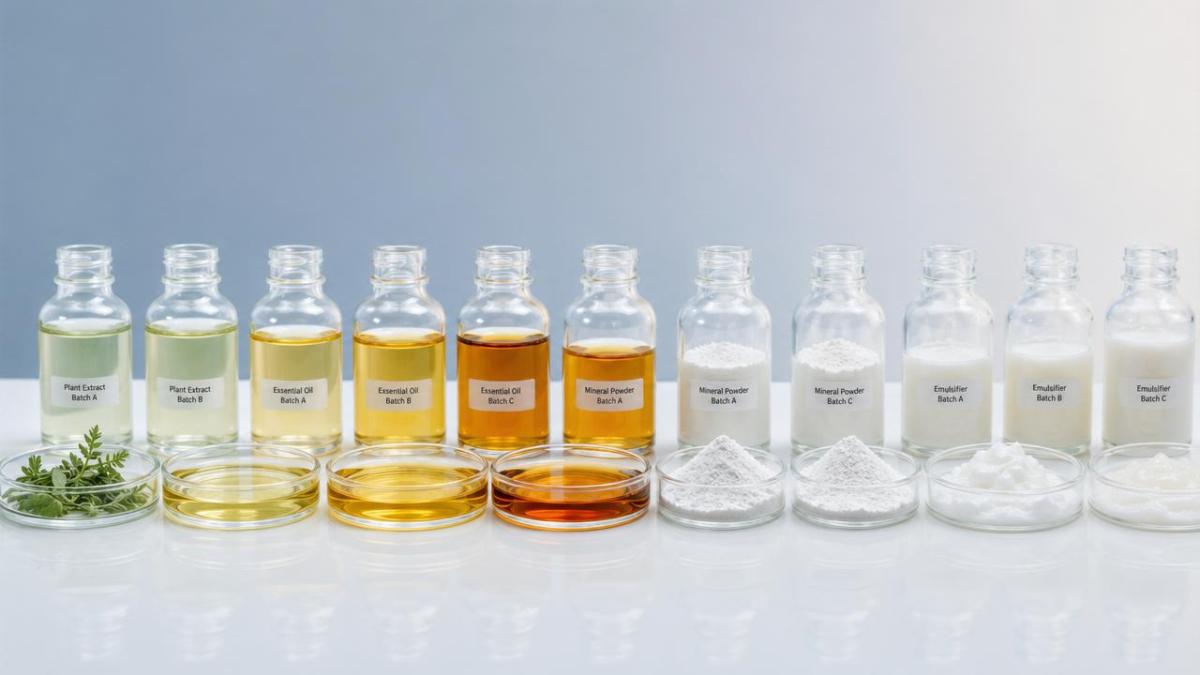
Ingredients derived from plants, minerals, marine inputs, or fermentation often show inherent color fluctuations. Botanical extracts may vary with harvest season, soil profile, rainfall, maturity at collection, and extraction yield. Mineral powders can shift due to ore composition and particle distribution. Even oils may present different yellow, amber, or green notes depending on origin and refining stage. In these cases, cosmetic raw materials bulk lots are not always perfectly identical, even when they remain fit for use.
2. Oxidation and environmental exposure
Oxygen, heat, light, and moisture can gradually alter the color of sensitive materials. Unsaturated oils may darken. Certain actives can yellow over time. Polyphenol-rich extracts may brown when exposed to air. Hygroscopic powders may clump and appear uneven after moisture pickup. Where storage and transport controls are weak, shade variation often reflects progressive degradation rather than raw material origin alone.
3. Processing conditions
Temperature, pH, drying time, filtration efficiency, solvent purity, and reaction completion all influence final color. Overheating during concentration can deepen tone. Incomplete decolorization may leave residual pigments. Variability in neutralization or purification steps can create inconsistent appearance from one batch to another. This is especially relevant in bulk cosmetic intermediates and fine chemical ingredients where the process window is narrow.
4. Cross-contamination and equipment residue
Poor line clearance, inadequate cleaning validation, or carryover from previous production runs can shift shade unexpectedly. Minor contamination may not always create a clear compositional failure, yet it can alter visual appearance enough to trigger investigation. For safety managers, this is a critical point because color anomalies may be one of the first signs that hygiene barriers or segregation practices failed.
5. Packaging, storage, and batch handling
Even compliant material can change after manufacture if it is packed in unsuitable containers, exposed to UV during warehousing, or repeatedly opened during sampling. Differences between top, middle, and bottom layers in drums or sacks may also create apparent shade variation if the material settles, stratifies, or absorbs humidity unevenly. Bulk handling errors can therefore turn a stable ingredient into a disputed shipment.
Industry overview: where shade variation appears most often
Not all ingredient classes carry the same level of color risk. The table below gives quality and safety teams a practical overview of where cosmetic raw materials bulk programs typically experience the highest attention needs.
Business impact for quality control and safety management
The practical consequences of shade variation in cosmetic raw materials bulk go beyond incoming inspection delays. First, it can interrupt production planning. A batch held for color review may stop compounding schedules, force reformulation decisions, or increase safety stock requirements. Second, it can complicate deviation management. Teams may need to investigate supplier history, environmental logs, retained samples, and cleaning records before deciding whether the change is acceptable.
Third, color inconsistency can weaken confidence in supplier capability. Even when the root cause is harmless, repeated appearance differences suggest poor process discipline or insufficient communication about expected natural ranges. Finally, in regulated or audit-heavy environments, unexplained variation creates documentation risk. If internal standards say “light yellow liquid” and received material is noticeably amber, release personnel need objective criteria to support disposition.
How to distinguish acceptable variation from a true risk signal
A disciplined assessment starts by comparing three things: the approved specification, historical batch trend data, and the material’s intended use in formulation. Some cosmetic raw materials bulk categories legitimately vary within a known range. In such cases, the supplier should define a realistic appearance description and, where possible, support it with instrumental color values such as L*, a*, and b* measurements rather than subjective wording alone.
A stronger signal of concern appears when color changes are sudden, directional, or linked to storage time. For example, if a material is usually pale straw and arrives dark gold after a summer shipment, the issue may relate to thermal exposure. If one lot is mottled while previous lots were uniform, segregation or moisture uptake may be involved. The key is to treat color as one element of an integrated review that includes odor, viscosity, assay, pH, moisture, particle size, and packaging condition.
Practical control measures for cosmetic raw materials bulk programs
To reduce recurring disputes, organizations should build color consistency into supplier qualification and internal quality systems. The following measures are especially effective:
- Define appearance specifications with enough detail to be useful, but not so narrowly that natural materials fail without real risk.
- Use standardized lighting, viewing background, and sample presentation during incoming visual inspection.
- Request trend data or retain sample comparisons from suppliers for high-risk ingredients.
- Adopt instrumental color measurement for materials where visual judgment alone causes inconsistent decisions.
- Verify packaging suitability for oxygen, moisture, and light-sensitive ingredients.
- Review transport and warehousing controls, especially for temperature excursions and prolonged port storage.
- Strengthen batch segregation, cleaning verification, and line clearance where cross-contamination is plausible.
Application-focused guidance by material type
Control strategy should reflect the specific role of the ingredient in finished products. The same level of variation may be acceptable in one use case and unacceptable in another.
What to ask suppliers when color variation appears
When a cosmetic raw materials bulk shipment shows unusual shade variation, supplier dialogue should be technical and evidence-based. Ask whether there was a raw source change, a revised process parameter, a packaging modification, or a storage excursion before dispatch. Request batch production dates, retain sample photos, color test data, and any deviation records linked to filtration, drying, pH adjustment, or holding time. Where natural ingredients are involved, ask for seasonal context and standardization controls.
A capable supplier should be able to explain whether the variation is cosmetic only or linked to a measurable quality shift. This level of transparency is increasingly important in global ingredient markets where procurement teams depend on reliable, audit-ready information to support release decisions.
Conclusion and next-step guidance
Shade variation in cosmetic raw materials bulk is a manageable issue when organizations understand its technical origins and treat color as part of a full quality system. Natural source differences, oxidation, processing variability, contamination, and storage conditions all play a role, but their significance depends on the ingredient, formulation use, and the strength of supplier controls. For quality control and safety managers, the goal is not zero variation in every case; it is controlled variation, justified by data and contained within a transparent risk framework.
For teams seeking stronger consistency, the most effective next steps are to tighten appearance specifications, build historical color trending, verify packaging and storage safeguards, and require better supplier disclosure around batch-to-batch change. In a market where cosmetic raw materials bulk decisions influence compliance, production continuity, and brand outcomes, disciplined color management is both a technical necessity and a strategic advantage.
Related Intelligence
- Natural IngredientsIndonesia BPOM Updates Natural Ingredients Labeling RulesIndonesia BPOM updates natural ingredients labeling rules: New Microbial Tolerance Statement required for plant, enzyme & prebiotic powders by Oct 2026 — act now to avoid customs delays.
- Natural IngredientsCosmetic raw materials bulk: what causes shade variationCosmetic raw materials bulk shade variation can signal oxidation, source changes, or storage issues. Learn the key causes, QC risks, and smart controls to protect quality and avoid costly delays.
- Natural IngredientsFood additives manufacturer selection for stable repeat ordersFood additives manufacturer selection made practical: learn how distributors and agents can secure stable repeat orders through supplier fit, compliance strength, and reliable delivery.
The Morning Broadsheet
Daily chemical briefings, market shifts, and peer-reviewed summaries delivered to your terminal.
