
Kelp Powder vs. Other Seaweed Supplements: What's the Difference?

Kelp Powder vs. Other Seaweed Supplements: Key Nutritional and Industrial Differences
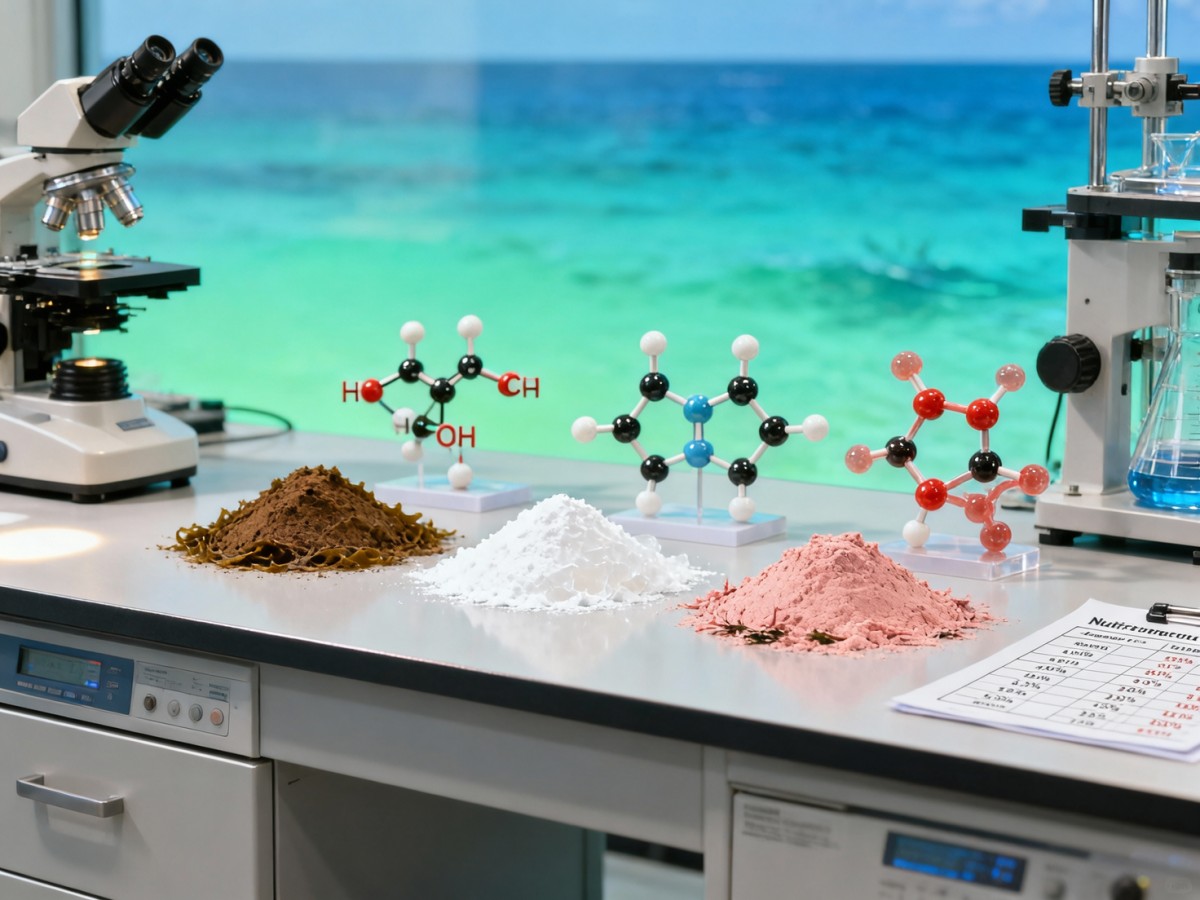
Navigating the world of seaweed supplements? Discover how kelp powder stands apart from agar agar, sea moss, and other marine-derived ingredients in our comprehensive comparison. As procurement specialists and technical evaluators seek premium bulk organic options – from diatomaceous earth to bentonite clay – this analysis delivers critical insights on nutrient profiles, industrial applications, and compliance standards. Essential reading for buyers weighing kelp powder wholesale against alternative functional ingredients in food-grade and nutraceutical formulations.
1. Composition and Nutrient Profiles
Kelp powder (derived from brown algae species like Laminaria and Macrocystis) contains 15-20% alginate by dry weight, distinguishing it from red algae-based supplements such as agar agar (85-90% galactose polymers) or Irish moss (carrageenan content up to 75%). Its mineral density exceeds most terrestrial plants, with iodine concentrations reaching 1500-8000 ppm – 3-5 times higher than bladderwrack or dulse.
For industrial food processors, these compositional differences dictate functional applications. Kelp's alginate content makes it ideal for viscosity control in sauces (0.1-0.5% w/w), while agar agar's thermo-reversible gelling properties suit confectionery molds requiring 1-2% concentrations.
2. Industrial Processing Considerations
Bulk kelp powder production follows strict ISO 22000 and FSSC 22000 standards, with heavy metal testing for arsenic (<0.5 ppm) and cadmium (<0.2 ppm) being mandatory. Unlike sea moss which requires extensive freshwater washing (3-5 cycles), kelp undergoes controlled drying at 60-70°C to preserve heat-sensitive nutrients like fucoxanthin.
- Drying Efficiency: Kelp achieves 8-10% moisture content in 4-6 hours vs. 12+ hours for agar strips
- Particle Size: Standard 80-100 mesh for food applications vs. 200+ mesh for nutraceuticals
- Stabilization: Requires antioxidant treatment (0.01-0.05% tocopherols) to prevent lipid oxidation
2.1 Regulatory Compliance Factors
EU Novel Food regulations (2015/2283) classify certain seaweed extracts differently. While kelp powder falls under traditional food status, some carrageenan types from sea moss require additional safety evaluations. FDA 21 CFR 184.1120 specifically addresses kelp's GRAS status for use at 2-5% in various food matrices.
3. Cost-Benefit Analysis for Bulk Purchasers
Wholesale kelp powder prices range $8-15/kg for food-grade (500kg+ orders), compared to $25-40/kg for pharmaceutical-grade sea moss extracts. However, dosage efficiency must be factored in – kelp's higher nutrient density often reduces required inclusion rates by 30-50% in animal feed formulations.
For aquaculture operations, kelp's 5-7% protein content and mineral profile can reduce supplemental vitamin premix costs by $15-20/ton of feed compared to synthetic mineral additives.
4. Technical Selection Criteria
When evaluating kelp powder suppliers, industrial buyers should verify:
- Third-party heavy metal certificates (As, Cd, Hg, Pb)
- Radiation sterilization documentation (≤10 kGy)
- Species identification via DNA barcoding
- Moisture equilibrium isotherms (aw ≤ 0.6)
4.1 Common Procurement Mistakes
Over 60% of first-time buyers underestimate kelp's iodine variability. Reputable suppliers provide batch-specific mineral assays and recommend pre-blending for consistent formulations. Another frequent error is neglecting particle size distribution - D90 below 150μm is critical for uniform dispersion in liquid systems.
5. Future Market Outlook
The global kelp powder market is projected to grow at 8.2% CAGR (2023-2030), driven by demand in plant-based meat alternatives where its umami flavor compounds (glutamic acid 3-5%) reduce sodium needs. Emerging extraction technologies like subcritical water processing may increase fucoidan yields from current 2-4% to 8-10%, creating new high-value applications.
For formulation specialists and procurement teams, understanding these distinctions ensures optimal material selection. Contact our marine ingredient specialists for customized technical sheets and sample requests tailored to your production parameters.
Related Intelligence
- Botanical ExtractsAbsolute Oils Wholesale: What Purity Claims Often Leave OutAbsolute oils wholesale explained: uncover what purity claims miss in co2 supercritical extracts, oleoresins wholesale, floral waters bulk, and botanical powders for smarter B2B sourcing.
- Botanical ExtractsCO2 Supercritical Extracts or Solvent Extracts for Clean Label UseCO2 supercritical extracts vs solvent extracts for clean-label sourcing: compare purity, compliance, flavor retention, and sourcing risk across oleoresins wholesale, absolute oils wholesale, and floral waters bulk.
- Botanical ExtractsWhy Oleoresins Wholesale Orders Fail in Heat Sensitive FormulasOleoresins wholesale orders often fail heat-sensitive formulas due to thermal instability and poor carrier fit. Compare co2 supercritical extracts, absolute oils wholesale, and floral waters bulk to reduce risk.
The Morning Broadsheet
Daily chemical briefings, market shifts, and peer-reviewed summaries delivered to your terminal.
