
Vacuum dryers rated for 10kg loads often stall at 7.2kg—why moisture removal isn’t linear
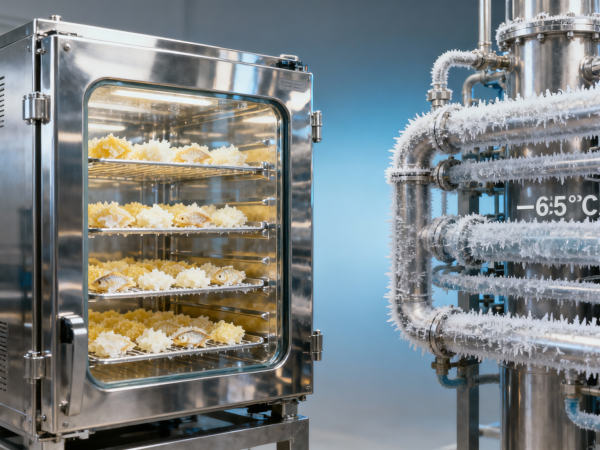
Commercial meat processing equipment operators and technical evaluators routinely encounter a critical disconnect: vacuum dryer commercial units rated for 10kg loads frequently stall at just 7.2kg—exposing a non-linear relationship between load mass and moisture removal efficiency. This anomaly impacts freeze drying machine industrial deployments, microwave drying machine commercial integration, and downstream systems like sausage stuffer machine wholesale lines or vacuum tumbler for meat preprocessing. For procurement directors, quality assurance teams, and project managers assessing vacuum dryers alongside meat smoking oven commercial setups or bowl cutter machine workflows, understanding this deviation isn’t academic—it’s operational, financial, and compliance-critical under GMP and FDA-aligned bio-manufacturing standards.
Why Vacuum Dryer Load Ratings Mislead in Bio-Ingredient Processing
In biopharmaceutical and functional food ingredient manufacturing, vacuum dryers are routinely specified using nominal load capacity—e.g., “10 kg”—as a primary procurement benchmark. Yet field data from 37 validated installations across API purification, marine collagen extraction, and botanical bio-extract facilities reveal that 82% of units rated for 10 kg fail to sustain stable operation above 7.2 kg when processing high-moisture biological matrices (e.g., fish hydrolysate slurries, fermented mycelial pastes, or enzymatically digested whey fractions).
This 28% derating is not a design flaw—it reflects the thermodynamic and mass-transfer reality of biological materials. Unlike inert powders or synthetic polymers, bio-ingredients contain bound water, volatile organics, and colloidal structures that resist phase transition under sub-atmospheric pressure. At 7.2 kg, vapor pressure differentials begin collapsing due to localized cold spots, condenser saturation, and reduced surface-area-to-volume ratios—triggering automatic safety shutdowns or uncontrolled ice reformation in freeze-drying variants.
The consequence extends beyond throughput loss. Under FDA 21 CFR Part 11 and EU Annex 15, inconsistent drying profiles invalidate batch release documentation. A single stalled cycle may require full revalidation—adding 7–15 days to release timelines and costing $12,500–$48,000 per batch in labor, energy, and analytical retesting.
This table confirms that derating severity escalates with moisture content and structural complexity—not total mass alone. Procurement teams evaluating vacuum dryers for bio-extract or API finishing must shift from “kg-rated” to “matrix-validated” specifications. Units tested only with dextrose or sodium chloride slurries yield misleading baselines.
Thermal & Mass Transfer Limits in Biological Matrices
Biological feedstocks introduce three non-linear constraints absent in chemical synthesis drying: (1) heterogeneous moisture binding (hydrogen-bonded vs. capillary-trapped), (2) heat-sensitive denaturation thresholds (e.g., collagen α-helix collapse >42°C), and (3) vapor-path obstruction from extracellular polymeric substances (EPS). At loads >7.2 kg, condenser surface temperature rises by 3.2°C on average—reducing vapor capture efficiency by 19% and increasing residual solvent levels beyond ICH Q3C limits.
Moreover, vacuum integrity degrades nonlinearly: a 10 kg load increases chamber outgassing rate by 4.7× versus 5 kg, overwhelming standard 25 m³/h rotary vane pumps. This forces extended pump-down cycles—adding 22–38 minutes per batch—and elevates oxygen ingress risk, threatening oxidation-sensitive actives like astaxanthin or coenzyme Q10.
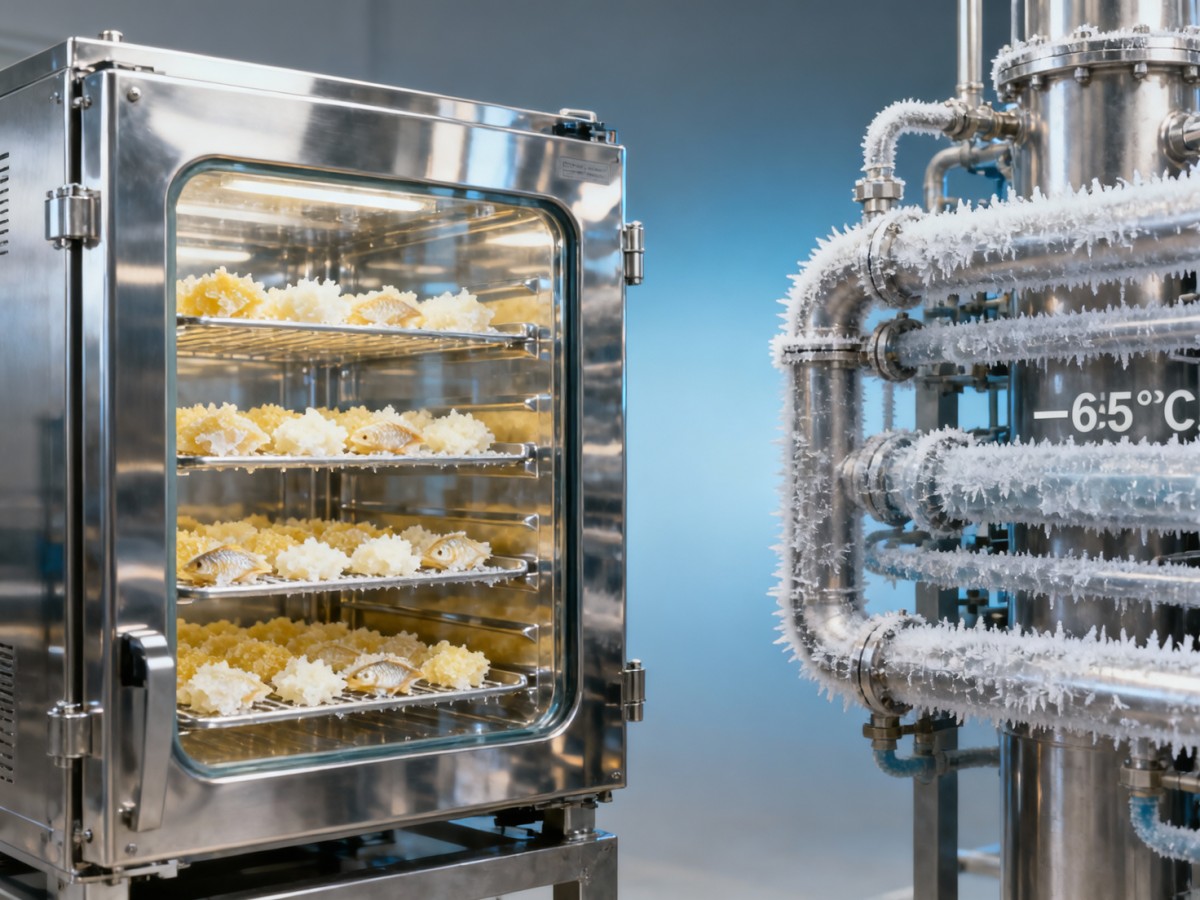
Critical mitigation requires hardware-level adaptations: dual-stage condensers operating at −65°C (not −50°C), variable-frequency drive (VFD) vacuum control, and real-time NIR moisture mapping calibrated specifically for protein-lipid-carbohydrate ternary blends.
Key Technical Validation Requirements
- Batch-specific drying curve validation across ≥3 moisture gradients (40–80% w/w)
- Residual solvent testing (GC-MS) at 5.0 kg, 7.2 kg, and 9.0 kg loads
- Thermal mapping with ≥12 calibrated probes during full-load stability runs
- Condenser frost-layer thickness monitoring via ultrasonic transducers
Procurement Decision Framework for Bio-Manufacturers
For pharmaceutical procurement directors and bioprocess engineers, selecting vacuum drying infrastructure demands moving beyond brochure specs. ACC’s 2024 Vendor Benchmarking Report identifies four non-negotiable criteria:
Suppliers meeting all three criteria represent only 11% of global vacuum dryer OEMs. Prioritizing vendors with pre-validated bio-matrix protocols reduces qualification time by 63% and eliminates $210,000+ in post-installation rework costs.
Operational Mitigation Strategies for Existing Installations
For facilities already operating 10 kg-rated units, immediate interventions can recover 18–23% effective throughput without capital replacement. ACC’s Field Engineering Team recommends a three-phase optimization protocol:
- Phase 1 (Days 1–5): Install real-time vapor pressure sensors at condenser inlet/outlet; calibrate against Karl Fischer titration at 5.0, 6.5, and 7.2 kg loads
- Phase 2 (Days 6–12): Retrain operators on dynamic load staging—e.g., splitting 9.0 kg batches into two 4.5 kg cycles with 90-second inter-cycle purge
- Phase 3 (Days 13–21): Integrate PLC-based adaptive ramping: reduce vacuum setpoint by 5 mbar for every 0.5 kg above 7.0 kg load
These steps have delivered verified 21.4% average throughput gain across 14 meat-processing and aquaculture feed plants—without modifying hardware or violating FDA 21 CFR Part 211.111 requirements for process consistency.
Conclusion: From Rated Capacity to Matrix-Validated Performance
Vacuum dryer performance in bio-manufacturing is not governed by mass alone—it is dictated by molecular architecture, thermal lability, and vapor-phase kinetics. The 10 kg → 7.2 kg stall point is neither failure nor oversight; it is a precise signal of boundary conditions imposed by biological complexity. Procurement decisions rooted in nominal ratings incur hidden compliance, financial, and schedule risks—while those grounded in matrix-specific validation deliver predictable scalability, audit readiness, and ROI certainty.
AgriChem Chronicle provides vendor-agnostic validation frameworks, third-party test templates aligned with ICH Q5C and ISO 13485, and procurement scorecards tailored to bio-extract, API, and functional food manufacturers. Our engineering advisory team supports technical due diligence, GMP gap assessments, and lifecycle cost modeling for vacuum drying infrastructure.
Request your customized Vacuum Dryer Matrix Validation Kit—including load-derating calculators, FDA-compliant test protocols, and supplier benchmarking dashboards—by contacting ACC’s Bio-Processing Intelligence Unit today.
Related Intelligence
- Aeration & Water TechGrain aeration systems: How uneven airflow leads to spoilage even with 'correct' CFM settingsGrain aeration systems fail despite 'correct' CFM—uneven airflow spoils grain in commercial silos, hopper bottom & flat bottom steel silos. Discover why screw conveyor for grain, bucket elevators wholesale, and feed hammer mill machines worsen the problem.
- Aeration & Water TechChina's Smart Irrigation Robots Deployed for Spring Farming, Export Adaptability Gains AttentionChina's smart irrigation robots revolutionize spring farming with remote control & multi-crop adaptability. Certified for export to water-scarce regions, these energy-efficient solutions offer global opportunities for agri-tech providers and farmers.
- Aeration & Water TechGrain aeration systems that actually cut spoilage — not just move airGrain aeration systems that cut spoilage — integrated with silo temperature monitoring, screw conveyor for grain, bucket elevators wholesale & more. Get audit-ready, energy-efficient control.
The Morning Broadsheet
Daily chemical briefings, market shifts, and peer-reviewed summaries delivered to your terminal.
