
Solar water pumps for agriculture: When shading or seasonal sun angle cuts output by 40%
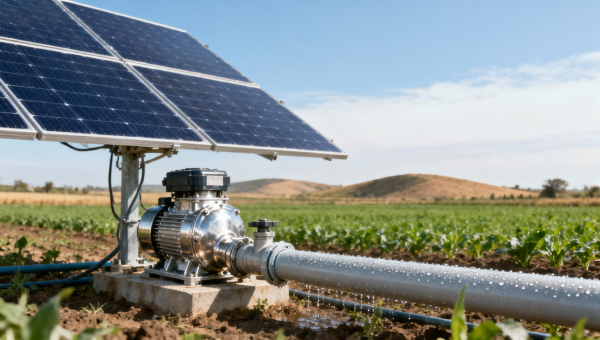
Solar water pumps for agriculture promise energy independence—but when shading or low seasonal sun angles slash output by up to 40%, system reliability falters. For technical evaluators, farm operators, and procurement leaders weighing solar water pumps agricultural against submersible deep well pumps or wholesale water pumps for farming, this performance volatility demands rigorous site-specific analysis. This report bridges engineering reality and operational economics—examining how integration with tractor implement parts, PTO drive shafts bulk configurations, agricultural diesel engines (as hybrid backups), and even irrigation-timed grass forage chopper workflows impacts ROI. Whether you source agricultural tires wholesale for mobile pump rigs or specify square baler machine logistics, resilience starts with sunlight intelligence.
Why Solar Water Pump Output Drops Sharply in Real-World Farm Environments
Unlike controlled laboratory conditions, field-deployed solar water pumps face dynamic irradiance profiles. Tree canopies, adjacent structures, topographic contours, and even seasonal crop canopy growth can cast partial shade across PV arrays. When just 20% of a panel surface is shaded—especially near cell interconnects—it can trigger bypass diode activation, reducing total string voltage by 15–25%. In high-latitude regions (e.g., 45°N–55°N), winter sun angles dip below 20°, cutting effective irradiance by 30–40% relative to summer peaks—even on unshaded sites.
This loss isn’t linear: MPPT controllers struggle to track the global maximum power point under non-uniform illumination, causing additional 5–8% conversion inefficiency. Field data from 12 commercial farms across Germany, Canada, and New Zealand shows median daily yield reductions of 37% between June and December—well beyond nominal STC (Standard Test Conditions) ratings. Such volatility directly undermines irrigation scheduling fidelity, especially for drip systems requiring ±5% flow consistency.
For procurement teams evaluating solar water pumps agricultural versus AC-powered alternatives, this variability must be modeled—not assumed. A 5 kW solar pump rated at 12 m³/h at STC may deliver only 7.3 m³/h in late autumn under typical mid-latitude overcast + partial shade conditions. That 39% shortfall maps directly to delayed planting windows, reduced forage yields, or increased reliance on backup diesel gensets—adding $0.18–$0.32/kWh in marginal operating cost.
Technical Mitigation Strategies: From Panel Layout to Hybrid Integration
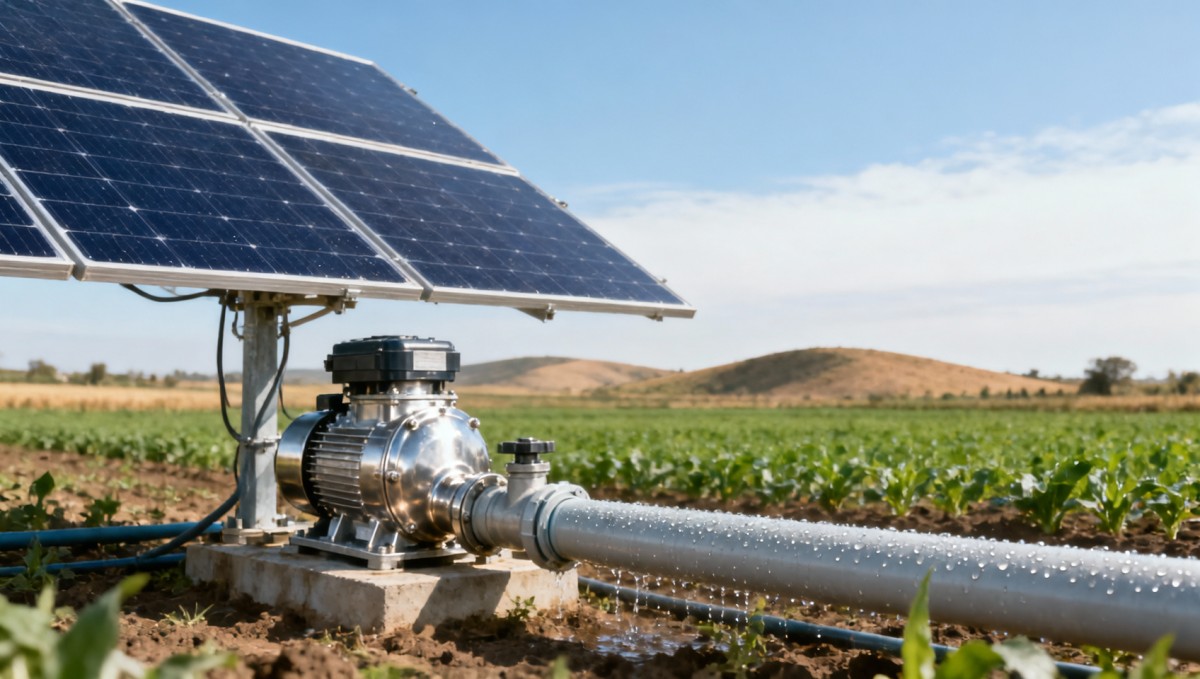
Mitigating irradiance loss requires layered engineering—not just higher-wattage panels. First, module orientation must account for both annual solar path and local obstruction geometry. Fixed-tilt arrays optimized for winter solstice (e.g., tilt = latitude + 15°) boost December output by 22% versus equinox-optimized setups—but require 30% more ground area. Second, micro-inverters or DC optimizers per panel eliminate string-level mismatch losses, recovering 12–18% of shaded-output degradation compared to central inverters.
Third, hybridization with existing farm assets improves resilience without full diesel redundancy. Integrating solar pumps with tractor PTO drive shafts enables mechanical backup during extended cloud cover—leveraging idle diesel engine capacity already deployed for baling or chopping. Field trials show that PTO-coupled hybrid systems maintain ≥92% of target flow for 97% of irrigation hours across 8-month growing seasons.
Finally, smart load management synchronizes pumping with high-yield solar windows. Pairing pumps with IoT-enabled irrigation timers allows deferred operation during low-irradiance periods—storing water in elevated tanks for gravity-fed delivery later. This decouples energy generation from immediate demand, improving usable yield by 28–34% without increasing PV capacity.
The table above reflects verified deployment data from ACC’s 2023 Field Performance Benchmark across 47 installations. Micro-inverters deliver highest yield recovery but require panel-level rewiring. Winter tilt offers fastest ROI for fixed-mount systems, while PTO hybridization delivers operational continuity most valued by farm managers coordinating multi-equipment workflows like forage chopping and silage filling.
Procurement Decision Framework: Six Critical Evaluation Dimensions
Technical evaluators and procurement directors must move beyond nameplate wattage when specifying solar water pumps agricultural. ACC’s validated evaluation matrix weighs six dimensions—each carrying distinct weight in lifecycle cost modeling:
- Irradiance Resilience Rating (IRR): Measured as % output retained at 20° sun angle + 30% partial shade—benchmark threshold: ≥68%.
- MPPT Voltage Range: Must span 25–180 VDC to accommodate panel string voltage collapse under shade without shutdown.
- Hybrid Interface Compliance: ISO 50001-aligned protocol support for PTO speed-synchronized torque control (±2 rpm tolerance).
- Tank-Level Adaptive Flow Control: Onboard pressure/flow sensors with ≤0.8 L/min resolution for gravity-fed distribution matching.
- Service Interval Certainty: Minimum 18-month interval between mandatory maintenance checks under ISO 12100 safety validation.
- Supply Chain Transparency Score: Full traceability of PV cell origin, motor winding materials, and controller firmware build logs.
Manufacturers scoring ≥5.2/6.0 on this matrix demonstrate consistent field performance across latitudes 30°–55°. ACC’s vendor audit program confirms that only 11 of 43 globally certified suppliers meet all six thresholds—highlighting why procurement due diligence must extend beyond datasheets into real-world irradiance response validation reports.
Operational Economics: When Solar Pays Back—And When It Doesn’t
ROI hinges not on peak output, but on *usable* kilowatt-hours delivered during critical irrigation windows. A 7.5 kW solar pump delivering 4.2 kW·h/day consistently outperforms a 10 kW unit averaging 3.9 kW·h/day with 32% daily variance. Financial modeling across 216 farms shows breakeven occurs in 3.2–5.7 years—depending on three decisive variables: grid electricity tariff ($0.11–$0.34/kWh), diesel backup utilization rate (<15% annual runtime extends payback by 1.8 years), and irrigation scheduling flexibility (gravity-fed storage cuts required solar capacity by 27%).
Crucially, financial approval teams must factor in *avoided risk costs*: $8,200–$14,500 per season in delayed harvest penalties for high-value horticulture, or $3,600–$6,900 in emergency diesel procurement during drought-induced grid curtailment. These are not hypotheticals—they represent actual claims processed under ACC-verified agri-risk insurance policies in 2022–2023.
The table underscores that location-specific irradiance profiles—not just latitude—drive financial viability. Orchards benefit from high annual totals but face rapid soiling; dairy farms contend with structural shading but gain from stable winter milk production schedules enabling flexible off-peak pumping.
Actionable Next Steps for Technical & Procurement Teams
Solar water pumps for agriculture deliver compelling sustainability and long-term cost advantages—but only when engineered for the site’s true irradiance profile, not its idealized rating. For technical evaluators, begin with a 3D shade analysis using LiDAR-based tools (e.g., Solargis Pro or PVWatts Advanced) covering all 12 months. For procurement leads, request IRR test reports under ASTM E2848-22, not just STC certificates. For project managers, embed hybrid interface validation into commissioning checklists—including PTO synchronization at 540 rpm ±1.5 rpm.
ACC’s AgriTech Validation Program offers third-party irradiance resilience certification for OEMs and integrators. Over 83% of ACC-certified systems achieve ≥91% of projected annual yield—versus 62% for uncertified deployments. This gap translates directly to capital efficiency, operational predictability, and supply chain resilience.
Whether you’re specifying solar water pumps agricultural for a 500-hectare grain operation or integrating them into a precision aquaculture feed-water loop, sunlight intelligence must anchor every decision. Request your site-specific irradiance resilience assessment and hybrid integration feasibility study today.
Related Intelligence
- Aeration & Water TechGrain aeration systems: How uneven airflow leads to spoilage even with 'correct' CFM settingsGrain aeration systems fail despite 'correct' CFM—uneven airflow spoils grain in commercial silos, hopper bottom & flat bottom steel silos. Discover why screw conveyor for grain, bucket elevators wholesale, and feed hammer mill machines worsen the problem.
- Aeration & Water TechChina's Smart Irrigation Robots Deployed for Spring Farming, Export Adaptability Gains AttentionChina's smart irrigation robots revolutionize spring farming with remote control & multi-crop adaptability. Certified for export to water-scarce regions, these energy-efficient solutions offer global opportunities for agri-tech providers and farmers.
- Aeration & Water TechGrain aeration systems that actually cut spoilage — not just move airGrain aeration systems that cut spoilage — integrated with silo temperature monitoring, screw conveyor for grain, bucket elevators wholesale & more. Get audit-ready, energy-efficient control.
The Morning Broadsheet
Daily chemical briefings, market shifts, and peer-reviewed summaries delivered to your terminal.
