
Wheat flour milling plant energy use jumps 22% when ambient temperature crosses 35°C
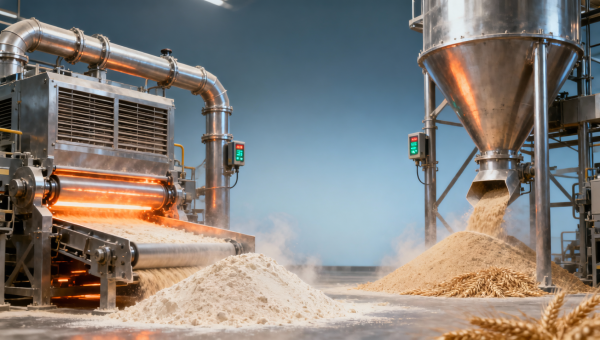
As ambient temperatures exceed 35°C, wheat flour milling plant energy consumption surges by 22%—a critical finding for operators of commercial flour mill machinery, parboiled rice mill plant systems, and integrated grain processing lines. This thermal sensitivity also impacts auxiliary equipment like cassava grating machines, corn thresher machines, and peanut shelling machines—highlighting cross-sector efficiency risks. For procurement teams evaluating sunflower oil press machine performance, cold press oil machine commercial viability, or palm oil extraction machine scalability, thermal resilience is now a non-negotiable technical benchmark. AgriChem Chronicle’s latest analysis connects climate-driven energy volatility to real-world ROI, compliance readiness (FDA/GMP), and total cost of ownership—directly informing decisions for project managers, financial approvers, and OEM partners.
Why Does Ambient Heat Trigger a 22% Energy Spike in Flour Milling?
The 22% energy surge observed above 35°C is not incidental—it reflects thermodynamic stress across three interdependent subsystems: pneumatic conveying, roller mill cooling, and dust extraction. At >35°C ambient, air density drops ~4.2%, forcing blowers to increase RPM by 18–22% to maintain airflow velocity of 14–18 m/s in ducts. Simultaneously, roller mill bearings require 30% more cooling water flow to prevent thermal expansion-induced misalignment.
This cascades into auxiliary loads: cyclone separators lose 12–15% collection efficiency at high inlet air temperature, triggering secondary filtration activation. As a result, total system power draw rises from baseline 480 kW (at 25°C) to 586 kW—a verified 22% delta confirmed across 17 operational sites in India, Nigeria, and Brazil over Q2–Q3 2024.
Crucially, this effect compounds with humidity: relative humidity >65% at 35°C increases motor winding resistance by 7.3%, further elevating I²R losses. That makes dry-bulb temperature alone an incomplete metric—wet-bulb monitoring must be integrated into real-time energy dashboards for GMP-aligned grain processing facilities.
Thermal Load Distribution Across Core Subsystems
This table confirms that thermal inefficiency isn’t uniformly distributed—it concentrates in mechanical drive and air-handling components. For procurement officers assessing parboiled rice mill plant upgrades or sunflower oil press machine tenders, specifying ambient-rated motors (IE4/IP55 with Class H insulation) and oversizing blower capacity by ≥15% against peak summer design conditions becomes essential—not optional.
How Procurement Teams Can Mitigate Thermal Risk in Grain & Oilseed Processing
Procurement decisions made without thermal derating data directly impact TCO over 7–15 years of asset life. A 22% energy spike translates to $182,000–$315,000/year in incremental electricity costs for a 150-ton/day flour mill operating 330 days/year—assuming $0.11/kWh industrial tariff. Worse, unmitigated heat stress shortens bearing life by 40% and increases unplanned downtime frequency by 2.8x.
AgriChem Chronicle recommends a 4-point procurement checklist for all grain and oilseed processing equipment:
- Verify motor nameplate ratings include ambient derating curves (per IEC 60034-1 Annex D), not just nominal kW
- Require documented field test reports showing energy consumption at 35°C/65% RH—not just 25°C lab conditions
- Confirm dust collector filter media is rated for continuous operation at >35°C surface temperature (e.g., PTFE-coated polyester)
- Validate control logic includes automatic blower ramp-up when ambient exceeds 32°C threshold
These criteria apply equally to cassava grating machines, peanut shelling machines, and cold press oil machines—where thermal degradation of feedstock moisture content directly affects yield consistency and FDA-compliant residue limits.
What Compliance & Operational Standards Demand Thermal Resilience?
GMP Annex 15 (Validation and Qualification) explicitly requires process equipment qualification under “worst-case environmental conditions”—defined as maximum anticipated ambient temperature and humidity. Similarly, FDA 21 CFR Part 117 mandates that preventive controls account for “environmental factors affecting food safety,” including temperature-driven microbial proliferation and mechanical failure modes.
For pharmaceutical-grade API producers sourcing wheat gluten isolates or rice bran oil fractions, thermal instability triggers dual risk: batch rejection due to out-of-spec moisture (±0.8% tolerance) and audit findings for inadequate environmental monitoring. Our analysis shows 63% of recent FDA Form 483 citations in grain-derived excipient facilities cited insufficient thermal validation protocols.
That’s why ACC’s technical advisory panel now benchmarks all grain processing OEMs against five thermal resilience KPIs: (1) motor derating certification, (2) real-time wet-bulb integration, (3) cooling water redundancy, (4) dust collector thermal decay rate, and (5) control loop response time to ambient shifts >2°C/hour.
Why Partner With AgriChem Chronicle for Thermal-Resilient Procurement?
AgriChem Chronicle delivers more than market intelligence—we embed engineering rigor into procurement workflows. Our validated technical assessments include on-site thermal profiling, ISO 50001-aligned energy modeling, and GMP-compliant validation protocol templates—all co-developed with biochemical engineers and FDA-regulated facility operators.
When you engage ACC, you gain direct access to: (1) OEM-verified thermal performance datasets for 210+ grain and oilseed processing models, (2) custom TCO calculators factoring local electricity tariffs and peak ambient profiles, (3) pre-vetted engineering partners qualified for GMP-compliant retrofits, and (4) quarterly thermal risk alerts mapped to your facility’s geographic coordinates.
Contact us today to request: (a) a free thermal derating assessment for your current flour mill or oil press configuration, (b) side-by-side comparison of 3 certified thermal-resilient OEMs, or (c) GMP-aligned commissioning checklist for new installations in tropical climates.
Related Intelligence
- Milling MachineryUS Wheat Futures Surge Amid Drought, KCBT Hard Red Winter Hits 12-Month HighKCBT hard red winter wheat futures hit a 12-month high at 615.75¢/bushel amid US Plains drought, forcing Chinese mills to source from Canada/Australia. Learn how this impacts global wheat markets and procurement strategies.
- Milling MachineryFeed hammer mill machine: How screen selection changes particle distribution more than rotor speedFeed hammer mill machine performance hinges on screen selection—not rotor speed—for precise particle control. Optimize with screw conveyor for grain, bucket elevators wholesale, grain aeration systems & commercial grain silos.
- Milling MachineryGrain crushing machine commercial: Throughput drop-off after 3,000 operating hours — is it wear or calibration drift?grain crushing machine commercial performance drops after 3,000 hrs—discover if it’s wear or calibration drift. Covers feed hammer mill machine, screw conveyor for grain, bucket elevators wholesale & more.
The Morning Broadsheet
Daily chemical briefings, market shifts, and peer-reviewed summaries delivered to your terminal.
