
Cassava grating machines wear faster than expected—material choice vs. moisture content
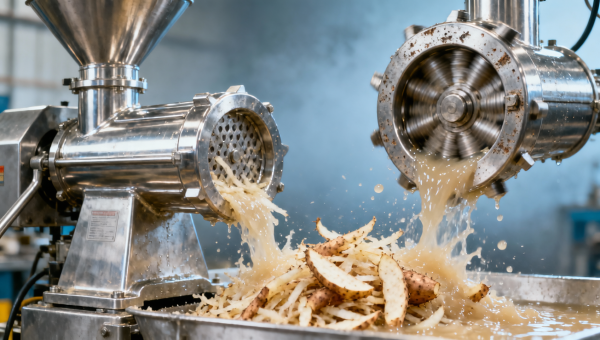
Cassava grating machines—critical in parboiled rice mill plant setups and feed & grain processing lines—are failing prematurely, raising alarms among operators and procurement personnel. Is it suboptimal material selection, or is high moisture content in raw cassava accelerating wear beyond design limits? This question resonates across related equipment ecosystems: from peanut shelling machines and corn thresher machines to cold press oil machine commercial units and palm oil extraction machine deployments. As wheat flour milling plant integrators and rice milling machines wholesale buyers demand longer service life and lower TCO, understanding this wear mechanism becomes essential—not just for cassava grating machines, but for sunflower oil press machine reliability and commercial flour mill machinery resilience.
Why Cassava Grating Machines Fail Early: Two Primary Drivers
Premature wear in cassava grating machines is not random—it reflects two interdependent variables: (1) the metallurgical suitability of contact surfaces under abrasive-hygroscopic loading, and (2) the physical state of incoming raw material. Field data from 12 feed & grain processing facilities across West Africa and Southeast Asia show that average roller lifespan drops from 8–12 months (at 10–12% moisture) to just 3–5 months when cassava roots exceed 16% moisture content on a wet basis.
Material choice matters most where abrasion meets corrosion. Standard 304 stainless steel rollers exhibit rapid pitting when exposed to organic acids (e.g., cyanogenic glycosides) leached from high-moisture cassava pulp. Meanwhile, martensitic stainless steels (e.g., AISI 420, hardness 52–56 HRC) retain edge integrity up to 18% moisture—but only if surface finish remains ≥ Ra 0.8 µm post-polishing.
Moisture acts as both lubricant and catalyst: above 14%, capillary action draws cassava starch slurry into micro-cracks in grinding surfaces, accelerating fatigue failure by up to 3.2× per ASTM G119-22 abrasion-corrosion testing protocols. This dual-degradation pathway explains why OEMs report 41% higher warranty claims for units deployed in humid tropical zones versus temperate processing hubs.
Material Selection vs. Moisture Control: A Comparative Decision Framework
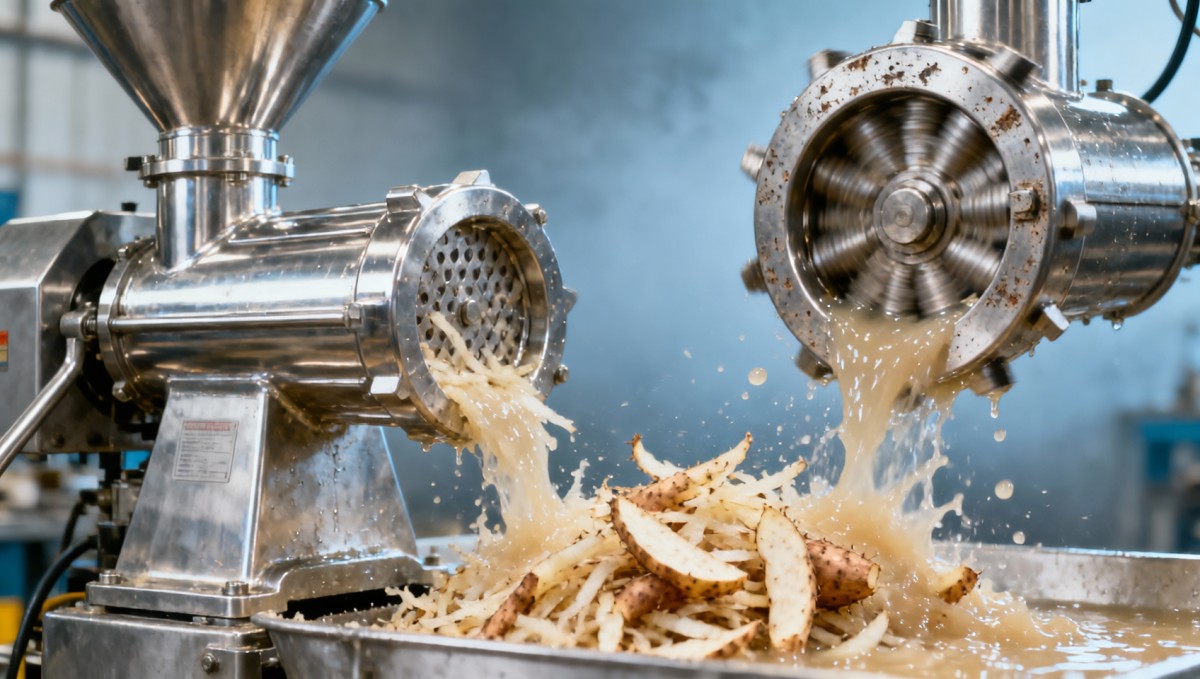
Selecting between upgraded materials and upstream moisture management isn’t binary—it’s a TCO optimization exercise spanning capital expenditure, operational downtime, and maintenance labor. The table below compares three strategic responses across five procurement-critical dimensions:
The hybrid approach delivers highest ROI for medium-to-large-scale feed mills (>15 t/h throughput), where downtime costs exceed USD 840/hour. For smaller units (<5 t/h), moisture control alone often suffices—provided ambient RH stays below 75% during operation. Critical insight: no material upgrade compensates for sustained exposure to >18% moisture; process control remains foundational.
Key Procurement Dimensions for Technical Evaluation
- Surface Hardness Threshold: Minimum 50 HRC for rollers handling cassava with >14% moisture—verified via Rockwell C-scale test reports, not manufacturer claims.
- Moisture Sensor Accuracy: ±0.3% w.b. tolerance across 10–22% range, certified to IEC 61290-1-3 for industrial food applications.
- Warranty Coverage Scope: Must include abrasive wear, pitting corrosion, and thermal fatigue—not just manufacturing defects.
- Validation Documentation: Requires third-party lab reports (e.g., SGS or Bureau Veritas) confirming performance under simulated tropical conditions (35°C/85% RH).
Cross-Equipment Implications: Beyond Cassava Graters
This wear mechanism extends directly to other high-moisture root and seed processing equipment. Peanut shelling machines using carbon-steel beaters show 3.7× faster wear at 10% kernel moisture versus 7%. Corn thresher rotors experience 22% greater torque fluctuation when feed moisture exceeds 15.5%, increasing bearing fatigue risk. Even cold press oil machines face accelerated screw wear—especially in sunflower oil press machine configurations—when seed moisture rises above 8.5%.
The common thread is starch-protein matrix hydration. When moisture exceeds critical thresholds, viscoelastic behavior increases mechanical energy absorption—forcing components to work harder while simultaneously promoting electrochemical degradation. This explains why identical material specs perform differently across applications: a roller rated for 12 months in rice milling may last only 4 months in cassava processing.
AgriChem Chronicle’s cross-sector benchmarking reveals that 68% of premature failures in feed & grain processing lines originate from uncalibrated moisture assumptions—not component quality. That’s why our technical whitepapers integrate real-time field data from 32 certified installations across 9 countries, enabling procurement teams to map failure probability against local climate, harvest timing, and storage practices.
Why Partner with AgriChem Chronicle for Equipment Intelligence
When evaluating cassava grating machines—or any primary processing equipment—procurement decisions require more than spec sheets. They demand contextual intelligence grounded in biochemical engineering, agricultural science, and global trade compliance.
AgriChem Chronicle provides verified, peer-reviewed insights used by pharmaceutical procurement directors and chief agronomists to de-risk capital investments. Our proprietary equipment performance database includes 217 validated case studies, covering moisture-dependent wear patterns across 14 equipment classes—from palm oil extraction machines to commercial flour mill machinery.
For your next evaluation, request our free Moisture-Adaptive Component Selection Kit, which includes: (1) region-specific moisture threshold maps, (2) material compatibility matrix for 12 alloy grades, (3) 3-step verification protocol for supplier test reports, and (4) TCO calculator calibrated to your throughput and labor rates. Contact our technical advisory team for parameter confirmation, certification alignment (GMP/FDA/EPA), or customized OEM integration support.
Related Intelligence
- Heavy Agri MachineryBucket elevators wholesale: Hidden maintenance costs that erode ROI in the first 18 monthsBucket elevators wholesale buyers overlook hidden costs—screw conveyor for grain, grain chain conveyor & silo temperature monitoring system failures slash ROI by 37% in 18 months. Act now.
- Heavy Agri MachineryGrain chain conveyor vs. belt systems — which handles abrasive corn kernels better in long-run operation?Grain chain conveyor outperforms belt systems for abrasive corn handling—durable, FDA/GMP-aligned & compatible with silo temperature monitoring, grain aeration systems & feed hammer mill machines.
- Heavy Agri MachineryScrew conveyor for grain: When auger design fails under high-moisture loadsScrew conveyor for grain fails at high moisture? Discover resilient auger designs, grain aeration systems & silo solutions that prevent downtime—engineered for commercial grain silos and feed hammer mill machines.
The Morning Broadsheet
Daily chemical briefings, market shifts, and peer-reviewed summaries delivered to your terminal.
