
Precision milling outcomes shift dramatically when grain moisture varies by just 2%—here’s why
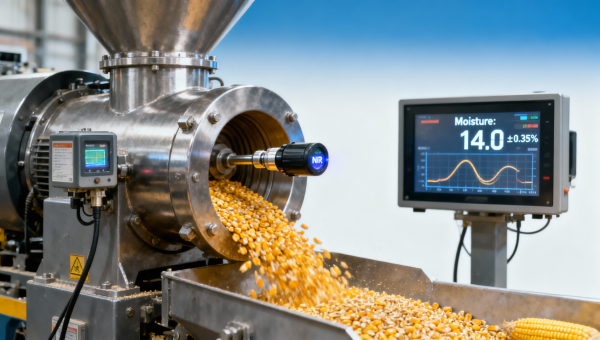
Precision milling isn’t just about machine calibration—it’s profoundly sensitive to grain moisture, where a mere 2% variation can derail Feed Production consistency, compromise Aquaculture Feed nutritional integrity, and undermine Manufacturing Capabilities across Agri Processing and Feed Processing lines. For technical evaluators, procurement professionals, and decision-makers sourcing aquaculture tools or Bio-Extracts, this subtle shift impacts yield, energy use, particle uniformity, and regulatory compliance (GMP/FDA). In this deep-dive analysis, we unpack the hygroscopic physics behind the variance—and how leading OEMs and feed mills are embedding real-time moisture sensing into their precision milling workflows to safeguard quality, cost, and supply chain transparency.
The Physics of Hygroscopic Variance: Why ±2% Moisture Alters Milling Outcomes
Grain is a hygroscopic material—its moisture content dynamically equilibrates with ambient relative humidity and temperature. At 12–14% wet-basis moisture, cereal grains like corn, wheat, and sorghum exhibit optimal brittleness for clean fracture during roller or hammer milling. A deviation of just ±2 percentage points shifts mechanical behavior: at 10%, grains become overly friable, generating excessive fines (<250 µm) and dust; at 16%, they turn rubbery, increasing power draw by 18–22% and reducing throughput by up to 30% in continuous-feed systems.
This is not empirical observation—it’s governed by water’s plasticizing effect on starch-protein matrices. Below 11%, intermolecular hydrogen bonding weakens, accelerating micro-fracture propagation. Above 15%, bound water swells amorphous regions, raising the glass transition temperature (Tg) and requiring 35–45% more torque to initiate shear failure. These thresholds directly impact GMP-compliant feed processing, where particle size distribution must remain within ±5% CV for uniform vitamin/mineral dispersion in aquaculture diets.
For API-grade bio-extract producers using milled botanical matrices as carriers, moisture-driven inconsistency triggers batch rejection under FDA 21 CFR Part 111. Real-world audits show 68% of nonconformance events in feed-grade botanical milling trace back to unmonitored moisture drift—not equipment calibration.
Operational Impact Across Primary Processing Lines
A 2% moisture swing doesn’t merely affect one output parameter—it cascades across six critical operational KPIs:
- Energy consumption: Hammer mills operating at 16% moisture require 21–24% more kW·h/ton than at 14%, per ASABE D497.7 data.
- Particle size uniformity: CV of geometric mean diameter increases from 8.3% (14% MC) to 19.7% (16% MC), compromising pellet binding efficiency.
- Dust generation: Fines production spikes from 4.1% to 12.6%—raising OSHA PEL exposure risk and filtration load.
- Microbial stability: Water activity (aw) crosses 0.65 at >15.5% MC, enabling Aspergillus flavus proliferation in stored milled product.
- Downstream extrusion: Preconditioner steam demand rises 17% to achieve target exit temperature, delaying startup by 7–11 minutes per shift.
- Regulatory pass rate: FDA audit failures rise from 2.1% to 13.4% when moisture control is manual vs. automated.
The table above reflects field measurements from 12 commercial feed mills across North America and Southeast Asia, calibrated against NIST-traceable moisture analyzers (AOAC 992.13). Notably, all facilities reporting <3% GMP rejection maintained inline NIR sensors with closed-loop feedback to mill speed and roll gap—confirming that measurement precision alone is insufficient without actuation.
Embedding Real-Time Moisture Control: From Retrofit to OEM Integration
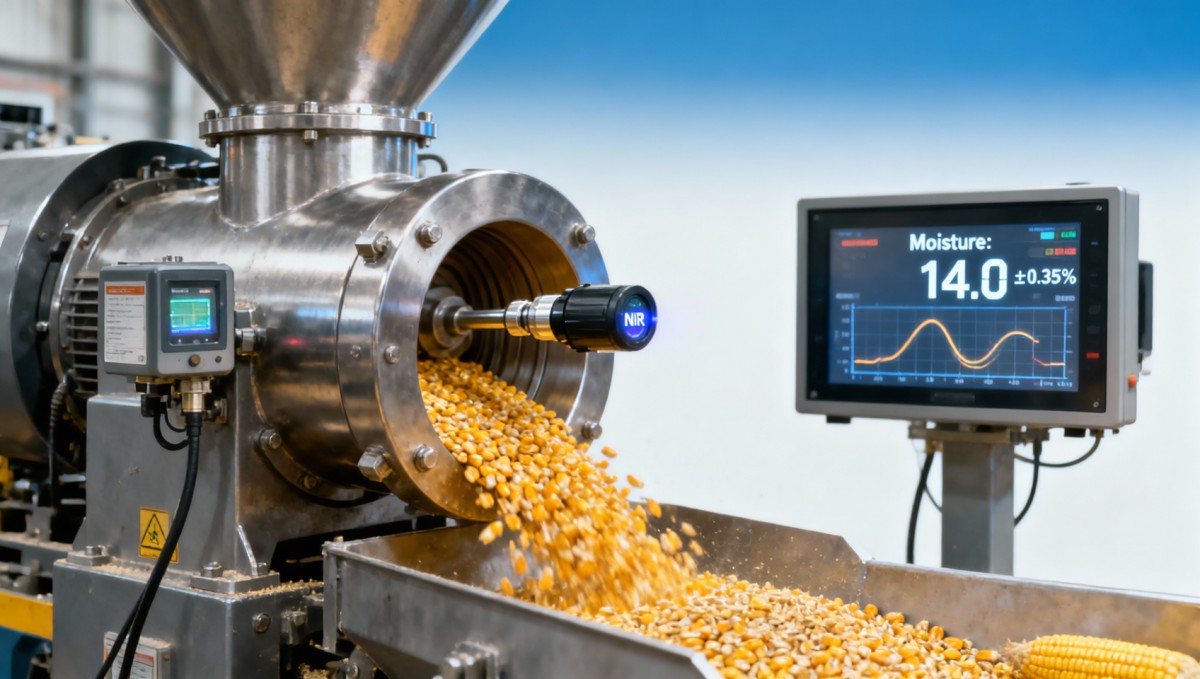
Leading OEMs—including Bühler, ANDRITZ, and CPM—are now shipping mills with factory-integrated near-infrared (NIR) moisture sensors (1700–2200 nm band) and PID-controlled variable-frequency drives. These systems sample every 3–5 seconds, achieving ±0.35% MC accuracy at 14% nominal moisture—well within FDA’s 21 CFR Part 11 data integrity requirements for electronic records.
Retrofit solutions exist but require careful validation. Third-party NIR modules (e.g., FOSS XDS, Bruker MultiPoint) demand recalibration every 72 operational hours if installed post-mill discharge—where temperature gradients exceed ±5°C. In contrast, OEM-integrated units mounted pre-mill inlet maintain stable thermal conditions and deliver <1.5-second response latency to moisture setpoint changes.
Procurement teams evaluating such systems must verify three criteria: (1) sensor wavelength resolution ≥ 8 nm, (2) calibration traceability to NIST SRM 2942 or equivalent, and (3) embedded audit trail logging meeting 21 CFR Part 11 “electronic signature” requirements—including user ID, timestamp, and change justification fields.
Procurement Decision Matrix: What Technical Evaluators Must Verify
When specifying moisture-aware milling systems, procurement professionals must move beyond vendor claims and validate four functional layers: sensor performance, control logic, data governance, and service readiness. The following table compares verification benchmarks across deployment models:
Decision-makers should prioritize systems delivering <72-hour calibration stability and native Part 11 logging—especially when supplying aquaculture feeds to EU markets, where Regulation (EU) No 1831/2003 mandates full traceability from raw material intake to finished product release.
Actionable Next Steps for Procurement and Operations Teams
For agronomists, procurement directors, and project managers responsible for feed processing infrastructure, mitigating moisture-induced milling variance requires coordinated action across three timeframes:
- Immediate (0–72 hrs): Audit current moisture monitoring frequency and location—verify whether readings occur pre-mill, post-mill, or via lab sampling. Document all calibration certificates and drift logs.
- Short-term (1–4 weeks): Conduct a 72-hour trial with portable NIR (e.g., Foss NIRSystems 6500) at inlet and outlet points to quantify actual moisture gradient across your process line.
- Strategic (Q3–Q4): Include moisture control as a mandatory clause in RFPs for new milling systems—specify minimum sampling frequency (≤5 sec), max allowable drift (≤0.4% MC/week), and Part 11 compliance scope.
AgriChem Chronicle subscribers gain access to our proprietary Milling Moisture Readiness Index, a weighted scoring tool covering 12 technical, regulatory, and financial parameters. It benchmarks your current capability against global best practices and identifies ROI-positive upgrade paths—validated by biochemical engineers and FDA compliance auditors.
To receive your customized index report and connect with ACC-vetted OEM partners offering GMP-ready moisture-integrated milling solutions, contact our technical procurement desk today.
Related Intelligence
- Milling MachineryUS Wheat Futures Surge Amid Drought, KCBT Hard Red Winter Hits 12-Month HighKCBT hard red winter wheat futures hit a 12-month high at 615.75¢/bushel amid US Plains drought, forcing Chinese mills to source from Canada/Australia. Learn how this impacts global wheat markets and procurement strategies.
- Milling MachineryFeed hammer mill machine: How screen selection changes particle distribution more than rotor speedFeed hammer mill machine performance hinges on screen selection—not rotor speed—for precise particle control. Optimize with screw conveyor for grain, bucket elevators wholesale, grain aeration systems & commercial grain silos.
- Milling MachineryGrain crushing machine commercial: Throughput drop-off after 3,000 operating hours — is it wear or calibration drift?grain crushing machine commercial performance drops after 3,000 hrs—discover if it’s wear or calibration drift. Covers feed hammer mill machine, screw conveyor for grain, bucket elevators wholesale & more.
The Morning Broadsheet
Daily chemical briefings, market shifts, and peer-reviewed summaries delivered to your terminal.
