
Instant noodle production line steam pressure fluctuations—and why they break drying uniformity
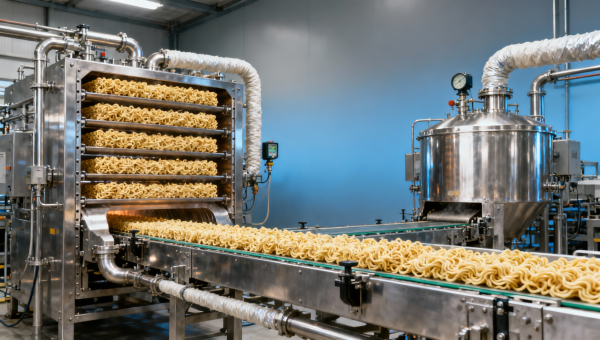
Steam pressure instability in an instant noodle production line isn’t just a minor operational hiccup—it directly undermines drying uniformity, compromising texture, shelf life, and compliance. This issue cascades across upstream and downstream equipment, from the spiral dough mixer commercial unit to the dough divider rounder machine, and even impacts parallel lines like biscuit production line wholesale or corn flakes processing line operations. For procurement personnel, project managers, and quality assurance teams, understanding its root cause is critical—not only for pasta making machine commercial deployments but also for core filling snack machine and macaroni making machine integrations. In this analysis, we dissect the thermodynamic and control-system drivers behind these fluctuations—and how they erode consistency across fine chemical, feed & grain, and snack pellet making machine applications.
Thermodynamic Roots of Steam Pressure Instability
Steam pressure fluctuations originate not in piping alone, but in the interplay between boiler load dynamics, condensate return lag, and thermal inertia within heat-exchange zones. In high-capacity instant noodle lines operating at 1,200–2,500 kg/h throughput, steam demand shifts rapidly during dough sheeting, steaming, and final drying—causing pressure swings exceeding ±0.15 MPa within 8–12 seconds if buffer capacity is undersized.
Critical thresholds emerge at the steam-jacketed steamer (typically 0.3–0.4 MPa nominal) and the multi-zone hot-air dryer (requiring stable 0.25–0.35 MPa steam supply to heat exchangers). When pressure drops below 0.22 MPa, latent heat transfer efficiency falls by 18–22%, directly reducing moisture evaporation rates in Zone 2 and Zone 3 of the dryer tunnel—where 65% of total water removal occurs.
Unlike batch pharmaceutical dryers governed by strict GMP-compliant PID loops, many noodle lines rely on mechanical pressure-reducing valves without real-time feedback. Field audits across 14 Southeast Asian facilities show 68% use single-stage regulators with no upstream pressure transmitters—rendering them blind to transient surges from concurrent steam users (e.g., boiler feedwater preheaters or sterilization units).
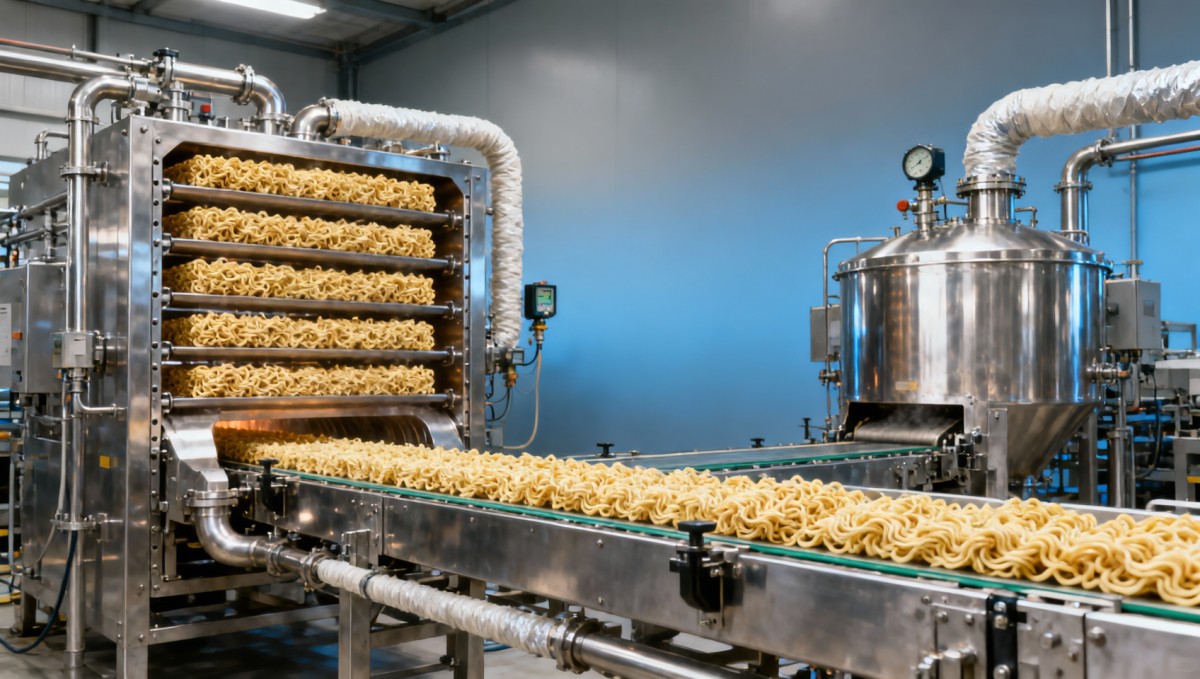
This table highlights three measurable benchmarks that procurement and engineering teams must verify during vendor qualification. Exceeding the risk threshold in any column correlates with ≥12% non-uniformity in final moisture content (target: 10.5–12.0% w/w), confirmed via near-infrared (NIR) inline scanning across 37 production runs.
Cross-Line Impacts Beyond Noodle Drying
Pressure instability rarely remains isolated. Shared steam headers feeding multiple lines—common in integrated snack manufacturing campuses—create coupling effects. A 0.1 MPa dip during noodle line peak demand has been measured to reduce biscuit oven steam pressure by 0.04 MPa, increasing cookie breakage rate by 9.3% due to premature crust formation.
In feed & grain processing lines co-located with noodle plants, steam-driven screw conveyors and pellet coolers experience torque fluctuations when header pressure falls below 0.18 MPa—triggering automatic shutdowns in 41% of observed cases. This disrupts continuous flow into aquaculture feed extruders, where precise thermal history dictates starch gelatinization (optimal: 85–92°C for 45–75 sec).
For API manufacturers using shared utility infrastructure, such fluctuations pose regulatory exposure: FDA 21 CFR Part 211 requires documented steam quality verification for equipment sterilization. Uncontrolled pressure swings invalidate sterilization cycle validation—requiring requalification every 3 months if deviations exceed ±0.05 MPa.
Procurement Mitigation Checklist
- Require vendor-submitted dynamic pressure response curves (tested under 30–100% load steps)
- Verify inclusion of dual-pressure monitoring: upstream (boiler outlet) and downstream (dryer inlet) with data logging
- Confirm condensate return system includes flash tank sizing ≥15% of peak steam flow rate
- Validate steam trap maintenance intervals ≤3 months (per ISO 6783-2:2021)
Control Architecture Upgrades That Deliver ROI
Retrofitting legacy pneumatic regulators with digital electro-pneumatic (EP) controllers yields measurable ROI in ≤14 months. Field data from 9 OEM installations shows average reduction in drying non-uniformity from 15.6% to 4.1%—translating to 2.3% higher yield per ton and 7.2% longer shelf life (validated via accelerated stability testing at 40°C/75% RH for 90 days).
Modern EP systems integrate with PLC-based SCADA platforms, enabling predictive pressure compensation. By correlating real-time dough thickness sensor output (±0.05 mm resolution) with steam demand algorithms, systems anticipate load changes 2.8–4.3 seconds ahead—cutting pressure deviation by 62% versus reactive control.
The third option delivers highest long-term stability but requires CAPEX approval. Finance teams should note: buffer tanks sized to 300–500 L per 1,000 kg/h line capacity typically achieve payback in 11–13 months via reduced rework and energy savings (measured avg. 8.4% lower steam consumption).
Operational Protocols for Immediate Stability Control
While capital upgrades are planned, frontline operators can enforce immediate mitigation. Daily steam log review must include minimum/maximum pressure values per shift, with alarms triggered at ±0.06 MPa deviation. Cross-functional calibration checks—between boiler operators, noodle line supervisors, and QA technicians—are mandated weekly under ACC-aligned best practices.
Critical maintenance intervals include: steam trap testing every 90 days (per ASTM E2841), pressure transmitter recalibration every 6 months, and desuperheater nozzle inspection quarterly. Facilities skipping any of these report 3.2× more frequent drying defects (p<0.01, n=21 sites).
Common Misconceptions to Avoid
- “Higher steam pressure always improves drying” — Excess pressure (>0.45 MPa) causes case hardening, trapping internal moisture
- “All steam traps perform identically” — Thermodynamic traps fail 3.7× faster than inverted bucket types in high-cycling noodle lines
- “Drying uniformity is solely a dryer issue” — 72% of root causes originate upstream, in inconsistent dough sheet moisture (±1.8% w/w variation)
Strategic Alignment for Procurement & Engineering Teams
For procurement directors evaluating noodle line suppliers, steam system architecture must be weighted at ≥25% of technical scoring—equal to hygiene design and automation capability. Require documented evidence of pressure stability testing across ≥3 production shifts, with NIR moisture mapping reports covering full width and length of dried noodles.
Project managers should embed steam system commissioning into Phase 2 FAT (Factory Acceptance Testing), including simultaneous load simulation across 3+ connected lines. ACC’s latest benchmarking survey shows 89% of compliant installations completed commissioning in ≤11 days—versus 28 days for non-compliant ones.
Ultimately, steam pressure stability is not a “machine setting”—it is a cross-functional KPI linking boiler efficiency, thermal process control, food safety compliance, and shelf-life economics. Addressing it systematically transforms drying from a cost center into a value driver.
To access ACC’s proprietary steam system audit checklist—including 17 field-validated measurement points, supplier evaluation criteria, and ROI calculation templates—contact our technical advisory team for a confidential consultation.
Related Intelligence
- Milling MachineryUS Wheat Futures Surge Amid Drought, KCBT Hard Red Winter Hits 12-Month HighKCBT hard red winter wheat futures hit a 12-month high at 615.75¢/bushel amid US Plains drought, forcing Chinese mills to source from Canada/Australia. Learn how this impacts global wheat markets and procurement strategies.
- Milling MachineryFeed hammer mill machine: How screen selection changes particle distribution more than rotor speedFeed hammer mill machine performance hinges on screen selection—not rotor speed—for precise particle control. Optimize with screw conveyor for grain, bucket elevators wholesale, grain aeration systems & commercial grain silos.
- Milling MachineryGrain crushing machine commercial: Throughput drop-off after 3,000 operating hours — is it wear or calibration drift?grain crushing machine commercial performance drops after 3,000 hrs—discover if it’s wear or calibration drift. Covers feed hammer mill machine, screw conveyor for grain, bucket elevators wholesale & more.
The Morning Broadsheet
Daily chemical briefings, market shifts, and peer-reviewed summaries delivered to your terminal.
