

The Authority in Global Agricultural Chemistry & Bio-Resources
Wholesale Essential Oils: Why GCMS Reports Don't Tell the Whole Story

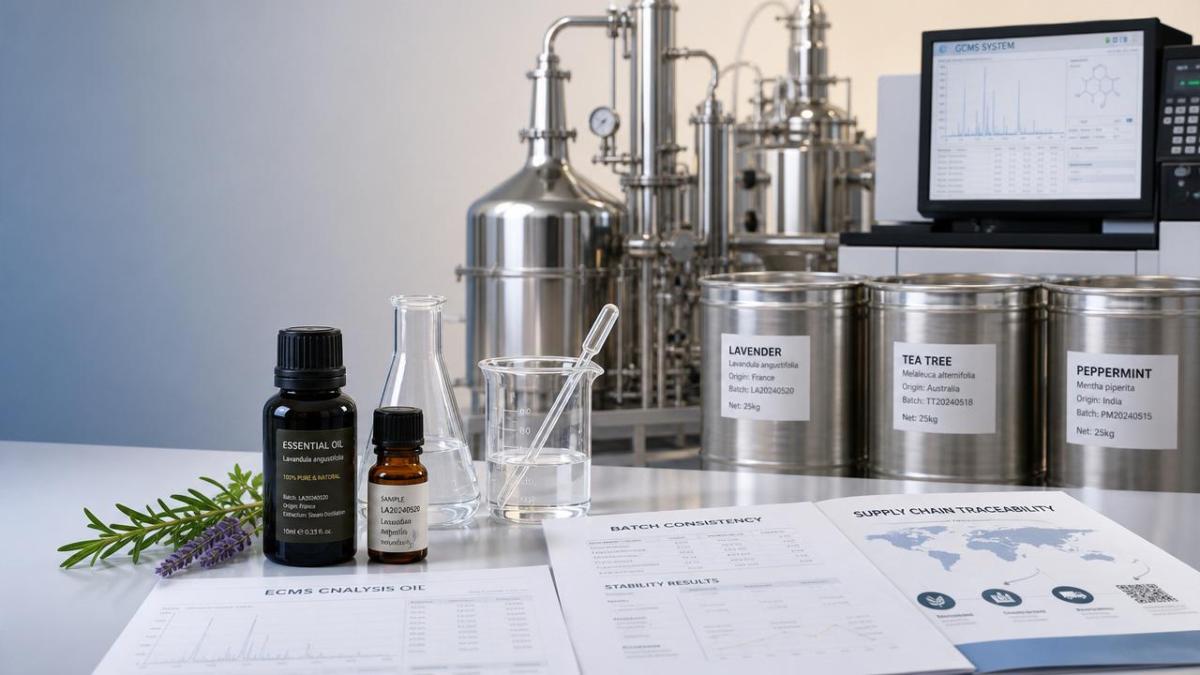
In wholesale essential oils procurement, a GCMS report is often treated as the gold standard for quality verification—but it reveals only part of the commercial and technical risk profile. For business evaluators comparing suppliers, factors such as botanical authenticity, batch consistency, adulteration methods, traceability, and regulatory alignment can be just as decisive. Understanding what GCMS can and cannot confirm is essential to making reliable, defensible sourcing decisions.
Why scenario-based evaluation matters in wholesale essential oils sourcing
For business evaluators, the central question is not whether a supplier can provide a GCMS report. Most established suppliers can. The real question is whether that document is sufficient for the intended use case. In wholesale essential oils, the same batch may be acceptable for one customer segment and unsuitable for another. A fragrance house, a personal care manufacturer, a nutraceutical blender, and an aromatherapy brand all face different quality, compliance, and reputational exposures.
This is why scenario-based assessment is essential. GCMS can help identify volatile component distribution, reveal some unusual peaks, and support comparative analysis. However, it does not independently confirm ethical sourcing, storage stability, full authenticity, or whether the lot matches the supplier’s historical quality profile. In commercial procurement, especially in wholesale essential oils, the cost of a wrong decision usually appears later: customer complaints, reformulation, failed audits, customs delays, or damaged product performance.
A practical review framework should therefore connect testing to business context. Instead of asking, “Do we have a GCMS report?” evaluators should ask, “What risks remain if GCMS is the only evidence?” That shift leads to better supplier qualification and more resilient sourcing decisions.
What GCMS does well—and where it stops short
GCMS, or gas chromatography-mass spectrometry, is valuable because it separates and identifies many volatile compounds in an oil. For wholesale essential oils buyers, it can flag obvious dilution, help compare chemotypes, and provide a technical baseline for incoming lot review. It is particularly useful when a buyer must screen many vendors and narrow options quickly.
Yet GCMS has important limits. It does not always detect sophisticated adulteration if the adulterant is chosen to mimic the expected profile. It may not capture non-volatile residues, pesticide issues, heavy metals, or oxidation status unless paired with other tests. It also cannot prove that the claimed botanical species, harvest region, or extraction method is truthful if the paperwork behind the sample is weak. In wholesale essential oils markets, where mixed lots and broker chains are common, that gap matters.
For evaluators, the takeaway is simple: GCMS is a strong analytical tool, but not a complete sourcing decision tool. It should sit inside a wider verification process rather than function as the single pass-fail criterion.
Typical procurement scenarios and what evaluators should prioritize
The most effective way to assess wholesale essential oils is to align testing depth with downstream application. The table below shows how priorities shift across common commercial scenarios.
This comparison matters because business evaluators often inherit supplier dossiers that look technically complete on the surface. In practice, wholesale essential oils purchasing should be reviewed against intended formulation risk, customer claim exposure, and supplier process maturity.
Scenario 1: When fragrance performance is the core requirement
In fragrance, home care, and certain personal care applications, the buyer may be less concerned with therapeutic storytelling and more focused on odor profile, consistency, and blending behavior. Here, GCMS remains useful, but sensory evaluation and retained sample comparison become equally important. Two lots with similar chemical ranges may still behave differently in finished products because minor compounds, age, oxidation, or handling conditions alter perception.
For this scenario, evaluators should request not only the latest GCMS report but also historical batch summaries, storage conditions, and packaging specifications. Drums lined with unsuitable materials or prolonged exposure to heat can degrade performance without creating an instantly obvious red flag on a routine report. In wholesale essential oils procurement for fragrance use, sensory reproducibility often determines whether a supplier relationship scales successfully.
Scenario 2: When brand trust depends on authenticity claims
Retail wellness and aromatherapy brands face a different challenge. Their commercial risk sits heavily in storytelling and consumer trust. If a label claims a specific botanical source, region, or extraction style, the sourcing file must support that claim. GCMS may show a plausible chemical composition, but it does not automatically prove that lavender is from the claimed origin, or that frankincense was not blended across species or lots.
Business evaluators in this scenario should prioritize chain-of-custody documents, supplier transparency around distillation partners, and clarity on whether material is single-origin, co-mingled, rectified, or standardized. Some wholesale essential oils suppliers operate responsibly yet sell to both purity-driven brands and cost-focused industrial buyers. That is not inherently negative, but it means specifications must be matched carefully to claim strategy. The stronger the brand narrative, the less acceptable a GCMS-only approval model becomes.
Scenario 3: When compliance and safety are more important than romance
For food, nutraceutical, and highly regulated export channels, the evaluation lens changes again. In these settings, buyers need evidence that the oil is suitable for the target legal market and application class. A compliant chemical fingerprint does not guarantee compliant commercialization. Residual solvents, pesticide carryover, contaminant controls, and document readiness may become decisive.
This is where wholesale essential oils procurement intersects with broader supply chain governance. Evaluators should confirm whether the supplier maintains current specifications, certificates of analysis tied to lot numbers, allergen statements, SDS documentation, and the relevant declarations for the destination market. If the supplier cannot map documents cleanly from production batch to shipping lot, then even a strong GCMS report may have limited practical value during an audit or import review.
Scenario 4: When the buyer is scaling and batch consistency becomes the real risk
A supplier may pass initial technical screening but fail under growth conditions. This is common when a buyer moves from pilot orders to container-level procurement. At small volume, a supplier can often allocate premium lots selectively. At larger volume, consistency pressures reveal weaknesses in sourcing control, raw material access, and internal release criteria.
In this scenario, evaluators should ask for trend evidence across multiple batches rather than a single attractive report. Review variance ranges for key markers, not only one-time peak percentages. Confirm whether the supplier keeps retain samples, how deviations are handled, and whether substitution between harvests or origins is disclosed before shipment. In wholesale essential oils sourcing, long-term repeatability is usually a stronger predictor of commercial success than one perfect laboratory document.
Common misjudgments evaluators make when relying too heavily on GCMS
Several recurring mistakes appear in supplier reviews. The first is assuming that a professional-looking report equals analytical credibility. Unless the laboratory method, date, lot number, and testing party are clear, the document may have limited decision value. The second is treating “within expected range” as proof of authenticity. Sophisticated adulteration can sometimes remain within broad commercial ranges.
A third mistake is ignoring time. Essential oils change. Oxidation, storage, and transit conditions can alter quality after testing. A fourth is failing to connect laboratory data with contract terms. If batch tolerances, origin rules, and substitution permissions are not written into the purchasing agreement, a dispute later becomes difficult to defend. In wholesale essential oils, technical review and procurement governance must support each other.
A practical decision framework for business evaluators
To make sourcing decisions more defensible, evaluators can use a layered review model. Start with GCMS as a screening tool, then expand according to the business scenario. For lower-risk fragrance applications, sensory control and lot consistency may be enough. For high-claim or regulated markets, traceability and compliance evidence should carry more weight.
A sound framework for wholesale essential oils typically includes five checkpoints: identity, purity, traceability, consistency, and regulatory fit. Identity asks whether the botanical material is correctly represented. Purity asks whether adulteration or contamination risk has been reduced to an acceptable level. Traceability asks whether the lot history can be followed. Consistency asks whether future lots are likely to perform similarly. Regulatory fit asks whether the material can legally and safely support the intended commercial use.
Recommended approval questions before onboarding a supplier
- Is the GCMS report tied to the exact sale lot, with test date and method clearly shown?
- Can the supplier provide multi-batch data for the same product over time?
- What documents support species, origin, extraction method, and custody chain?
- What additional tests are available for residues, oxidation, or contaminants?
- How are deviations, substitutions, and seasonal variations disclosed commercially?
FAQ for wholesale essential oils evaluation
Is a third-party GCMS report better than an in-house report?
Often yes, but only if the lab is credible and the report is lot-specific. In-house reports can still be useful when the supplier has a strong quality system and consistent documentation.
Can GCMS detect all adulteration in wholesale essential oils?
No. It can detect many issues, but not every manipulation method. That is why authenticity assessment should combine analytical review, supplier history, and traceability evidence.
When should a buyer request more than a standard GCMS package?
Whenever the oil supports regulatory claims, ingestible use, premium origin marketing, or large-scale manufacturing where batch variation would be costly. Higher commercial exposure requires deeper verification.
Final takeaway: match evidence to the business scenario
In wholesale essential oils procurement, GCMS should be treated as an important data point, not the entire decision. The right evaluation standard depends on where the oil will be used, what claims the finished product makes, how much scale is involved, and how much regulatory or reputational risk the buyer carries. Business evaluators who map supplier evidence to application scenario make better sourcing decisions than those who rely on laboratory paperwork alone.
If your team is comparing suppliers, begin by defining the actual commercial use case, then build the approval checklist around that scenario. In wholesale essential oils, the most reliable partner is rarely the one with the prettiest report—it is the one whose data, process control, and traceability stand up under the realities of your market.
Related Intelligence
- Natural IngredientsBulk Antioxidants: Why Oxidation Control Fails in StorageBulk antioxidants can still fail in storage due to moisture, heat, oxygen exposure, and poor handling. Learn the hidden risks and practical controls to protect stability.
- Natural IngredientsWholesale Essential Oils: Why GCMS Reports Don't Tell the Whole StoryWholesale essential oils buyers: learn why GCMS reports alone are not enough. Discover how to assess authenticity, consistency, traceability, and compliance before choosing a supplier.
- Natural IngredientsChlorella Powder Wholesale: How to Screen for Purity RisksChlorella powder wholesale: learn how to screen purity risks, verify COAs, spot heavy metal and microbial issues, and choose safer suppliers with confidence.
The Morning Broadsheet
Daily chemical briefings, market shifts, and peer-reviewed summaries delivered to your terminal.
