

The Authority in Global Agricultural Chemistry & Bio-Resources
When industrial enzymes bulk pricing stops saving money
Bulk buying looks efficient on paper, but industrial enzymes bulk pricing can quietly erode margins when quality drift, storage losses, regulatory exposure, and hidden logistics costs are ignored. For business evaluators comparing suppliers or contract terms, the real question is not unit price alone, but total procurement value. This article examines when volume discounts stop delivering savings and start creating operational risk.
For procurement teams in food processing, feed manufacturing, bio-extracts, fermentation, wastewater treatment, and fine chemical production, the phrase industrial enzymes bulk often signals better leverage. In practice, however, the lowest per-kilogram or per-liter rate can be the most expensive choice once potency decline, cold-chain variance, excess inventory, and batch inconsistency are priced into operations.
Business evaluators need a framework that goes beyond unit cost. The right purchase volume depends on shelf life, dosing accuracy, regulatory documentation, process criticality, and the ability of the supplier to maintain lot-to-lot stability over 3, 6, or 12 months. A discount of 8% may look attractive, but a 2% yield loss or a 5-day production delay can wipe it out quickly.
Why low unit pricing in industrial enzymes bulk procurement can become a hidden cost center
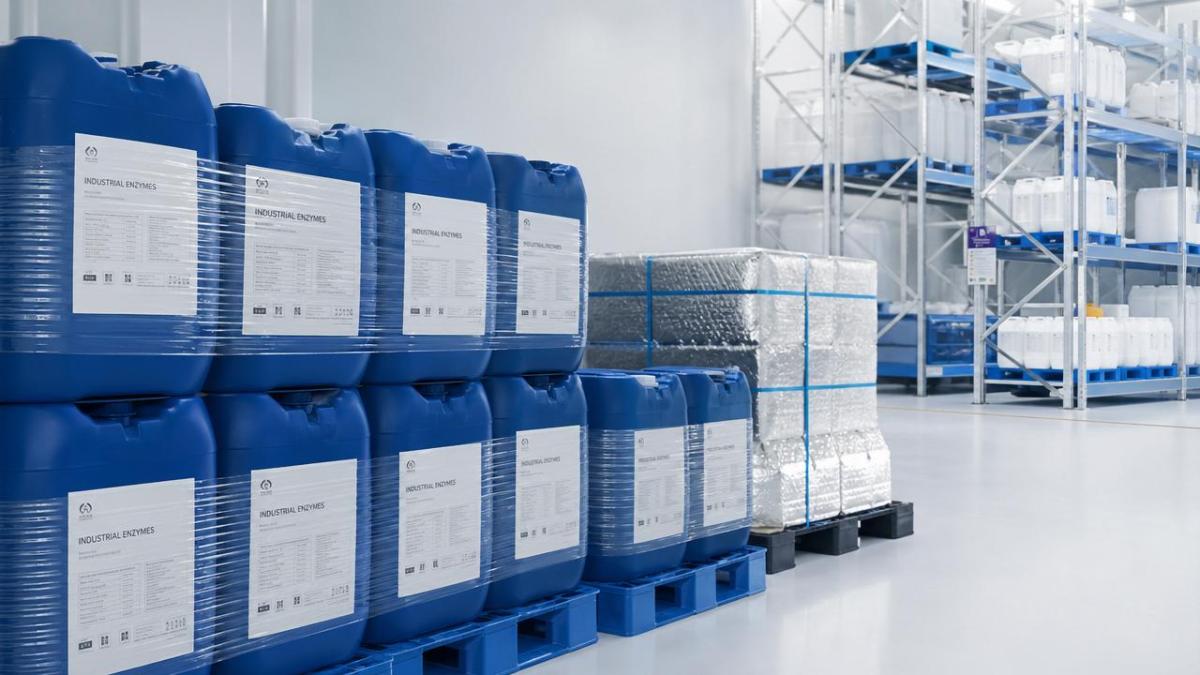
Industrial enzymes are not passive commodities. Their value depends on activity retention, formulation compatibility, transport conditions, and process performance under specific pH and temperature ranges. In many sectors, including starch conversion, feed optimization, and specialty biochemical processing, a small reduction in enzymatic activity can affect throughput, waste levels, and compliance records.
The discount trap: volume bought versus volume effectively used
A common purchasing assumption is that a larger lot always lowers average cost. That only holds when 95% to 100% of delivered enzyme activity is actually consumed within validated storage and usage windows. If a plant orders 12 months of inventory but the material remains stable for only 6 to 9 months under site conditions, the apparent savings turn into write-downs, reformulation work, or emergency replacement orders.
The risk is higher when industrial enzymes bulk shipments are imported across long transit routes. Ocean freight, customs hold times of 3 to 10 days, and port-side temperature excursions can degrade sensitive formulations. Even where the product remains legally usable, lower activity may force higher dosing rates, pushing actual cost per production batch above the level of a smaller, fresher order.
Four hidden cost drivers that business evaluators should quantify
Before approving large-volume contracts, evaluators should model at least four cost categories beyond base price:
- Storage overhead: chilled warehousing, humidity control, segregation, and handling labor over 3 to 12 months.
- Potency drift: activity loss that increases dosage requirements by 3% to 15% depending on formulation and storage stress.
- Quality deviation costs: process rework, retesting, batch holds, or customer complaints triggered by inconsistent performance.
- Compliance exposure: incomplete CoA, traceability gaps, or supplier documentation delays affecting GMP, FDA, or internal audit readiness.
The table below helps compare apparent price savings against broader procurement impact in typical industrial enzyme sourcing scenarios.
The pattern is straightforward: lower invoice pricing does not guarantee lower delivered cost. For industrial enzymes bulk purchases, the financially better option is often the one with stronger turnover, cleaner documentation, and less process variability, even if nominal unit cost is slightly higher.
When quality drift has a bigger impact than price variance
In enzyme-dependent operations, consistency matters more than headline discounting. If one lot requires a 7% higher dosage to reach the same conversion target, the effect compounds across every production run. In sectors such as feed and grain processing, small shifts in activity can alter nutrient release, pellet durability, or digestibility outcomes, affecting both cost efficiency and downstream product claims.
For fine chemicals and APIs, the stakes can be even higher. Enzyme performance drift may force extended reaction times, extra purification steps, or additional validation. A lower purchase price loses relevance when process interruption costs are measured in hours of reactor downtime, lab retesting cycles, and delayed shipments to regulated customers.
How to calculate total procurement value instead of unit price alone
A sound evaluation model for industrial enzymes bulk sourcing should combine commercial, technical, and operational variables. The goal is to estimate cost per effective unit of activity delivered to the process, not just cost per drum, tote, or pallet. That distinction allows evaluators to compare offers that look similar commercially but behave very differently in production.
Five metrics that belong in every supplier comparison
At minimum, business evaluators should score suppliers across five metrics before awarding high-volume contracts:
- Activity retention over time, including expected loss after 30, 60, and 90 days in actual site storage conditions.
- Lot-to-lot consistency, measured by specification range and historical deviation tolerance.
- Documentation completeness, including CoA, SDS, traceability records, origin details, and compliance declarations.
- Logistics reliability, including lead time stability, temperature control capability, and packaging protection.
- Commercial flexibility, such as staggered release schedules, safety stock support, or MOQ negotiation options.
The following table provides a practical scoring approach for procurement teams comparing industrial enzymes bulk offers.
A weighted scorecard often reveals that the best-value supplier is not the cheapest one. In many cases, a supplier with 4% higher unit pricing but tighter lot consistency and shorter replenishment cycles produces a lower annual procurement cost after waste, testing, and downtime are included.
A practical landed-cost formula for evaluators
A simple internal model can improve decision quality. Start with purchase price, then add freight, temperature-control charges, customs and storage cost, internal quality control cost, expected activity loss, and working capital impact. Finally, divide by usable activity delivered to production. This creates a more realistic cost per effective unit than invoice price alone.
For example, Supplier A may offer a 10-ton contract at 9% below market average. But if 6% of activity is lost during storage, 2% of material is written off after packaging damage, and 1 extra QC cycle is needed per lot, the total cost can exceed a supplier offering quarterly deliveries at a higher list price. That is the decision lens business evaluators should use when reviewing industrial enzymes bulk proposals.
The operational signals that bulk enzyme buying has crossed the line
There are clear warning signs that bulk purchasing has stopped adding value. These signals usually emerge in inventory aging, process deviation, or supplier communication. The earlier they are tracked, the easier it is to renegotiate contract structure before losses accumulate over two or three procurement cycles.
Five warning signs procurement teams should not ignore
- More than 20% of stock remains on hand after half of the validated shelf-life window has passed.
- Dosing rates have increased by 5% or more compared with the initial receiving lot.
- Inbound shipments require frequent quarantine because of labeling, seal, or documentation discrepancies.
- Production teams report inconsistent reaction times, conversion rates, or process yields across batches.
- Finance teams see slower inventory turns and higher carrying costs despite lower average invoice pricing.
Any one of these issues may be manageable in isolation. When two or more appear together, the bulk contract should be reviewed immediately. In industrial enzymes bulk sourcing, operational friction is often the first visible sign that a discount structure is misaligned with real consumption patterns.
Why storage reality matters more than supplier brochure claims
Many enzymes are sold with storage guidance such as 2°C to 8°C, below 25°C, or protected from moisture and direct light. Those requirements seem manageable until they are tested against actual site conditions: shared warehousing, frequent door opening, variable ambient temperatures, and mixed-material storage practices. If local handling cannot maintain the required environment 24 hours a day, large orders increase risk by design.
This is especially relevant in primary industries and processing environments where warehouse infrastructure was built for dry commodities, machinery components, or general chemicals rather than sensitive bioactive inputs. Evaluators should validate internal storage capability before expanding industrial enzymes bulk commitments, not after the first degradation claim appears.
Smarter purchasing structures that preserve value without overbuying
The solution is not always to avoid volume agreements. In many industrial settings, the better path is to redesign contract architecture so price efficiency is preserved while inventory and compliance risk are reduced. Well-structured supply arrangements can secure favorable rates without forcing the buyer to hold excessive stock for 9 or 12 months.
Contract models that work better than one-time overstocking
Several commercial models deserve consideration:
- Annual volume commitment with monthly or quarterly releases.
- Call-off agreements linked to forecast bands, such as plus or minus 15% demand flexibility.
- Vendor-held inventory near the destination market, reducing onsite carrying burden.
- Dual-batch validation before full-scale annual award, allowing comparison over 60 to 90 days.
These structures are often better suited to industrial enzymes bulk procurement because they separate price leverage from physical overexposure. A buyer can still secure commercial advantage while protecting product freshness, audit readiness, and production reliability.
Questions to ask suppliers before accepting a bulk discount
Before signing, evaluators should ask direct technical and commercial questions. How much activity drift is expected after 90 days under standard storage? What packaging options are available for partial release? Can the supplier provide retained sample protocols, temperature-monitoring records, and lot traceability within 24 to 48 hours? Is there a documented claim procedure for transit-related degradation?
The quality of these answers often matters more than the final discount line. Reliable suppliers of industrial enzymes bulk products tend to be transparent about storage sensitivity, logistics controls, and application boundaries. Weak suppliers usually focus only on per-unit savings, leaving the buyer to absorb downstream variability.
Internal alignment: procurement, QA, operations, and finance
A robust purchasing decision should involve at least four functions: procurement, quality assurance, operations, and finance. Procurement evaluates commercial terms, QA confirms documentation and release standards, operations validates real usage rates, and finance measures carrying cost and working capital exposure. When one function is missing, bulk decisions become vulnerable to hidden assumptions.
For business evaluators, that cross-functional review is often the difference between a disciplined sourcing strategy and a superficially attractive order that underperforms in the field. The larger the industrial enzymes bulk commitment, the more important it becomes to test assumptions across all four groups before approval.
The most effective approach to industrial enzymes bulk purchasing is not to chase the lowest visible price, but to control the full chain of value: stability, storage fit, documentation, logistics, and actual process performance. Volume discounts add value only when the material remains usable, compliant, and consistent throughout the planned consumption cycle.
For business evaluators working across primary industries, fine chemicals, feed processing, and bio-based manufacturing, disciplined total-cost analysis turns procurement from price comparison into risk-adjusted decision making. If you are reviewing supply terms, evaluating a new enzyme partner, or redesigning bulk purchase structures, now is the right time to map actual usage against hidden cost drivers and supplier capability.
To assess where your current industrial enzymes bulk strategy may be leaking value, contact us for a tailored evaluation framework, supplier comparison checklist, or a more resilient procurement model aligned with your operational and compliance requirements.
Related Intelligence
- Food Grade EnzymesGeneral Mills Wanchai Dock Food Safety Innovation at Global SummitGeneral Mills Wanchai Dock food safety innovation—blockchain traceability, AI-HACCP alerts & real-time cold-chain telemetry—verified under FDA FSMA Section 204. A benchmark for exporters.
- Food Grade EnzymesAPVMA Expands Fast-Track Pathway for Fermentation-Derived Food Grade Enzymes in AustraliaAPVMA fast-track pathway now covers fermentation-derived food grade enzymes—cutting registration to 6 months. Key for enzyme manufacturers, ANZ exporters & regulatory teams.
- Food Grade EnzymesWhen industrial enzymes bulk pricing stops saving moneyIndustrial enzymes bulk deals can backfire when storage loss, potency drift, logistics, and compliance costs erase discounts. Learn how to compare true procurement value before you buy.
The Morning Broadsheet
Daily chemical briefings, market shifts, and peer-reviewed summaries delivered to your terminal.
